
As the capital of Morocco, Rabat stands out as a destination in its own right, far from the hustle and bustle of Marrakech or Casablanca. We were charmed by the balance the city offers between imperial heritage, a lively medina, and the Atlantic coast—all within an atmosphere that remains surprisingly calm for a capital city. Seven days give you plenty of time to explore Rabat itself, as well as to take day trips to Casablanca, Volubilis, or Meknes.
Here’s our ideal itinerary for spending a week in Rabat, complete with plenty of photos!
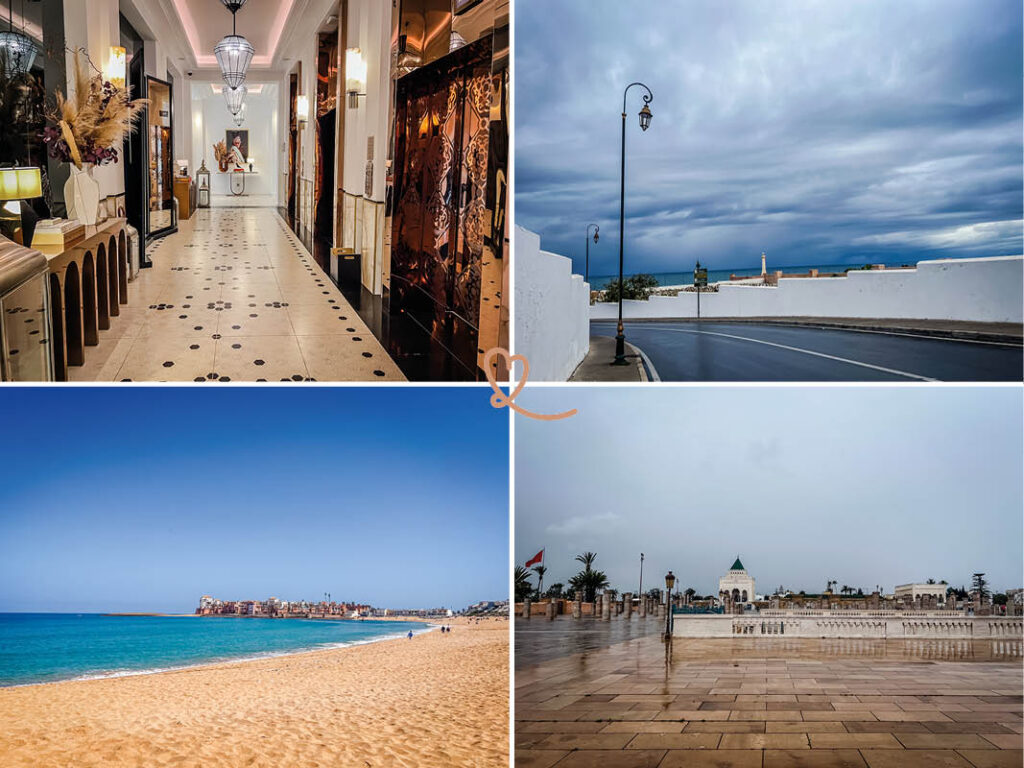
This opinion is completely independent, based on our experiences. We visited the region anonymously, making our own choices and paying our bills in full.
Visiting Rabat in 7 Days: Practical Tips
What can you see in Rabat in 7 days? Is that long enough?
A week in Rabat gives you time to see the city’s highlights—the kasbah, the medina, the imperial sites, and the museums—while still leaving time to take day trips to Casablanca, Volubilis, or Meknes. It’s the perfect length of stay to alternate between exploring the city’s heritage, relaxing, and going on excursions without feeling rushed.

Maps of must-see attractions
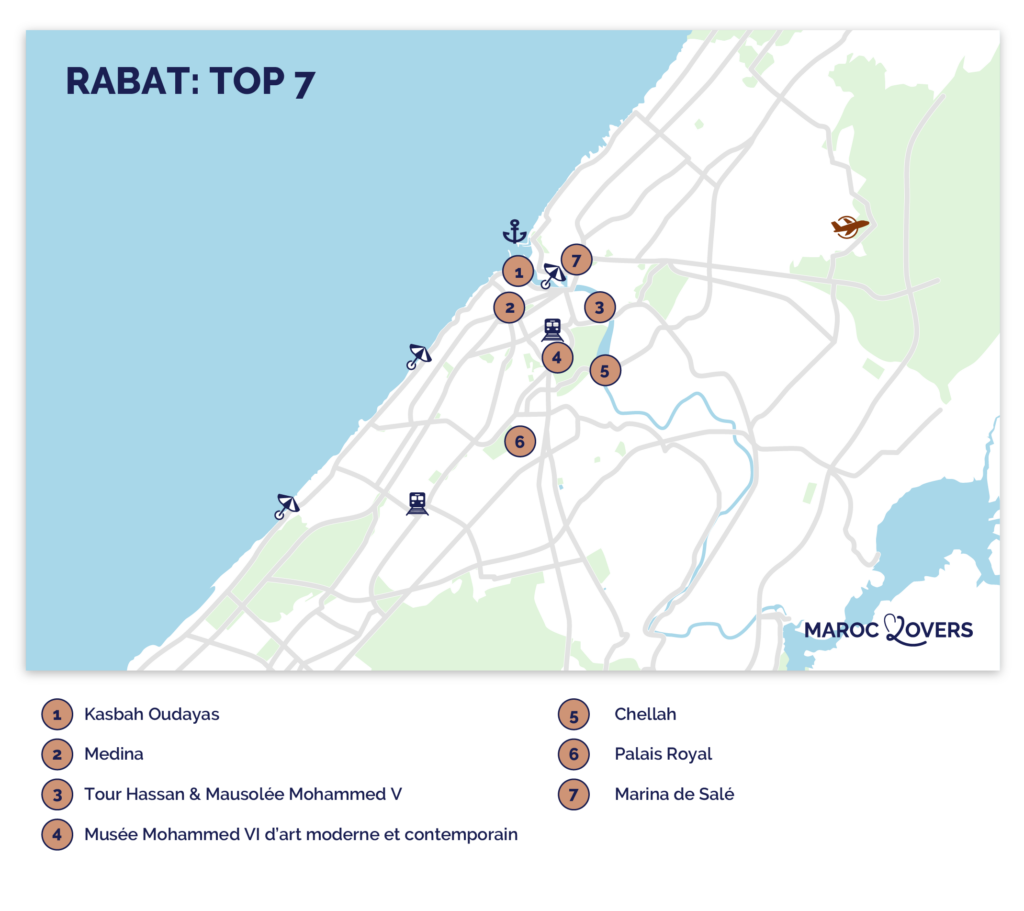
To help you follow along as you read our itinerary below, here is our map of Rabat’s main tourist attractions:
Getting Around in Rabat
Rabat’s historic center, the medina, and the Kasbah of the Oudayas can be explored on foot, as these areas are entirely pedestrian-only and closed to cars. For longer distances, the tram serves the main neighborhoods and tourist sites via two lines—a mode of transportation we found convenient and affordable. Small blue taxis round out the options for short distances: make sure the driver uses the meter. To cross over to Salé, there are also traditional boats that shuttle back and forth across the Bouregreg River—a unique way to reach the other side.

Where to Stay in Rabat
WHERE TO STAY IN Rabat
Our favorites: neighborhoods and hotels
Hassan District –
La Tour Hassan Palace Hotel – see prices, photos and availability
Historic Center of Rabat –
Riad Meftaha Hotel – see prices, photos and availability
Marina Rabat-Salé –
Fairmont La Marina Rabat Salé Hotel – see prices, photos and availability

Our Ideal Itinerary: 7 Days in Rabat
We wanted to strike a balance in this itinerary between the capital’s must-see attractions and day trips to the surrounding area, alternating between days in the city, days on excursions, and some downtime by the sea. Here’s our ideal week in Rabat.
Day 1 – Kasbah of the Oudayas and the Medina of Rabat
Morning: The Oudayas Kasbah and its Andalusian garden
To kick off this week in Rabat, head to the Kasbah of the Oudayas, perched on the heights overlooking the mouth of the Bouregreg River. Founded by the Almoravids and fortified by the Almohads in the 12th century, it later became home to Andalucian exiles in the 17th century. We enjoyed its narrow streets lined with white and blue houses, as well as its ramparts, which offer a view of the Atlantic. You enter through Bab Oudaia, the kasbah’s monumental gate, whose ornamentation surprised us with its delicacy. Inside, a Hispano-Moorish-inspired garden features fountains and lush greenery, offering a refreshing break before continuing the tour.

Allow about 2 hours to explore the kasbah, the garden—which is open from 10 a.m. to 6 p.m.—and the walk along the ramparts. Admission is free; only the Musée de la Parure, located on the grounds, requires an admission fee. The cobblestone streets, some of which are steep, make the site less suitable for people with limited mobility. Since the kasbah is entirely pedestrian-only, we recommend leaving your car at the hotel; otherwise, the closest parking lot is at Rabat Beach, a 9-minute walk from the entrance. The Café Maure, located on-site, is a spot we recommend for extending your visit.

Afternoon: The Medina of Rabat
After lunch, head to the medina of Rabat, which is easily accessible on foot from the kasbah. We particularly loved its lively atmosphere, which is less hectic than that of Marrakech. As you wander through its maze of narrow alleys, you’ll discover traditional architecture featuring ornate doors, whitewashed walls, and Merinid fountains. We also loved the explosion of colors at the artisans’ stalls, featuring rugs, pottery, jewelry, and traditional clothing—it’s hard to resist. The entrance is through the Bab El Had Gate, also known as the Sunday Gate, the only gate in the city wall that still serves as a passageway into the medina.

Plan on spending half a day exploring at a leisurely pace. Shops are generally open from 9 a.m. to 7 p.m., though some close during Friday prayers. Admission is free, but be sure to set aside a budget for shopping: feel free to haggle respectfully—it’s a long-standing local tradition in the souks. The narrow and sometimes crowded alleys are not well-suited for people with limited mobility. Cars are not allowed here, so leave yours at the hotel for this visit.

Day 2 – Hassan Tower, Mohammed V Mausoleum, and Chellah
Morning: Hassan Tower and the Mohammed V Mausoleum
This second day begins with Rabat’s most iconic monumental complex: the Hassan Tower and the Mohammed V Mausoleum. The Hassan Tower, an unfinished 12th-century minaret, was intended to be the tallest religious tower in the world. We were fascinated by its proportions and by the ruins of the mosque that was never completed, whose hundreds of columns bear witness to the scale of the original project. Across from it, the Mohammed V Mausoleum impresses with its refined architecture and meticulous decoration. The site, guarded by the Royal Guard in traditional dress, houses the tombs of King Mohammed V and his sons.

Allow about 1 hour to explore the entire site. The Hassan Tower is open daily from 6:30 a.m. to 10:45 p.m., and the Mausoleum from 8:00 a.m. to 6:00 p.m. Admission is free. The grounds are flat, but there are a few steps leading up to the mausoleum. Located on the Hassan II Esplanade, a 15-minute walk from the medina, you can park on Saadiyine Street or in the surrounding area. Modest attire is recommended for visiting the mausoleum. If you’d prefer to be accompanied, a guided tour is a convenient option for learning all the historical details of the site. Interested in a guided tour? See prices and availability

Afternoon: The Ruins of Chellah
In the afternoon, you’ll visit the Chellah site, a UNESCO World Heritage Site located a 6-minute drive from the Royal Palace. Once the ancient Roman city of Sala Colonia and later a Merinid necropolis, this place moved us with its atmosphere steeped in history. As you explore the Roman ruins, you’ll discover the remains of thermal baths, ancient buildings, and the Merinid necropolis.

Allow 1.5 to 2 hours to explore the entire site. It is open daily, with hours that vary by season: generally from 9 a.m. to 6 p.m. in winter and from 9 a.m. to 8 p.m. in summer. Check the hours before your visit, especially during Ramadan. The terrain is uneven and sometimes steep, which may make certain areas difficult to access for people with limited mobility. Parking is available at the entrance, and there is a café and restaurant on site. We recommend visiting in the morning to enjoy milder temperatures and ideal lighting for photos.
OUR TIPS FOR RENTING A CAR IN MOROCCO
- Compare prices on our preferred platform: DiscoverCars – one of the best rated sites.
- Not too wide
- A good engine
- For more choice, book early.

Day 3 – Museums and Heritage Sites in the Hassan District
Morning: The Mohammed VI Museum of Modern and Contemporary Art
Today, on our third day, we’re focusing on art with a visit to the Mohammed VI Museum of Modern and Contemporary Art on Moulay Hassan Avenue, right in the heart of downtown. As Morocco’s first major museum dedicated to contemporary art, it’s a must-see for art lovers. We were impressed by the building’s architecture, which blends Moroccan traditions with clean, contemporary lines. Inside, the collection features more than 500 paintings and about ten sculptures, showcased through eclectic temporary exhibitions that we found to be particularly well-curated.

Plan on spending 1.5 to 2 hours to enjoy the entire collection. The museum is open daily from 10 a.m. to 6 p.m., except on Tuesdays. It is fully accessible to people with limited mobility, which is a real plus for this type of modern facility. There are a few parking spaces on Rue d’Ifni, and a café-restaurant inside the museum serves Moroccan specialties so you can linger a while longer.

Afternoon: the Museum of History and Civilizations and St. Peter’s Cathedral
The afternoon continues at the Museum of History and Civilizations, a stop we recommend to archaeology enthusiasts and anyone curious about Morocco’s history. This museum traces millennia of evolution through collections ranging from prehistory to the great ancient and Islamic civilizations. Highlights include prehistoric artifacts from the Sidi Abderrahmane site, Roman bronzes from Volubilis, and the bronze statue of Juba II. Located in the southern part of the Hassan district, next to the Villa des Arts, the museum is easily accessible on foot from downtown.

Plan to spend 1 to 2 hours there. The museum is open Wednesday through Monday from 10 a.m. to 6 p.m., closed on Tuesdays, and is accessible to people with limited mobility. End your day at Saint-Pierre Cathedral, the capital’s only Catholic religious building, which elegantly blends Art Deco elements with Arabic influences. We were surprised by the colorful stained-glass windows inside, as well as by the role the cathedral plays as a gathering place for locals.

It takes 5 to 15 minutes to tour the cathedral, which is open daily from 10 a.m. to 4 p.m., except on Sundays, when it closes at 1 p.m. Admission is free, and an accessible entrance is available on the side streets. Appropriate attire is recommended, as with any place of worship, and there are many cafes and restaurants nearby to round out the day.
A LITTLE MORE PATIENCE
All the photos, maps, information and addresses you need to make your stay at Maroc a success will soon be available in a single ebook!
Coming soon!
Day 4 – Royal Palace, Bouregreg, and Salé Marina
Morning: the Esplanade at the Palais Royal
This fourth day begins at the Royal Palace, located in the Touarga neighborhood. The building is worth a visit for its majestic architecture and historical significance: it is the official residence of the King of Morocco. Although the interior is closed to the public, you can admire the façade, stroll through the surrounding gardens, and watch the royal guard. We found this moment particularly representative of the symbolic weight the monarchy carries in the capital’s daily life.

Allow 30 minutes to 1 hour to stroll through the gardens. The site is open daily from 9 a.m. to 6 p.m., subject to official events, on flat, easily accessible grounds. Admission is free. Parking is available on the outskirts of the neighborhood, in accordance with current safety guidelines. A few parking spaces are available inside the palace if space permits, at the entrance to the police station, and cafés are just a few minutes’ walk away. Please note that you must present a valid ID to enter the site: a passport for foreigners, or a CIN for Moroccans.

Afternoon: the Bouregreg River and the Salé Marina
The afternoon is perfect for a stroll along the Bouregreg, the river that separates Rabat from its twin city, Salé. We particularly enjoyed this well-maintained path, which blends nature, culture, and modernity. As you walk along the river, you’ll enjoy views of both banks, with the Kasbah of the Oudayas on one side and the medina of Salé on the other. To get to Salé, it’s a 9-minute drive via the Hassan II Bridge, or a 30-minute tram ride to the Bab Lamrissa stop.
Once in Salé, the marina offers one of the most beautiful views of Rabat. We enjoyed this modern promenade, which runs along the north shore, where you can see the pleasure boats moored in the harbor, with the Hassan Tower rising in the background. It’s a popular spot among locals at the end of the day, when the setting sun bathes the city in golden light. Allow 1 to 2 hours for the entire walk, which is flat and well-maintained. The Bab Fès underground parking garage is a 20-minute walk from the marina, and numerous cafés with outdoor seating line the river.

Day 5 – Day Trip to Casablanca
Why do we recommend this tour?
Just an hour from Rabat, Casablanca offers a striking contrast to the capital. It is Morocco’s largest metropolis, a vibrant blend of Art Deco architecture, urban culture, and Moroccan traditions. We were impressed by the buildings that reflect early 20th-century French influence, and especially by the Hassan II Mosque, built on the oceanfront, one of the country’s most impressive monuments. For a first taste of the city, a guided tour from Rabat lets you discover the must-see sights without worrying about transportation.

What you will see
- The Hassan II Mosque, a contemporary masterpiece open to visitors
- The Art Deco neighborhood and the downtown boulevards
- The Central Market and the Habous neighborhood, with their traditional atmosphere
- The cliffside promenade and its terraces overlooking the Atlantic

How much time to allow
Casablanca is easily accessible from Rabat in 1 to 1.5 hours by car or train. Plan on spending a full day visiting its iconic sites at a leisurely pace. Several tour operators offer tours of the old city, the mosque, the Habous district, and the more modern neighborhoods. Book this guided tour that covers all the must-see attractions: see details, prices, and availability, or opt for a food tour: see prices, details, and availability.
Day 6 – Excursion to Volubilis and Meknes
Morning: The archaeological ruins of Volubilis
A 2.5-hour drive from Rabat, the archaeological site of Volubilis is well worth the detour. This ancient city of Mauritanian origin, which flourished during the Roman Empire, is a UNESCO World Heritage Site. We thoroughly enjoyed this stroll among the ruins, lush vegetation, and panoramic views of the valley, and we’ll always have fond memories of the Arch of Caracalla, the site’s most iconic landmark.

While there, you’ll also discover temples, thermal baths, and patrician houses, as well as a panoramic view of the surrounding hills. Plan on spending half a day to fully enjoy the site. Less than a 10-minute drive away is the village of Moulay Idriss, one of Morocco’s holiest sites, which you can visit in combination with Volubilis if time permits.

Afternoon: Meknes, the unassuming gem
Though often overshadowed by Fez and Marrakech, Meknes is nonetheless a hidden gem that charms visitors with its tranquility and historical heritage. Once the imperial capital during the reign of Moulay Ismail, the city offers a mix of imposing monuments, bustling alleyways, and peaceful squares. Some of Meknes’s monuments may be undergoing restoration work: check for access to Bab Mansour, the Mausoleum of Moulay Ismail, and Heri es-Souani before your visit.

Less crowded, it offers a gentle immersion into historic Morocco, between the monumental Bab Mansour Gate, the Mausoleum of Moulay Ismaïl, and the royal granaries and stables of Heri es-Souani. Our favorite spot? The Dar Jamaï Museum, dedicated to traditional Moroccan music, instruments, and their history.

Don’t miss El Hedim Square either—it’s more intimate than Marrakech’s Jemaa el-Fna but just as lively. Meknes is about a 2-hour drive from Rabat, making it an easy day trip to combine with Volubilis and Moulay Idriss: see details, prices, and availability.

Day 7 – Oulja Pottery Complex, Botanical Garden, and Beach
Morning: The Salé Pottery Complex and the Botanical Research Garden
On this final day, let’s focus on crafts at the Oulja Pottery Complex in Salé. It’s definitely worth a visit, even if you don’t plan to buy anything, as it offers such a wonderful glimpse into Moroccan craftsmanship. We were impressed by the variety of creations and the skill of the artisans—one of the activities we rank among the best in the Rabat region. The site is currently being renovated and will soon give way to a new City of Crafts and Arts.

Allow 1 to 2 hours, depending on how long you’d like to wander among the workshops, which are generally open from 9 a.m. to 6 p.m., though some close on Friday afternoons. Admission is free; just set aside some money for potential purchases. Then continue on to the Botanical试验 Garden, a 17-hectare space created in the early 20th century during the French Protectorate. We enjoyed its botanical diversity and serene atmosphere, with palm trees, colorful bougainvilleas, and imposing cacti creating a landscape perfect for contemplation.

Plan on spending about an hour there strolling through the alleys. Admission is free, but some uneven surfaces may not be suitable for wheelchairs. There are a few public parking spaces on the streets adjacent to Annasr Avenue in the Agdal neighborhood. There are no dining options on site, but you can have a picnic there.
Afternoon: beach and coastal road
To wrap up the week, what could be better than a lazy afternoon to balance out days of intense cultural sightseeing? The city beaches, such as Oudayas Beach and Rabat Beach, though crowded, offer sunsets that we found spectacular. You’ll also find quieter beaches outside the city, such as Bouznika Beach or Skhirat Beach, about a 30- to 45-minute drive away, depending on traffic.

Extend your day with a stroll along the Rabat Corniche, a promenade running along the coastline—the perfect spot to watch the sunset with the ocean stretching as far as the eye can see. Plan on spending half a day to a full day on this itinerary, depending on your planned activities. Access to the beaches is free, with lifeguards on duty during the summer at the main beaches; some have accessible entry points. Be mindful of currents, which can be strong at some beaches, and pay attention to the swimming flags. If you’d prefer to limit your travel, choose between the Oulja complex and the Botanical Garden, then save the afternoon for the beach.

Option 1: with children
Rabat is a great destination for family vacations, and several of the city’s green spaces are suitable for all ages. The Andalucian Gardens, nestled in the Kasbah of the Oudayas, invite visitors to take a leisurely stroll among fountains, orange trees, and flower-lined paths. Hassan II Park offers a more modern atmosphere, with vast open spaces for relaxation and playgrounds, making it ideal for families and joggers. The Nouzhat Hassan Garden, right in the city center, is also a cool retreat where locals and visitors alike enjoy relaxing in the shade of palm trees, not to mention the Maâmora Forest, one of the largest cork oak forests in the world, which is perfect for a picnic.

The Rabat Zoo remains a must-see for families: Atlas lions, monkeys, giraffes, and crocodiles can be seen in well-designed enclosures, along with an educational trail that appeals to both children and parents. In Salé, the Magik Park water park rounds out this list with numerous water attractions.
Option 2: A “Best of Rabat” Day Tour
If you only have one day to explore Rabat, focus on the must-see sights: the Kasbah of the Oudayas and its Andalusian garden in the morning, followed by the Hassan Tower and the Mohammed V Mausoleum, and finish with a stroll through the medina at the end of the day. You can also stroll through the stunning gardens of the Royal Palace. This itinerary lets you experience the city’s main highlights—from Almohad heritage and imperial landmarks to the bustling souk—without needing a car to get around.
Option 3: with more excursions
Rabat is also an excellent base for exploring further into northern Morocco. If you have more time, there are several excursions worth adding to your trip:
- Fez, a 2½-hour drive away, charms visitors with its labyrinthine medina—one of the largest pedestrian zones in the world—as well as its madrasas and colorful tanneries.
- Tangier, just a 1-hour-and-20-minute ride away on the Al Boraq high-speed train, charms visitors with its white medina and the Cave of Hercules, overlooking the ocean.
- Marrakech, a 3½- to 4-hour drive away, offers a sensory feast with Jemaa el-Fna Square, the Majorelle Garden, and the Bahia Palace; you’ll want to plan a long weekend for this trip.
- Assilah, about a 2½- to 3-hour drive away, is a small coastal town with a peaceful atmosphere, surrounded by 15th-century Portuguese ramparts.
- Chefchaouen, a 4-hour drive away in the Rif Mountains, is undoubtedly Morocco’s most photogenic city with its blue alleyways.
- Read our article on day trips from Rabat
These cities, each of which has left its mark on Morocco’s history in its own way, offer you the chance to explore the country in greater depth beyond the capital.

Option 4: A day at the beach and some relaxation
The area around Rabat is home to some of the most beautiful beaches on the Atlantic coast, which are still relatively unknown to travelers. Whether you’re looking to relax, go surfing, or take in unspoiled scenery, you only need to travel a few kilometers to experience a completely different atmosphere. Skhirat Beach and Bouznika Beach are perfect for swimming, while Mehdiya Beach is more popular with surfers. Half a day is enough to enjoy them, but we highly recommend setting aside a full day and packing a picnic to enjoy there.

Subscribe to our Newsletter
- Get away from it all with Region Lovers’ beautiful destinations!
- Once a month
- Advertising-free

What You Need to Know for Your Week in Rabat
The Weather in Rabat
So far, we’ve mainly explored Rabat in the winter, a season we highly recommend. From November through March, temperatures range from 10°C (50°F) to 18°C (64.4°F), making it comfortable to explore the city. We enjoyed the bright light of this season—ideal for photography—and the chance to visit museums and historic sites without the summer crowds. A few rainy days may occur, but they’re usually short-lived. Accommodation prices are also often more affordable during this time. Be sure to pack a sweater for cool evenings and a lightweight raincoat in case of showers.

The Crowds in Rabat
Rabat struck us as more laid-back than Marrakech or Fez, but it’s worth familiarizing yourself with its weekly schedule before you go. On Fridays, the Muslim day of prayer, some businesses adjust their hours or close, even though it’s not an official holiday. On the weekend—Saturday and Sunday—some shops also close, particularly those owned by the Jewish community. You’ll also hear the five daily calls to prayer echoing from the minarets, a local custom to keep in mind when planning your visits.

Adjusting Your Itinerary When It Rains
Rabat has plenty to keep you busy on rainy days, thanks to its many museums: the Mohammed VI Museum, the Museum of History and Civilizations, and the Museum of Jewelry will keep you occupied for several hours indoors. You can also catch a play or a musical at the Mohammed V National Theater. Finally, rain is a great excuse to go shopping: the medina has plenty of covered arcades, starting with Souika Street, the liveliest spot for finding traditional souvenirs. If you prefer modern shops, Fal Ould Oumeir Avenue in the Agdal neighborhood or Mohammed V Avenue are brimming with stores.

Where to Eat in Rabat
The Moroccan capital charms visitors as much with its cultural richness as with its refined flavors. From gourmet restaurants tucked away in luxury hotels to seafood restaurants along the marina, and traditional tea rooms, Rabat is brimming with great places to eat.
In this article, discover our selection of the best restaurants to eat at in Rabat.

PLAN YOUR TRIP TO Morocco
- Best of
Top Destinations
Must-See Places in Morocco
Most Beautiful Riads
Most Beautiful Cities
Most Beautiful Medinas
Morocco’s Most Beautiful Landscapes
Most Beautiful Gardens
Best Museums
Morocco’s Most Beautiful Beaches

- Practical advice
When to go?
How to rent a car in Morocco
Driving tips

- The must-dos
Marrakech
Casablanca
Fez
Meknes
Chefchaouen
Essaouira
Rabat
Tangier
Tetouan
Agadir
The Sahara Desert

