
Do you know Meknes? An imperial city with a rich historical heritage, its monumental ramparts, majestic gates and fascinating National Music Museum make it a must-see destination in northern Maroc. We were seduced by the authenticity of this city, less frequented than Fez or Marrakech, but just as interesting to discover for a short stay or an excursion.
Discover our ideas for what to do in Meknes, illustrated with photos! Bonus: useful tips and additional activities.
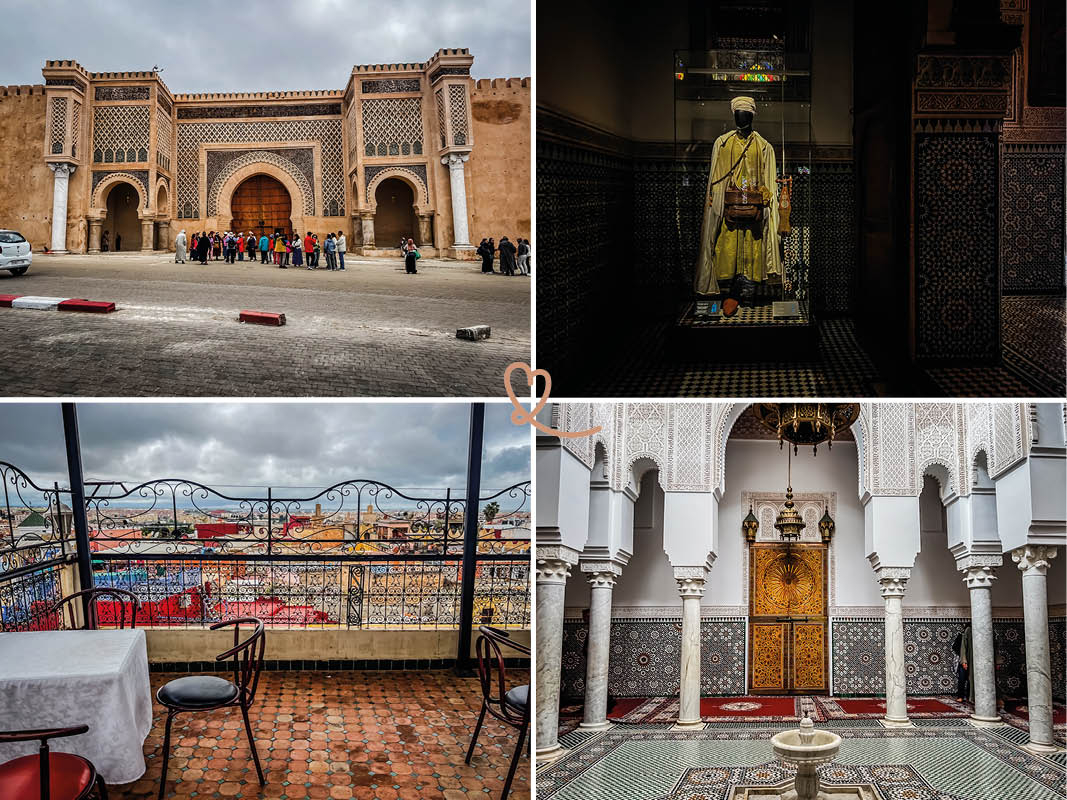
This opinion is completely independent, based on our experiences. We visited the region anonymously, making our own choices and paying our bills in full.
Is Meknes worth a visit?
Yes, we think Meknes is well worth a visit. Less well known to travelers than Fez, this imperial city, a UNESCO World Heritage Site, promises a different kind of immersion in the history of Morocco. Its more compact medina seduced us with its peaceful atmosphere and authenticity. We enjoyed the contrast between its monumental ramparts, the Bab Mansour gate and the Dar Jamaï Museum, a veritable national treasure dedicated to music. Meknes can be discovered in one or two days, giving you time to feel the city’s tranquil rhythm.
For us, it’s one of the most beautiful cities in Maroc.
If you don’t have a car, you can discover Meknes on an organized tour from Fez.
1. Discover the Dar Jamaï Museum, a treasure trove of art and musical instruments

Pushing open the doors of this 19th-century palace, we plunged into a veritable treasure trove of Moroccan heritage. What a marvel! In our opinion, it’s one of the finest museums in Maroc. Built in 1882 for Mohamed Ben Larbi Jamaï, grand vizier to Sultan Moulay Hassan Iᵉʳ, this palatial residence is a model of traditional Moroccan architecture: colorful zelliges, finely carved cedar wood ceilings, ironwork, stucco and fountains adorn the various rooms opening onto a lush patio. Palm trees, roses, camellias, banana trees and succulents make up a veritable Andalusian garden, pleasant in all seasons. Also known as the National Music Museum, Dar Jamaï houses an exceptional collection of wind, string and percussion instruments, from the XIXᵉ century to the present day. The museography is both rich and interactive, with explanatory panels in three languages (French, English, Arabic), booklets on Berber dance and music, ancient manuscripts and handicrafts. Our favorite? The room devoted to the manufacture of wooden instruments: several pieces are presented here, with remarkable documentation and memory work. In the center, we are comfortably seated on footstools in the projection area, which shows archive images and explanatory videos. You’ll travel through the eras and history of Moroccan music, from rural traditions to urban styles inspired by the Andalusian heritage, including Reggada, Gnaouas and Aïta. Not to mention the ancient techniques used to make the instruments: lutherie, woodworking, metalworking, distillation of orange blossom water… Rare know-how, sometimes on the verge of extinction. This sensitive, well-documented approach, combined with the exemplary preservation of the building, makes Dar Jamaï a cultural, artistic and emotional place, accessible to all. A must-see if you’re visiting Meknes!

Practical advice
- Duration: 1h30min to 3h depending on your interest
- Opening hours: open Wednesday to Monday, 10 a.m. to 6 p.m., closed Tuesdays.
- Rates: children under 10 and school groups 10 dhs (MAD), children over 10 20 dhs (MAD), adults over 18 30 dhs (MAD); free access on Wednesdays for pupils and students, on Fridays for Moroccans, foreign residents and students.
- Difficulties: Museum generally accessible to PRM, a few steps, PRM-accessible WC at entrance and in patio, several interactive devices with headphones for listening to music, explanatory panels in French, English and Arabic.
- Food & beverage: no food & beverage outlets inside, close to medina with several cafés and tables nearby
- See the latest news on the official website of the Fondation nationale des Musées here
- Would you like to take advantage of the expertise of an accredited local guide to discover all the treasures of this exceptional museum? Reserve your place now
A LITTLE MORE PATIENCE
All the photos, maps, information and addresses you need to make your stay at Maroc a success will soon be available in a single ebook!
Coming soon!
2. Admire Bab Mansour, the triumphal gateway

To stand before this monumental gateway is to feel the full symbolic power of Meknes, the imperial city of Sultan Moulay Ismaïl. Completed in 1732 by his son Moulay Abdellah, Bab Mansour is one of the most beautiful gates in Maroc. Its name, “Mansour”, is said to refer to the craftsman who designed its decoration, an architect who converted to Islam according to oral tradition. We were impressed by its massive white marble columns, copper lamps and rich ornamentation. The eight-metre-high central pointed arch is surrounded by green and blue ceramic scrolls and a trellis in relief on a polychrome mosaic background, typical of Alawite art. Come closer to admire the finesse of the work: meticulous zelliges, Koranic inscriptions, capitals inspired by Antiquity… Every detail bears witness to the expertise of Moroccan craftsmen and the meeting of different artistic heritages. Opposite Place El Hedim, you won’t want to miss it! The Bab Mansour Gate remains one of the most majestic faces of Meknes.

Practical advice
- Duration: 15min to 30min
- Free access 24/7, prioritize daytime visits to better observe architectural details
- Opposite Place El Hedim
- Best light for late-afternoon photos, as facade faces northwest
- Consider including it in a guided tour of the city with a local to learn more about its history and secrets!
3. Stroll through Place El Hedim, the lively heart of the medina

Another must-see is Place el Hedim. This large main square overlooks the covered market and two entrances to the medina. We enjoyed the lively atmosphere here, especially in the evenings when musicians and vendors liven up the space from time to time. Opposite Bab Mansour, Place Lahdim will surprise you with its vast proportions. It is the meeting point between the medina and the imperial city. In the narrow streets around the square, you’ll find all kinds of wares. From colorful pottery to tea sets and Berber-patterned carpets, it’s the epitome of local craftsmanship. You’ll also find a wide selection of children’s toys and novelty items. It’s the ideal place to take home a souvenir of local craftsmanship, or simply to observe local life. Around the edges of the square, several vendors offer food and juice. Wander into the covered market and browse its stalls of traditional Moroccan cakes, sun-drenched fruit and vegetables. Immerse yourself in the local atmosphere!

Practical advice
- Duration: 15min to 1h if you also visit the covered market
- Free access 24/7, prioritize daytime visits to take full advantage of the ambience and shops
- Public toilets opposite the Dar Jamaï Museum
- Paved square, flat ground
- Catering available in the covered market and surrounding alleyways in the medina
OUR TIPS FOR RENTING A CAR IN MOROCCO
- Compare prices on our preferred platform: DiscoverCars – one of the best rated sites.
- Not too wide
- A good engine
- For more choice, book early.

4. Entering the Mausoleum of Moulay Ismaïl

Do you know the Mausoleum of Moulay Ismaïl in the imperial city of Meknes? To visit this masterpiece of marble, wood and stucco is to connect with the history of the sultan who left his mark on the city. This place of meditation, accessible to all, is located opposite the royal stables, within the ramparts of Dar al Makhzen (formerly the ruling quarter). Built in 1703 and restored in 1960, the mausoleum impressed us from the moment we entered, with its magnificent fountain surrounded by mosaics. A succession of patios lined with blind walls led us to the ablutions courtyard, surrounded by a beautiful colonnade. We admired the stained glass windows, copper chandeliers and carved cedarwood ceiling dating back to the 17th century. A real feast for the eyes, whether you’re a fan of Moroccan craftsmanship or simply curious! The mausoleum room is divided into two parts: on the right are the royal tombs where Moulay Ismaïl is laid to rest surrounded by members of his family. At the corners of the room stand four Comtoises clocks given to the sultan by Louis XIV. To the left, an ornate room serves as an antechamber, with a delicate marble fountain. Remember to both look up and down to admire the carpets, sculptures, stained-glass windows and marble columns. There’s so much to admire, you won’t know where to look!

Practical advice
- Duration: 30min to 1h depending on your interest
- Opening hours: open daily from 9 a.m. to 6:30 p.m.
- Admission: free
- Difficulties and access for disabled persons: a few steps but generally accessible for disabled persons, respectful dress recommended, place of worship accessible to Muslims and non-Muslims, please note that you must remove your shoes to enter the mausoleum room, respectful dress and attitude required.
- Parking: Zine-El-Abidine pay parking lot 5 minutes’ walk from the mausoleum
- Want to find out more about this major Meknes landmark? Opt for a guided city tour that includes this must-see site!
5. Explore the Royal Stables and the Moulay Ismaïl Granary

Imagine thousands of horses and colossal stocks in these monumental buildings, and you’ll know just how ambitious the sovereign was. These granaries and royal stables (Hri Souani and Roua) were built in the kasbah in the 17th century. The granaries held more than 10 years’ worth of reserves in case of siege. The sheer size of the site reflects the ambitions of Sultan Moulay Ismaïl, the great builder of the imperial city. Adjacent to the granaries, the royal stables could hold 12,000 horses, four per pillar. We were impressed by the striking perspective offered by the pillars lined up in such a way that a supervisor could see several corridors. The succession of columns provides remarkable views, with vaults following one another with careful geometric regularity. It is said that up to 12,000 horses were housed here and cared for by thousands of grooms. Even today, the singular atmosphere of the place captivates visitors. Did you know that several films have been shot here? The most famous are “The Diamond of the Nile” and “The Last Temptation of Christ”, due to the very high walls, almost 4 meters thick.
Practical advice
- Duration: 30min to 1h30min
- Opening hours: open daily from 9 a.m. to 12 p.m. and from 3 p.m. to 6:30 p.m.
- Parking: Zine-El-Abidine pay parking lot 5 minutes’ walk from the mausoleum and stables
- Book your guided city tour including entrance fees for this visit!
WHERE TO STAY IN FES
Our favorites: neighborhoods and hotels
In Fès El-Bali (old medina)
Hotel Riad Dar Lys – See prices, photos and availability
Hotel Riad Dar Laura – See prices, photos and availability
Fès El-Jdid (near the Royal Palace)
Palais Faraj Suites & Spa Hotel – See prices, photos and availability

6. Stroll the narrow streets of the medina

To immerse yourself in local craftsmanship by wandering among colorful pottery, traditional fabrics and spice stalls in Meknes is to discover a more intimate atmosphere than in the neighboring medinas. The medina of the imperial city is aUNESCO World Heritage Site. Founded in the 11th century by the Almoravids as a military settlement, Meknes became the capital under the reign of Moulay Ismaïl, founder of the Alaouite dynasty. We enjoyed this Hispano-Moorish-style city surrounded by high walls pierced by more than twenty gates, including 9 monumental ones. Here, we saw the meeting of Arabo-Andalusian and European styles in 17th-century Maghreb. Sheltered by high defensive walls pierced by nine monumental gates, you’ll discover twenty-five mosques, ten hammams, palaces, vast granaries, the remains of fondouks and private dwellings. Indeed, Meknes stands out for the gigantic appearance of its ramparts, which reach 15 meters in height. It’s a medina on a human scale, where we enjoyed getting lost, stopping, observing and listening to the heartbeat of the city.

Practical advice
- Duration: 1 hour to several hours for leisurely exploration
- Free access 24 hours a day, 7 days a week. We recommend a daytime visit to better appreciate all its treasures with complete peace of mind.
- Difficulties and PRM access: not recommended for claustrophobic people, uneven cobbled ground, narrow streets but fairly flat ground (few undulations), partial PRM access (some stairs), wear good shoes with non-slip soles.
- Parking: several paying parking lots at the main gates with security guards (bring change in dhs), Bab Khemis parking lot near the Jewish cemetery or Zine-El-Abidine parking lot 5 minutes’ walk from the mausoleum, then visit on foot.
7. Tour the ramparts and monumental gates

To walk along the 40 kilometers of city walls and pass through the fortified gates is to understand the past power of the imperial capital. The presence of this historic city, with its rare remains and important monuments, in the midst of a rapidly changing urban space, gives this urban heritage its universal value. The two ensembles (medina and kasbah) are surrounded by a series of ramparts that separate them from each other. We were impressed by the gigantic, voluminous appearance of these ramparts, which reach a height of 15 meters. Meknes is considered an edifying example of the fortified cities of the Maghreb. These fortifications bear witness to the urban and architectural structure of a 17th-century North African capital, combining elements of Arab-Andalusian and European design and planning. Along the way, you’ll pass through various gates punctuating these walls, each with its own style and architectural particularities, from Bab Khemis to Bab Mansour, via the Porte Moulay Ismaïl pictured above. This two-arched gateway, decorated with zellige mosaics, leads to the mausoleum of the sovereign whose name it bears.
Practical advice
- Duration: depends on the number of gates visited. If you want to walk around the 9 monumental gates, allow about 2h to 2h30, with breaks for explanations and photos; if you want to see all the gates, the circuit is 40km long, allow a good half-day.
- Free access 24/7, we recommend a daytime visit to better distinguish the architectural details and differences between the doors.
- Difficulties and access for disabled people: generally accessible with flat sidewalks (city undergoing major urban transformation and renovation between 2022 and 2025), in the medina good walking shoes are recommended
- Parking: available inside the Kasbah opposite the Royal Stables, or park your car near a large gate and visit on foot (recommended), such as the Bab Khemis pay parking lot or the Zine-El-Abidine pay parking lot, a 5-minute walk from the mausoleum.
- To better appreciate the beauty of this city’s architectural heritage, we recommend taking a guided tour with a local!
8. Discover the Jewish cemetery and the community’s heritage

Strolling through this vast white cemetery, located near the Mellah (the old Jewish quarter of every Moroccan medina), promises a moment of calm and charged with memory. Renovated as part of a heritage preservation program, the city’s Jewish cemetery underwent a facelift in 2024, saving 170 tombs. We found this place full of emotion and memory. Initiated by King Mohamed VI, the restoration is a recognition of the community’s strength and a testament to the city’s cosmopolitan character. You’ll also find a small museum retracing the history of the Jewish presence in Meknes. Nearby is the monumental Bab Khemis gateway to the mellah district, with the cemetery just beyond. This visit is an important testimony to the cultural and religious diversity that has shaped the identity of Meknes over the centuries.
Practical advice
- Duration: 30min to 1h
- Free access, 5min walk from Porte Bab Khemis
- Difficulties and access for disabled people: accessible for disabled people, respectful dress and attitude required as place of worship
- Parking: open paid parking lot with attendant behind Bab Khemis (bring change in dhs)
9. Visit the Bou Inania Medersa

In the center of the Meknes medina, the Médersa Bou Inania is a Koranic school built by the Merinid Sultan Abou El Hassan and completed by his son Abou Inan in the 14th century, who gave his name to the building. A stop in this building will allow you to admire Merinid refinement in all its finesse, between carved wood, stucco and zelliges. Unfortunately, it was under renovation at the time of our visit. Its decoration, with calligraphy in stucco and wood, is one of the most refined in Maroc. On the 1st floor, you can visit the school’s former student bedrooms. Contemporary with the Fez medersa, completed around 1345, this Hispano-Moorish-style medersa is built according to classic Koranic school plans: rectangular floor plan, central courtyard with basin, surrounded by a gallery and prayer room, and upstairs tiny cells for students. Get up close to observe the meticulous workmanship of the courtyard walls, lined with zellij, inscriptions, chiselled plasterwork and magnificent cedar wood carvings. A fine example of Moorish decoration!
Practical advice
- Duration: 45min to 1h
- Opening hours: open daily from 9am to 12pm and from 2pm to 6pm
- Difficulties and PRM access: old building with a few staircases, so partial PRM access (bring a baby carrier if visiting with small children).
- Parking: there is no nearby parking lot, so park your car in a paying parking lot (e.g. Bab Khemis parking lot near the Jewish cemetery, Zine-El-Abidine parking lot 5 minutes’ walk from the mausoleum) and then visit on foot.
- Visit the area’s main points of interest, including the Médersa Bou Inania – Don’t wait any longer to get your tickets!
Subscribe to our Newsletter
- Get away from it all with Region Lovers’ beautiful destinations!
- Once a month
- Advertising-free

10. Take the Meknes wine route

Why not discover another facet of the region’s heritage? With its lush green hills and local produce, Meknes is also renowned for its vineyards. So if you’re a wine lover or simply curious, treat yourself to a tasting in the nearby countryside. Situated at the foot of the Atlas Mountains, this region enjoys an ideal climate and a terroir conducive to vine-growing. We learned that viticulture in the Meknes region dates back to Roman times, when settlers introduced vine cultivation. Over the centuries, the region became renowned for its fertile vineyards and wine-growing climate. Today, Meknes is one of Morocco’s leading wine-growing regions, producing wines such as Volubilia, Tandem (Moroccan Syrah), Guerrouane and Zerhoune, which are renowned both nationally and internationally. You can also stay at the Château Roslane Boutique Hôtel & Spa, a magnificent venue set amidst the vines, offering tastings and guided tours of the wine-making facilities.

Practical advice
- Reservations recommended for tours with tasting (examples: Domaine Villa Volubilia see here, Domaine de Baccari see here).
- Plan a visit with transport included if you wish to taste wine
- See the latest news about Les Celliers autour de Meknès on the city’s official website here
Other attractions in and around Meknes
Here are some other points of interest in Meknes that we wanted to mention:
The Agdal Basin
The Bassin de l’Agdal, built by Moulay Ismaïl to supply the city with water, will impress you with its sheer size and offer a beautiful sunset view.
Lahboul Gardens
The Jardins Lahboul are a popular strolling area for local residents, with shady paths, a rose garden and a small open-air theater.
The old Hebrew School Talmud Torah
The Mellah of Meknes, the old Jewish quarter, has preserved its discreetly charming alleyways and the facades of a few old houses that bear witness to this plural history. Located near the Jewish cemetery, past Bab Khemis, the former Hebrew school Talmud Torah (now closed) also houses a small synagogue. Note that you can take a peek through the door. If you’d like to see more, ask the guardians, who sometimes welcome visitors in exchange for a small contribution in dirhams.
This discreet place is a reminder of the importance of transmission and coexistence, which have shaped the plural identity of Meknes.
International Agricultural Show (SIAM)
If your trip coincides with the Salon International de l’Agriculture (SIAM), held every year in April, you can take advantage of one of Africa’s biggest agricultural events to discover innovations, terroirs and regional products. Find out more here
Excursions around Meknes
We’ve explored the area around Meknes and unearthed some exceptional sites that merit a half- or full-day excursion from the imperial city.
Volubilis, the UNESCO-listed Roman city
Do you know the ruins of Volubilis, just a 40-minute drive from Meknes? Founded in the 3rd century B.C., Volubilis was once the capital of Tingitane Mauritania, and is one of the most important archaeological sites in North Africa. An ideal complement to a visit to the village, this Roman city has been aUNESCO World Heritage Site since 1997, and the Romans lived here for 3 centuries! Take the time to wander around this immense 42-hectare estate, where you’ll find remarkably well-preserved mosaics. Just like the forum, the triumphal arch of the emperor Caracalla, which is virtually intact, and the ancient basilica. You’ll also enjoy a panoramic view of the Guerrouane Mountain and its vineyards, visible behind Volubilis. It’s the perfect way to learn about the thousand-year-old history of this region of Maroc in an exceptional setting! We recommend a guided tour if you don’t want to drive.

Moulay Idriss Zerhoun, spiritual village
Clinging to the hills, this Islamic holy site in Maroc is renowned for its mausoleum, white streets and panoramic views. An excursion just a 45-minute drive from Meknes that combines history, culture and spirituality, in a village where traditional architecture blends with an atmosphere of contemplation and serenity. Read more

Fez, the inevitable neighbor
About 1 hour from Meknes, the thousand-year-old city of Fès is a veritable open-air museum, home to the world’s largest medina. Its souks, museums, medersas and traditional tanneries really won us over during our stay. It’s a must-see if you’re in the region, as we think it’s one of the most beautiful cities in Maroc! See our article

The spa village of Moulay Yacoub
1h10min drive from Meknes, the spa village of Moulay Yacoub promises a rejuvenating break from the hustle and bustle of the medina. Known for centuries for the virtues of its hot sulfurous waters, it attracts both curists and travelers in search of relaxation. And don’t forget the natural setting, between hills and olive groves, for a moment of suspended animation! You can take advantage of the village’s traditional baths, or treat yourself to a more comfortable time in the modern spa center, which offers pools, treatments and massages. Looking to relax in the thermal waters of northern Maroc? Opt for a fully catered excursion to the thermal village of Moulay Yacoub.

Saïs vineyards and olive groves
Just a few kilometers from Meknes, wine estates and olive groves (such as those in Zerhoun) open their doors to visitors for tastings combining wines, oils and local produce. This gourmet excursion allows you to discover the region’s agricultural know-how.
The town of Azrou and the cedar forest
These destinations offer a radical change of scenery, with their centuries-old cedar forests, their populations of magot monkeys and the surprising architecture of Ifrane, nicknamed “Little Switzerland”. We marveled at the 8-century-old Gouraud Cedar! This mountain getaway offers an interesting contrast to the atmosphere of the medina and reveals the diversity of Moroccan landscapes. Take a day trip to the Middle Atlas and explore the monkey forest!
How to get to Meknes + parking
Where is Meknes
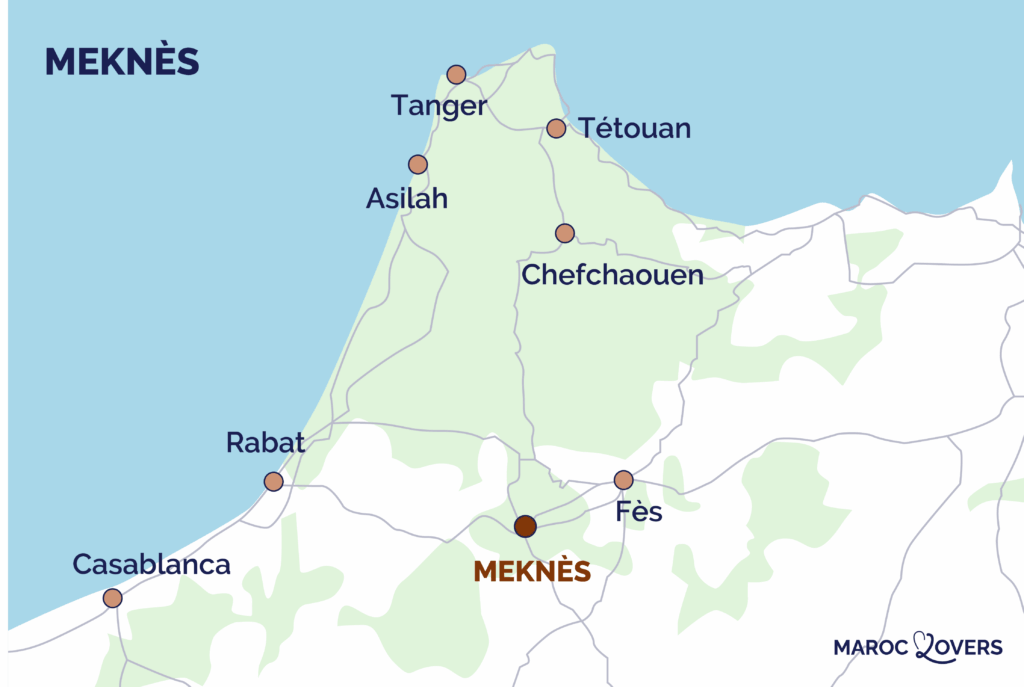
- In northern Morocco, between Fez and Rabat
- From Fez: about 1 hour’s drive
- From Rabat: about 2 hours’ drive
- From Casablanca: about 3 hours’ drive
How to get there
- By car: the A2 freeway links Meknes directly to Fez and Rabat, providing a fast, well-maintained route. From Casablanca, take the A1 freeway, then the A2 at Rabat.
- By train: Meknes is served by the main ONCF line between Rabat, Fez and Casablanca. The Meknès-Ville train station is a 10-minute cab ride from the historic center. Classic trains are frequent and comfortable, and one of the easiest and most pleasant ways to reach the imperial city.
- By bus: several companies provide daily connections from major Moroccan cities (CTM, Supratours, Alsa, etc.). Buses arrive at the Meknes bus station, close to the center.
- On an organized tour: if you don’t want to drive, take a day trip from Fez or Rabat, for example (often combined with Volubilis or Moulay Idriss). This is the best option, as you’ll be accompanied by a local guide, and you’ll be able to admire the scenery along the way as a bonus, or take a rest before and after the tour – see options.

Parking in Meknes
There are several guarded pay parking lots in Meknes, so don’t forget to bring some change. We advise you to park your car in a guarded parking lot such as the one near Bab Khemis or the one at Zine-Al-Abidine, a 5-minute walk from the Mausoleum of Moulay Ismaïl. Other public parking lots are located close to the medina. It’s best to avoid driving through the narrow streets of the old town and explore on foot. In fact, much of the medina is inaccessible by car.

Useful tips for visiting Meknes
How long and when?
Allow at least one full day to visit the main sites of Meknes. Two days will allow you to explore the city more leisurely and include an excursion to Volubilis and Moulay Idriss. Spring (March to May) and autumn (September to November) offer the best weather conditions, with pleasant temperatures. Just note the risk of crowds at the time of the Salon International de l’Agriculture (SIAM) in April. Summer can be very hot, so we recommend you avoid this period, as outdoor visits can be complicated by temperatures that sometimes rise to 34°C (93.20°F). Winter, on the other hand, is mild and less crowded, but sometimes rainy.

Tour directions, map and difficulty
We began our visit with Place El Hedim and the Bab Mansour gate, then explored the Dar Jamaï Museum, which won us over before venturing into the medina. The Mausoleum of Moulay Ismaïl is easy to visit next, followed by the Royal Stables opposite. Note that the medina is easily traversed on foot, with a few cobbled streets. You’ll need good walking shoes to feel comfortable. The mausoleum and the Dar Jamaï Museum are accessible to people with reduced mobility, but the medina remains difficult to access in places, with a few staircases and areas under construction.

Getting around Meknes
Small, light-blue cabs are plentiful and inexpensive, connecting the train station, the medina, Bab Mansour and the outlying districts. Just make sure the meter is on before you set off. Walking is still the best way to explore the medina and its monuments, which are grouped together in a compact area.

Visiting with children
Meknes lends itself well to a family visit, as most of its sites are easily discovered on foot, and some places of interest will also appeal to children:
- The vastness of Bab Mansour and the liveliness of Place El Hedim will keep them entertained, while a gourmet break with Moroccan pastries in the souk El Hedim (covered market) will delight the whole family.
- The Dar Jamaï Museum will captivate young visitors with its interactive devices for listening to traditional music, archive images and documentaries, as well as the many instruments on display.
- The Royal Stables can also impress with their size and history.
- The Lahboul Gardens are a place of relaxation for young and old with their open-air theater.

Restaurants
The range of restaurants in Meknes is still limited, especially in the medina, where we found mainly tourist establishments. Quality is often uneven, although some places offer simple, friendly Moroccan cuisine. For a more varied gastronomic experience, it’s best to plan a trip to Fez, just 1 hour away by car. See our article on the best restaurants in Fez

Visiting Meknes in winter
Fancy exploring Meknes in winter? It’s a great idea! The imperial city enjoys a mild, pleasant climate, although some days can be cool and rainy. Temperatures generally oscillate between 10°C (50°F) and 18°C (64.4°F). We enjoyed the city’s quieter atmosphere during this period, with fewer tourists in the main sights. It’s the ideal time to take full advantage of the museums and historic monuments open all year round, without the summer crowds. But don’t forget to bring a warm jacket or sweater for evenings and early-morning visits.

Other tips
- Islam is the official state religion, so you’ll hear the 5 daily calls to prayer echoing from the minarets of mosques across Maroc.
- Note a particularity of the weekly rhythm: on Friday, the Muslim prayer day, some shops adapt their opening hours or close. But this is not an official holiday.
- On weekends (Saturday and Sunday), some stores close on Saturday, notably those serving the Jewish community, and others on Sunday.
- Maroc remains a modern Muslim country, economically liberal, open to the world, which cultivates a balance between traditions and international dynamics.
Read all our tips for visiting Maroc in our dedicated article – coming soon.
PLAN YOUR TRIP TO Morocco
- Best of
Top Destinations
Must-See Places in Morocco
Most Beautiful Riads
Most Beautiful Cities
Most Beautiful Medinas
Morocco’s Most Beautiful Landscapes
Most Beautiful Gardens
Best Museums
Morocco’s Most Beautiful Beaches

- Practical advice
When to go?
How to rent a car in Morocco
Driving tips

- The must-dos
Marrakech
Casablanca
Fez
Meknes
Chefchaouen
Essaouira
Rabat
Tangier
Tetouan
Agadir
The Sahara Desert

