
Morocco offers a diversity of landscapes that fascinates travelers from all over the world: deserts with golden dunes, majestic mountains, spectacular gorges, historic cities, verdant valleys and wild coastlines.
Here is our selection of the most beautiful landscapes in Morocco to discover during your trip.
These photos of the most beautiful places in Morocco will give you a glimpse of the natural and cultural wealth of this fascinating country.
This opinion is completely independent, based on our experiences. We visited the region anonymously, making our own choices and paying our bills in full.
1. Merzouga dunes (Erg Chebbi)

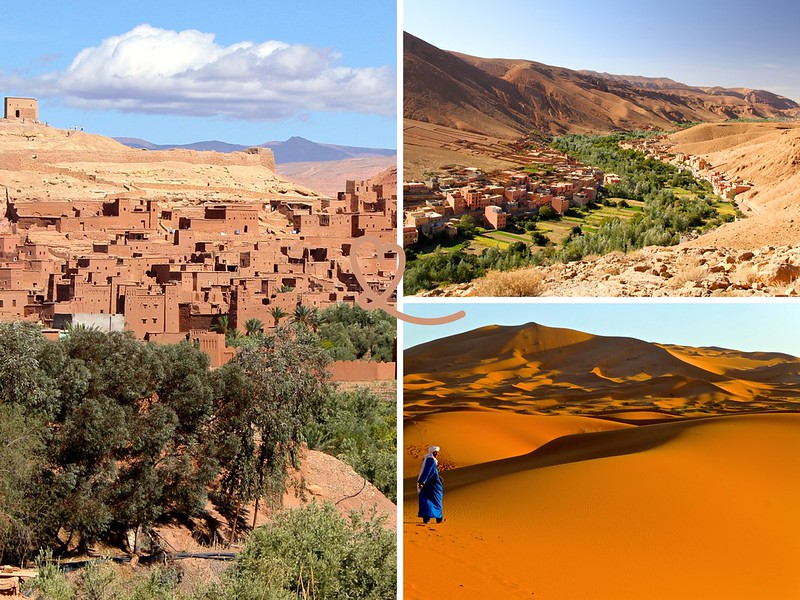
The Erg Chebbi dunes near Merzouga are one of Morocco’s most emblematic sites. These sand mountains can reach heights of 150 m and stretch some 22 km from north to south.
We marveled at the golden and orange hues that change with the light of day. The most memorable experience is undoubtedly sunrise, when the dunes are decked out in flamboyant colors. We recommend spending a night in a bivouac to take full advantage of this natural spectacle and observe the stars in a sky of rare purity.
But you’ll need to plan a long trip (it’s not a day trip from one of the big cities).
2. The Ksar of Aït-ben-Haddou

A UNESCO World Heritage Site, the Ksar of Aït-ben-Haddou is a fortified town of striking beauty. Its red ochre adobe buildings stand majestically on a hill, creating a unique silhouette that has seduced many a film-maker. We particularly enjoyed the view from the top of the ksar, where you can admire the whole valley and the Atlas Mountains in the background.
It’s best to visit early in the morning or late in the afternoon to avoid the heat and benefit from ideal light for your photos.
It has been the setting for films such as Gladiator and Game of Thrones.
OUR TIPS FOR RENTING A CAR IN Maroc
- Compare prices on our preferred platform: DiscoverCars – one of the best rated sites.
- Adapt your choice of vehicle to your itinerary!
- For more choice, book early.

Read our tips (coming soon)
3. Moulay Idriss Zerhoun, spiritual village

Clinging to the hills, this Islamic holy site in Morocco is renowned for its mausoleum, white streets and panoramic views. An excursion just a 45-minute drive from Meknes that combines history, culture and spirituality, in a village where traditional architecture blends with an atmosphere of contemplation and serenity. To find out more
4. The Dades Valley

The Dades valley forms a green ribbon in the heart of a desert landscape. This lush oasis contrasts magnificently with the arid mountains that surround it. We were captivated by the succession of Berber villages with ochre and red houses nestling along the river, surrounded by terraced fields and orchards. Traditional kasbahs dot the landscape, testifying to the region’s ancestral architecture. The road through the valley offers exceptional panoramas at every turn.
5. Dades gorges

At the end of the valley, the Dades gorges offer an impressive geological spectacle, where the river has carved its way through the red rocks. The road that crosses them winds between vertiginous cliffs and rock formations sculpted by erosion.
For hikers, there are a number of trails that allow you to explore the gorge in a more intimate way.
6. The blue city of Chefchaouen

Chefchaouen’s fascinating blue-painted alleyways create a unique atmosphere. Nestled in the Rif mountains, this small town offers a peaceful setting in which to stroll. We spent hours getting lost in the medina, admiring the different shades of blue adorning the walls, doors and staircases. Every street corner is a visual surprise and a perfect backdrop for photographers. The origin of this blue color is still debated, some attributing it to Jewish tradition, others to practical reasons such as protection against mosquitoes.
7. The Drâa Valley

Stretching over 200km between Ouarzazate and Zagora, the Drâa Valley is the longest river valley in Morocco. It forms a lush oasis bordered by palm groves that contrast magnificently with the surrounding desert.
We were captivated by the succession of fortified villages along the way and the lush gardens planted with date palms, olive and almond trees. The valley also reveals many traditional ksour, testimony to the region’s rich architectural heritage. Take the time to stop off in the villages to discover the local crafts and taste the delicious dates.
8. Ouzoud waterfalls

Located in the Middle Atlas mountains, the Ouzoud waterfalls are among the highest in North Africa. The water falls 110m in three successive stages, creating a breathtaking natural spectacle. We enjoyed the descent to the bottom of the cascades, where you can get up close to the falls and feel the power of the water. The site is also home to a colony of magot monkeys, who roam freely in the surrounding trees. To get the most out of the site, we recommend arriving early in the morning, when the light breaks through the spray to form rainbows.
9. Essaouira harbour at sunset

Essaouira’s port reveals all its magic at sunset. Blue fishing boats sway gently in the harbor as the last rays illuminate the ramparts and medina. We loved watching the activity of the returning fishermen at the end of the day, as they unload their catch under the gaze of the seagulls. The atmosphere becomes particularly authentic and lively. The 18th-century Portuguese fortifications frame this maritime scene perfectly. To immortalize this moment, take a seat along the ramparts or on the beach to capture the golden reflections on the ocean.
10. The High Atlas Mountains

The High Atlas forms the backbone of Morocco, culminating in Jebel Toubkal at 4167m, the highest peak in North Africa. This mountain range offers a varied landscape of snow-capped peaks, verdant valleys and hilltop Berber villages. We were impressed by the change of scenery as we gained altitude, from palm groves to cedar forests to alpine landscapes. Numerous hiking trails allow you to explore these mountains and discover the hospitality of the local population. In winter, the peaks are covered in snow, creating a striking contrast that reminds us that Morocco is not just a desert country.
11. The caves of Hercules

Located 14km from Tangier, the Hercules caves fascinate visitors with their natural opening, which resembles the inverted shape of the African continent. Legend has it that Hercules rested in these caves between his twelve labours. We were impressed by this natural cavity carved out by the ocean over thousands of years. The opening to the sea offers a unique setting for watching the waves breaking against the rocks. At low tide, you can access the beach below. The archaeological site also bears witness to prehistoric human occupation of these caves.
12. Hassan II Mosque

A true architectural feat, the Hassan II Mosque in Casablanca impressed us with its monumentality and meticulous craftsmanship. A masterpiece built between 1987 and 1993, it boasts the tallest minaret in the world at 210 metres.
We were equally fascinated by the richness of the local materials used: from Agadir marble and Atlas cedar to traditional “tadelakt” (Berber know-how for creating ancestral Moroccan plaster). You’ll be dazzled by refined details such as the Venetian chandeliers in the prayer room, the 1100-ton retractable roof and the sublime zellige motifs. Some 10,000 Moroccan craftsmen contributed to the design of this splendid place.
WHERE TO STAY IN Casablanca
Our favorites: neighborhoods and hotels
Corniche / Aïn Diab –
Four Seasons Hotel – see prices, photos and availability
Gauthier / Sidi Belyout –
Hôtel Le DOGE Relais & Châteaux – see prices, photos and availability

13. Paradise Valley

Located around 30 minutes from Agadir, Paradise Valley lives up to its name. This hidden oasis lies at the bottom of a canyon where crystal-clear water has carved out natural pools surrounded by palm trees. We found the ideal place to cool off after a hike under the Moroccan sun. The natural pools with their turquoise waters invite you to take a dip, while the rock formations offer jumping opportunities for the more adventurous. The path along the river reveals several successive pools, each with its own character. Visit on weekdays if possible to enjoy a more tranquil atmosphere.
14. Along the Bouregreg river (Rabat)

The banks of the Bouregreg river, which separates Rabat from its twin city Salé, offer one of the capital’s most pleasant walks. We particularly enjoyed this landscaped trail, which harmoniously blends nature, culture and modernity.
Following the river, you’ll enjoy spectacular views of both banks, with the Kasbah des Oudayas on one side and the Salé medina on the other.
WHERE TO STAY IN Rabat
Our favorites: neighborhoods and hotels
Hassan District –
La Tour Hassan Palace Hotel – see prices, photos and availability
Historic Center of Rabat –
Riad Meftaha Hotel – see prices, photos and availability
Marina Rabat-Salé –
Fairmont La Marina Rabat Salé Hotel – see prices, photos and availability

15. Legzira Arch

Legzira beach, near Sidi Ifni, is famous for its two natural arches carved by the ocean into the red cliffs. Although one of the arches collapsed in 2016, the one that remains is a remarkable natural spectacle. We were impressed by the bright red color of the rock, which contrasts magnificently against the blue sky.
But it’s a long way south!
16. Koutoubia Mosque

The Koutoubia Mosque, a jewel of 12th-century Almohad architecture, dominates Marrakech from its 69m-high minaret. Did you know? The minaret, decorated with green earthenware and geometric motifs, served as a model for the Giralda in Sevilla and the Hassan Tower in Rabat. You can contemplate the gardens surrounding the mosque, planted with orange and palm trees, offering a haven of peace just a stone’s throw from the hustle and bustle of Jemaa el-Fna Square.
WHERE TO STAY IN Marrakech
Our favorites: neighborhoods and hotels
In the Medina
Riad Kbour & Chou – See prices, photos and availability
In the Kasbah, an ancient fortified quarter
Riad Jonan & Spa – See prices, photos and availability
Luxury Hotel
Royal Mansour Hotel – See prices, photos and availability

17. Cap Spartel lighthouse

The Cap Spartel lighthouse marks a unique geographical location: where the Atlantic Ocean meets the Mediterranean Sea. In this highly poetic setting, where shades of blue intermingle, we were truly amazed by this promontory at the southern entrance to the Strait of Gibraltar. The view of the sea, the rocks, the surrounding forest and of course the lighthouse itself make this place a natural curiosity to put on your bucket list. We were really intrigued by the changes in water color, currents and rock types where the ocean meets the sea.
18. Tanneries Chouara (Fez)

Join us for a fascinating show at the Chouara Tanneries in Fez, where ancestral know-how has endured for centuries! We observed the natural coloring of the leathers: red from poppy, blue from indigo, orange from henna, green from wild mint, brown from cedar and yellow from saffron or turmeric. More than 250 families work in these tanneries, passing on this know-how from generation to generation.
WHERE TO STAY IN FES
Our favorites: neighborhoods and hotels
In Fès El-Bali (old medina)
Hotel Riad Dar Lys – See prices, photos and availability
Hotel Riad Dar Laura – See prices, photos and availability
Fès El-Jdid (near the Royal Palace)
Palais Faraj Suites & Spa Hotel – See prices, photos and availability

19. Achakdar beach, wilder

Achakkar beach, north of Rabat, offers an unspoilt natural setting close to the capital. This long stretch of fine sand attracts surfers with its steady, powerful waves. We enjoyed the authentic atmosphere of this beach, which contrasts with the more touristy areas of the Atlantic coast. The panorama reveals a wild coastline bordered by dunes and maritime vegetation, creating a landscape typical of Morocco’s Atlantic coastline.
20. The Agafay desert

The Agafay Desert, just 30km from Marrakech, offers a desert experience without having to travel hundreds of kilometers to the Sahara. We were amazed by this stony desert with its lunar landscapes, punctuated by rocky hills and arid plateaus offering spectacular panoramas of the Atlas Mountains. The changing colors of the landscape, from beige to red ochre depending on the light, create an atmosphere conducive to contemplation.
21. Volubilis

The archaeological site of Volubilis is well worth a visit. This ancient Roman city, founded in the 3rd century BC, reached its apogee under the Roman Empire before being abandoned in the 11th century, but is now a UNESCO World Heritage site. We loved our walk around the site, between the romantic ruins, the abundant vegetation and the sublime panoramic views over the valley!
22. Hassan Tower and Mohammed V Mausoleum, symbols of Rabat

The monumental ensemble of the Hassan Tower and Mohammed V Mausoleum is one of Rabat’s most emblematic landmarks. The Tour Hassan, an unfinished minaret dating from the 12th century, was intended to be the tallest religious tower in the world. We were fascinated by its imposing proportions and the remains of the unfinished mosque, with its hundreds of columns testifying to the ambition of the original project. Opposite the tower, the Mohammed V Mausoleum impresses with its refined architecture and sumptuous decoration.
This site, guarded by the Royal Guard in traditional costume, houses the tombs of King Mohammed V and his sons. Find out more in our dedicated article.
23. Aïn Zarka, a popular waterfall in Tétouan

Would you like to discover a natural interlude so popular with Tetouan‘s inhabitants? Head for the Aïn Zarka waterfall, a 20-minute drive from downtown. We really appreciated the tranquility of the area and the superb shades of green and ochre in the surrounding countryside.
24. Monkey fingers

The Doigts de Singes are one of the most surprising rock formations in the Dades Valley. These vertically-erect stone columns effectively evoke fingers pointing skywards. We were fascinated by this unique geological phenomenon, the result of millions of years of erosion that has sculpted the limestone into these singular shapes.
25. Merinid tombs overlooking Fez

For one of the finest panoramic views of Fez and the surrounding mountains of Mont Zalagh, head for the Merinid Tombs! This ancient royal necropolis is dedicated to the Merinid dynasty, which reigned from 1269 to 1465. We were intrigued by the remains of these tombs of former sultans and kings, which bear witness to past grandeur. You’ll discover a historic site dotted with fossils and ancient stones on this hill overlooking the medina.
26. Majorelle Gardens, Marrakech

The Jardin Majorelle, created by painter Jacques Majorelle in the 1920s, offers a cool oasis in the heart of the Guéliz district. We were captivated by the intense cobalt blue that adorns the buildings, now known worldwide as “Majorelle blue”, and by the exceptional collection of cacti and exotic plants. The garden is home to over 300 plant species from 5 continents, including giant bamboos, palms and bougainvillea. You’ll also discover the Museum of Berber Arts, with its remarkable collection of traditional objects.
27. Caraquia viewpoint, Asilah

At the western end ofAsilah‘s ramparts, we made our way to the Caraquia viewpoint, one of the city’s most breathtaking panoramas. This belvedere overlooks the Atlantic Ocean, the perfect place to contemplate the infinite seascape in front of you. You can listen to the soothing sound of the waves breaking on the rocks while admiring the sunset or the horizon. In the medina, it’s the only vantage point offering a view of both the city walls and the vastness of the ocean.
28. Somewhere in Morocco…

29. Lake and Gorges of Tislit
It’s off the beaten track, we’ve yet to go!
30. And one of our most beautiful photos of Morocco published in a National Geographic book.

PLAN YOUR TRIP TO Morocco
- Best of
Must-See Places in Morocco
Most Beautiful Riads
Most Beautiful Cities
Most Beautiful Medinas
Morocco’s Most Beautiful Landscapes
Most Beautiful Gardens
Best Museums
Morocco’s Most Beautiful Beaches
- Practical advice
When to go?
How to rent a car in Morocco
Driving tips
Where to Stay in Morocco
- The must-dos
Marrakech
Casablanca
Fez
Meknes
Chefchaouen
Essaouira
Rabat
Tangier
Tetouan
Agadir
The Sahara Desert