
Just a 1.5-hour drive from Casablanca, Rabat, the kingdom’s capital, is the perfect destination for a day trip. We were charmed by this imperial city, a UNESCO World Heritage Site, which blends Almohad heritage, royal landmarks, and the Atlantic coastline in an atmosphere that’s more laid-back than the country’s major tourist hubs. One day is enough to get a feel for its essence, from the kasbah to the imperial monuments and the medina.
Here’s our ideal itinerary for visiting Rabat in one day, complete with plenty of photos!
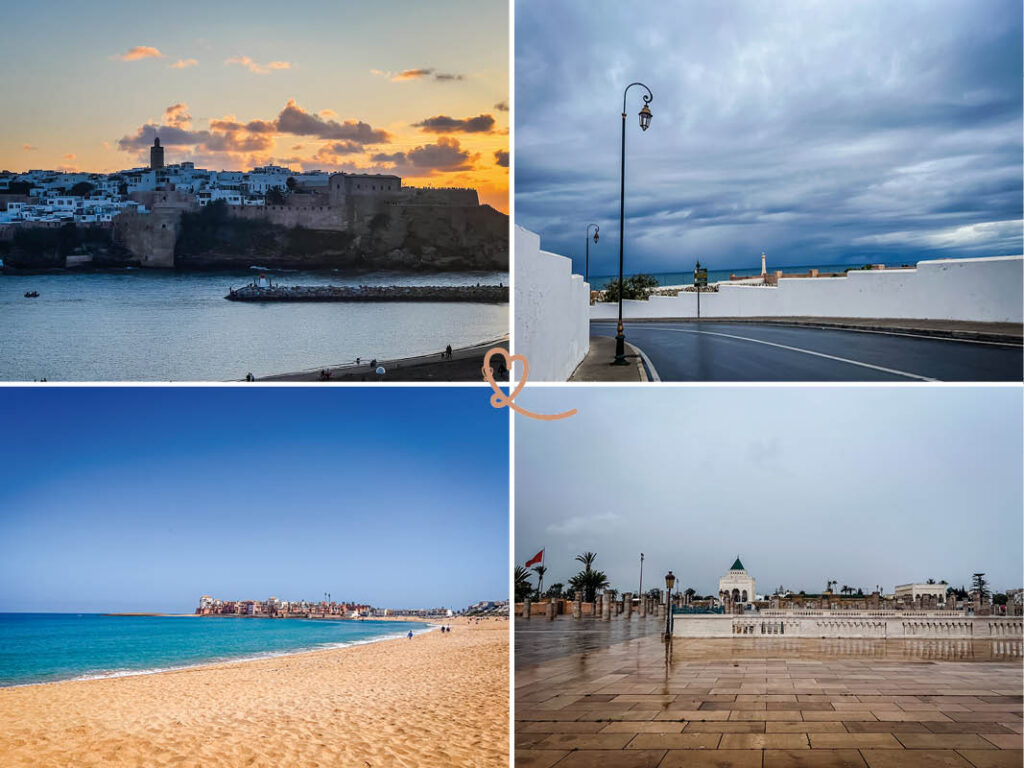
This opinion is completely independent, based on our experiences. We visited the region anonymously, making our own choices and paying our bills in full.
Visiting Rabat in 1 Day: Practical Tips
What can you see in Rabat in one day? Is that enough time?
One day is enough to see Rabat’s must-see sights: the Kasbah of the Oudayas, the Hassan Tower, the Chellah, and the medina. It’s the ideal length of time for a day trip from Casablanca, provided you leave early in the morning.

Maps of must-see attractions
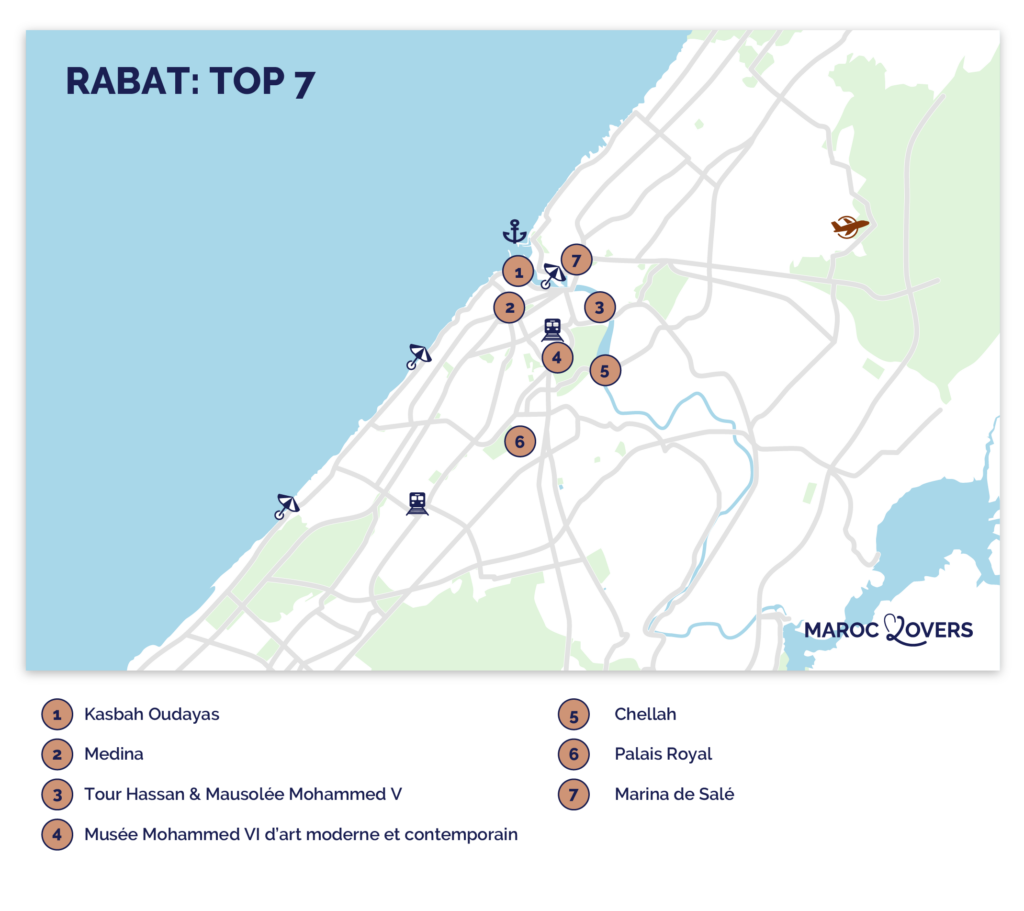
To help you follow along as you read our itinerary below, here is our map of Rabat’s main tourist attractions:
Getting Around in Rabat
The Kasbah of the Oudayas and the medina are best explored on foot, as these areas are almost entirely pedestrian-only. To get to Chellah or cross over to Salé, the tram and the small blue taxis are great options for rounding out your day without needing a car. We found the tram particularly convenient and affordable. If you’re driving from Casablanca, plan to leave your car at the hotel or in a parking lot as soon as you arrive in the city center, as traffic near the medina can be heavy.

Where to Stay in Rabat
If you decide to extend your stay there instead of returning home that same evening:
WHERE TO STAY IN Rabat
Our favorites: neighborhoods and hotels
Hassan District –
La Tour Hassan Palace Hotel – see prices, photos and availability
Historic Center of Rabat –
Riad Meftaha Hotel – see prices, photos and availability
Marina Rabat-Salé –
Fairmont La Marina Rabat Salé Hotel – see prices, photos and availability

Our Ideal Itinerary: A Day in Rabat
We’ve designed this tour to cover the main highlights of Rabat in a single day, alternating between Almohad heritage, imperial landmarks, and the bustling medina. An early morning start will allow you to fully enjoy each stop. This itinerary is intentionally packed to cover the major must-see sights in one day. If you prefer a more leisurely pace, skip the Chellah for now and spend more time in the medina and along the banks of the Bouregreg River.
9:00 a.m.–11:00 a.m.: The Oudayas Kasbah and its Andalusian garden
Start your day at the Kasbah of the Oudayas, the historic heart of Rabat. Founded by the Almoravids and fortified by the Almohads in the 12th century, it later became home to Andalucian exiles in the 17th century. We enjoyed its narrow streets lined with white and blue houses, as well as its ramparts, which offer a view of the Atlantic. You enter through Bab Oudaia, the kasbah’s monumental gate, before reaching the Hispano-Moorish-inspired garden, a cool oasis with fountains and lush greenery. Learn more in our dedicated article.

Allow about 2 hours to explore the kasbah, the garden, and the walk along the ramparts. Admission is free. The cobblestone streets, some of which are steep, make this visit less suitable for people with limited mobility. Since the kasbah is entirely pedestrian-only, it’s best to leave your car at the hotel or in a downtown parking lot. The Café Maure, located on-site, is a stop we recommend to make the most of your early morning.

11:00 a.m.–12:30 p.m.: Hassan Tower and the Mohammed V Mausoleum
Continue on to Rabat’s most iconic monumental complex: the Hassan Tower and the Mohammed V Mausoleum. The Hassan Tower, an unfinished 12th-century minaret, was intended to be the tallest religious tower in the Muslim world. We were fascinated by its proportions and by the ruins of the mosque that was never completed, whose hundreds of columns bear witness to the scale of the original project. Opposite it, the Mohammed V Mausoleum impresses with its refined architecture, guarded by the Royal Guard in traditional dress. Discover more historical details in our dedicated article.

Allow about 1 hour to explore the entire site, which is on flat ground despite a few steps leading up to the mausoleum. Admission is free. Appropriate attire is recommended for visiting the mausoleum. Located on the Hassan II Esplanade, a 15-minute walk from the medina, the site is easily accessible on foot from the kasbah in about 30 minutes, making it a natural stop on our itinerary. If you prefer to be accompanied, a guided tour is a convenient option for learning all the historical details of the site. See prices and availability

OUR TIPS FOR RENTING A CAR IN Maroc
- Compare prices on our preferred platform: DiscoverCars – one of the best rated sites.
- Adapt your choice of vehicle to your itinerary!
- For more choice, book early.

Read our tips (coming soon)
12:30 p.m.–2:00 p.m.: Lunch break in the medina
Take advantage of the midday break to visit Rabat’s medina and grab a bite to eat at one of the many traditional cafés and restaurants there. We enjoyed the variety of culinary options, from tagines and couscous to Moroccan pastries, all best enjoyed with a glass of mint tea. It’s also a great opportunity to spend some time strolling among the artisan stalls before continuing your tour in the afternoon. If you’re looking for other lunch options, check out our recommendations on where to eat in Rabat.

2:00–3:30 p.m.: Chellah, Roman and Merinid ruins
The afternoon begins at Chellah, a UNESCO World Heritage Site. Once the Roman city of Sala Colonia and later a Merinid necropolis, this site moved us with its atmosphere steeped in history. As you explore the ruins, you’ll discover remnants of thermal baths, ancient buildings, and the Merinid necropolis. The gardens surrounding these ruins are home to storks nesting on the ramparts and cats lounging among the stones, creating an atmosphere that is both peaceful and surprising.

Allow 1 hour and 30 minutes to explore the entire site, located 6 minutes by car or taxi from the Palais Royal. The terrain is uneven and sometimes steep, which may make certain areas difficult to access for people with limited mobility. There is a café and a restaurant on site if you’d like to extend your break there rather than in the medina.
A LITTLE MORE PATIENCE
All the photos, maps, information and addresses you need to make your stay at Maroc a success will soon be available in a single ebook!
Coming soon!
3:30 p.m.–5:30 p.m.: The Medina of Rabat
We returned to the medina in the late afternoon, which was less hectic than those in Marrakech or Fez. We particularly loved its lively yet relaxed atmosphere, where you can discover traditional architecture featuring ornate doors, whitewashed walls, and Merinid fountains. The artisans’ stalls—filled with rugs, pottery, jewelry, and traditional clothing—are perfect for the day’s final shopping. Find more details in our dedicated article.
Allow 1.5 to 2 hours for this tour, keeping in mind that the narrow and sometimes crowded alleys are not well suited for people with limited mobility. Feel free to haggle over prices in the souks—it’s a well-established local tradition.

5:30–6:30 p.m.: A stroll along the Bouregreg River at sunset
End the day with a stroll along the Bouregreg, the river that separates Rabat from its twin city, Salé. We particularly enjoyed this well-maintained path, which blends nature, culture, and modernity. As you walk along the river, you’ll enjoy a beautiful view of both banks, with the Kasbah of the Oudayas on one side and the medina of Salé on the other—a particularly stunning scene at sunset to round out the excursion.

Allow about 1 hour for this flat, well-maintained walk. It’s the perfect time to head back by car or train, or—if you’re extending your stay—to have dinner on a terrace overlooking the river. On the Salé side of the river, you’ll find the marina and the yacht harbor.
Option 1: with more time
If you have an extra day, spending the night there will allow you to visit the Salé Marina, which offers a unique panoramic view of Rabat with the Hassan Tower in the background, as well as the Oulja pottery complex in Salé, which we consider one of the best artisanal experiences in the region. Museum lovers can also spend a morning at the Mohammed VI Museum of Modern and Contemporary Art or the Museum of History and Civilizations.

Option 2: With the family
If you’re traveling with children, start your morning with a visit to the Kasbah of the Oudayas and its Andalusian garden, then swap the in-depth tour of Chellah for a break at the Botanical Garden or Hassan II Park, which offers spacious areas for relaxation and playgrounds. The medina remains a great place for a fun family outing, with the colors and bustle of the souks, before finishing with a stroll along the Bouregreg promenade, which is enjoyable for all ages.

Subscribe to our Newsletter
- Get away from it all with Region Lovers’ beautiful destinations!
- Once a month
- Advertising-free

What You Need to Know for Your Day in Rabat
How to get to Rabat
Rabat is a 1-hour drive or a 1-hour train ride from Casablanca via the ONCF network. Visit the official website for more information here. If you’d rather not drive and want to enjoy the scenery along the way, a guided tour with transportation from Casablanca is an excellent option for this day trip.
Book your guided tour of Rabat from Casablanca!
Rabat is also easily accessible from other cities in Morocco if you’re not traveling from Casablanca. From Tangier, the Al Boraq high-speed train connects the two cities in about 1 hour and 20 minutes—a fast and comfortable option. From Fez or Meknes, the ONCF’s regular rail network also serves Rabat; while the trips take a little longer, they’re just as convenient for planning a day trip. Visit the official website to check schedules and book your tickets here.

The Weather in Rabat
So far, we’ve mainly explored Rabat in the winter, a season we highly recommend for a day trip. From November through March, temperatures range from 10°C (50°F) to 18°C (64.4°F), making it comfortable to explore the city. We enjoyed the bright light of this season—ideal for photography—as well as the chance to enjoy the sights without the summer crowds. A few rainy days may occur, but they’re usually short-lived. Be sure to pack a sweater for the evening and a lightweight raincoat in case of showers.

The Crowds in Rabat
Rabat remains a less crowded capital than Marrakech or Fez, which makes a day trip there particularly enjoyable, even during peak season. On Fridays, the Muslim day of prayer, some shops adjust their hours or close, even though it is not an official holiday. You’ll also hear the five daily calls to prayer echoing from the minarets—a unique feature to keep in mind when planning your day.

PLAN YOUR TRIP TO Morocco
- Best of
Must-See Places in Morocco
Most Beautiful Riads
Most Beautiful Cities
Most Beautiful Medinas
Morocco’s Most Beautiful Landscapes
Most Beautiful Gardens
Best Museums
Morocco’s Most Beautiful Beaches

- Practical advice
When to go?
How to rent a car in Morocco
Driving tips
Where to Stay in Morocco

- The must-dos
Marrakech
Casablanca
Fez
Meknes
Chefchaouen
Essaouira
Rabat
Tangier
Tetouan
Agadir
The Sahara Desert

