
Getting away from it all in Rabat? The Oulja potters’ complex is a must-see place to discover Moroccan crafts and enjoy local immersion.
Now under redevelopment, the site has been moved and will soon make way for a new Cité d’Artisanat et des Arts.
In this article, we share our impressions and tips based on our visit to the former Potters’ Complex in Oulja, just outside Rabat.
This opinion is completely independent, based on our experiences. We visited the region anonymously, making our own choices and paying our bills in full.
Why visit the Ulaja Potters’ Complex
Is the complex worth it? Our opinion:
Yes, the Oulja potters’ complex is well worth a visit. Even if you don’t buy anything, it’s a great overview of Moroccan craftsmanship! We were impressed by the variety of creations and the skill of the craftsmen. For us, it’s one of the best things to do in Rabat!
Note to travelers: Since our visit in 2024, the site has been relocated to make way for a new City of Crafts and Arts, currently under construction. The photos and descriptions in this article therefore no longer accurately reflect the experience you’ll have on site once the project is completed. But if you’re curious about Moroccan craftsmanship, it’s always worth a visit!

Why is the Ulaja Potters’ Complex famous?
The Oulja Potters’ Complex was much more than just a pottery market: it was a veritable conservatory ofMoroccan craftsmanship, renowned for the diversity and quality of its traditional pottery at affordable prices. Far from standardized spaces, Oulja had a soul: in an organized jumble, you could stroll between the workshops and stalls, watch the craftsmen at work and discover a wide range of objects, witnesses to a know-how that was both ancestral and alive.

WHERE TO STAY IN Rabat
Our favorites: neighborhoods and hotels
Hassan District –
La Tour Hassan Palace Hotel – see prices, photos and availability
Historic Center of Rabat –
Riad Meftaha Hotel – see prices, photos and availability
Marina Rabat-Salé –
Fairmont La Marina Rabat Salé Hotel – see prices, photos and availability

Access: Potters’ complex, Ulaanbaatar
Where is the Potters’ Complex?
At the time of our visit, the complex was located on the banks of the Bouregreg river, on the site of the old marshes, a 15-minute drive from the Salé marina, but the site was demolished in 2024 as part of the redevelopment of the Bouregreg valley.
The site has therefore been temporarily relocated on the northern road leading to Kénitra.
Find out more about the progress of the work on the city’s official website here.

OUR TIPS FOR RENTING A CAR IN MOROCCO
- Compare prices on our preferred platform: DiscoverCars – one of the best rated sites.
- Not too wide
- A good engine
- For more choice, book early.

How to get there?
The Potters’ Complex is not easily accessible on foot. We therefore advise you to plan your own means of transport. A car remains the most practical option for getting there quickly. Alternatively, you can opt for a combined bus and streetcar journey from the Salé marina.
Parking
Parking is available on site. We easily found a place to park during our visit. Remember, however, to bring some change for the car attendant, as is often the case at Maroc.


Useful tips: duration, schedules, eating…
Best time to visit
The complex can be visited at any time of year. However, we strongly recommend that you plan your excursion for a day with good weather. In fact, most of the strolling between the various stands takes place outdoors.

Length of visit and main difficulties
Allow around 1h to 1h30 to explore the entire complex. We found this time sufficient for a leisurely stroll, watching the craftsmen at work and making a few purchases. The only difficulty might be the sheer size of the site and the fact that there are no special facilities for the PRM public, some stores being less accessible than others.

Advice on how to visit
You don’t need to know which way to go: let your desires guide you! The complex can be explored at your whim.
A LITTLE MORE PATIENCE
All the photos, maps, information and addresses you need to make your stay at Maroc a success will soon be available in a single ebook!
Coming soon!

Visiting with children
Although there are no special features for children, we think they will certainly enjoy the colorful stroll through the complex. The lively atmosphere and the spectacle of craftsmen at work will also captivate their attention.

Schedules and rates
The complex is open daily from 09:00 to 19:00.
Access to the site is entirely free of charge, except for purchases.
We strongly advise you to bring cash, as credit cards are not generally accepted in the shops.
If you need to make a cash withdrawal, there’s a cash dispenser just a 5-minute walk from the complex, near the Palais des Congrès de Rabat Bouregreg.

Guided tours
There are no official guided tours offered at the potters’ complex. However, we did discover that pottery classes are organized during the week.
Catering
There are no on-site catering options. We therefore suggest you plan your visit before or after a meal. For lunch or dinner, return to the center of Salé, where you’ll find a wide range of restaurants.
Subscribe to our Newsletter
- Get away from it all with Region Lovers’ beautiful destinations!
- Once a month
- Advertising-free

A labyrinth of shapes and colors: the diversity of Ulaja pottery
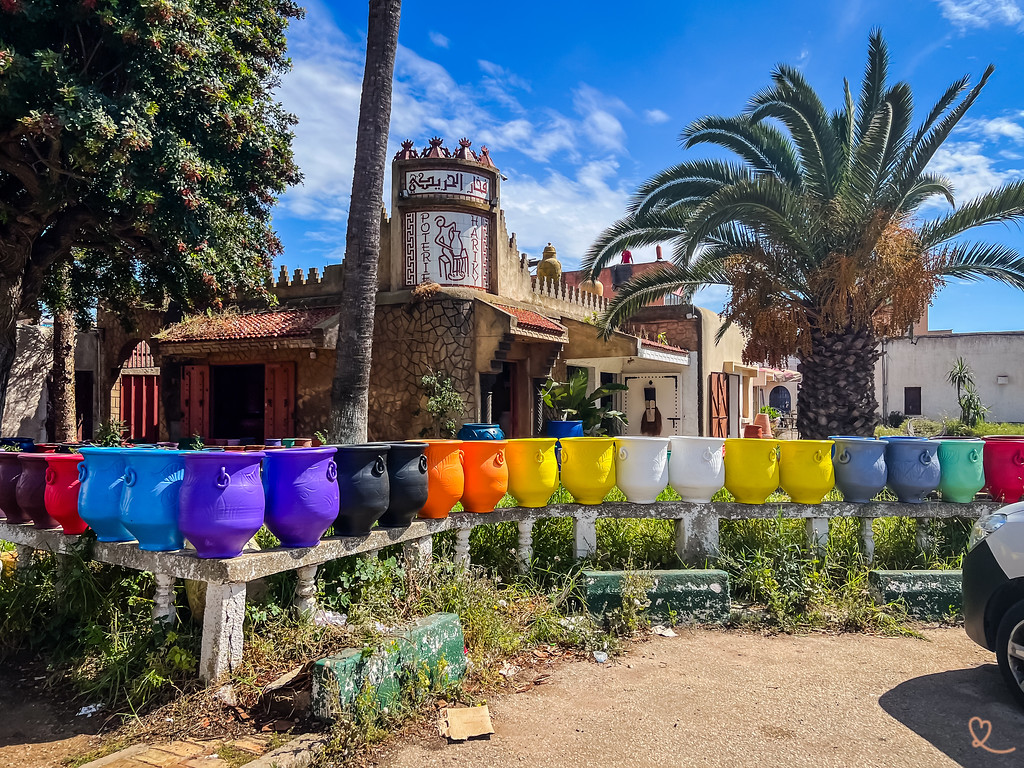
When we visited the Oulja potters’ complex in 2024, we were immediately seduced by the singular layout of the site, with its lanes lined with stacked pottery, open kilns and open-air workshops. This colorful maze offers a striking visual spectacle, attesting to the fact that Oulja was the beating heart of Moroccan craftsmanship, where every alleyway resounded with the clatter of tools and exchanges between artisans.

We were also struck by the diversity of the creations on display along the way: large, generously-shaped vases in raw terracotta, ceramics with traditional Berber or Andalucia motifs, colorful tagines with perfectly aligned pointed lids. The wealth of styles reflects the incredible heritage of Moroccan craftsmanship, where each piece tells a story.

An out-of-time stroll: meet the artisans
In addition to the colorful and pleasant stroll around the Oulja site, meeting the artisans is a captivating experience. Depending on the time of your visit, you may have the opportunity to observe the precision with which each piece of pottery is shaped by hand.
In some workshops, traditional kilns, still used according to ancestral methods, transform clay into unique pieces. A visit to Ulja means much more than admiring the beautiful pottery: it means contributing to the preservation of ancestral know-how, supporting responsible tourism and contributing to the dynamism of the local economy.

Oulja, a know-how on borrowed time: between tradition and modernization
We highly recommend a visit to the potters’ complex, even if you’re not a craftsman by trade. Moroccan pottery is much more than just a decorative object: it embodies a unique heritage, shaped by generations of craftsmen. Observing their precise gestures and the techniques they have handed down over the centuries is also a way of showcasing a living, evolving know-how.

However, with the demolition of the old Ulja site to make way for a more modern center, it’s hard to say whether the experience will be the same as when we visited in 2024. Let’s hope that the new Cité d’Artisanat et des Arts, currently under construction (more info here), will preserve the authenticity of the craft and give small-scale artisans the place they deserve.

PLAN YOUR TRIP TO Morocco
- Best of
Top Destinations
Must-See Places in Morocco
Most Beautiful Riads
Most Beautiful Cities
Most Beautiful Medinas
Morocco’s Most Beautiful Landscapes
Most Beautiful Gardens
Best Museums
Morocco’s Most Beautiful Beaches

- Practical advice
When to go?
How to rent a car in Morocco
Driving tips

- The must-dos
Marrakech
Casablanca
Fez
Meknes
Chefchaouen
Essaouira
Rabat
Tangier
Tetouan
Agadir
The Sahara Desert

