
Morocco surprises visitors with the diversity of its landscapes: deserts, mountains, plains, and coastlines all coexist within the same country. To freely explore this diversity and travel at your own pace, a car remains the most convenient mode of transportation. We’ve traveled across the country several times in a rental car, and here we share all our insights.
Here is our comprehensive guide to renting a car in Morocco without any stress: rental agencies, choosing a vehicle, driving rules, and practical tips.
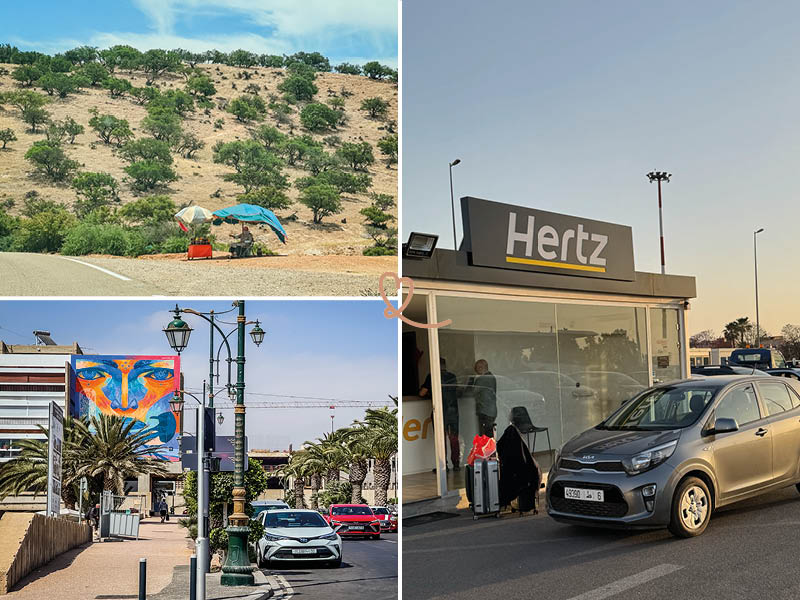
1. Where to Rent a Car in Morocco: Top Rental Companies
Our preferred platform
Our first instinct is to check the offers on DiscoverCars. This platform makes it easy to compare offers from different rental companies, both in terms of price and terms and conditions. We regularly find great deals there, which is why we’ve made it our go-to choice when planning a trip to Morocco. View car rental deals in Morocco
WHERE TO STAY IN Morocco
Our independent picks for the accommodation of your dreams:
- Where to stay in Morocco (coming soon)
- The most beautiful riads in Morocco
Select by city:

Where to pick up your car
Morocco has several major car rental hubs, located at the country’s main airports. The choice of airport naturally depends on your point of entry into the country and the itinerary you have planned for your trip.
- Marrakech Airport
- Casablanca Airport
- Fez Airport
- Agadir Airport
- Rabat Airport
- Essaouira Airport
- Tangier Airport
- Oujda Airport
- Nador Airport

OUR TIPS FOR RENTING A CAR IN MOROCCO
- Compare prices on our preferred platform: DiscoverCars – one of the best rated sites.
- Not too wide
- A good engine
- For more choice, book early.

When to Rent a Car
Reserve your car as soon as possible to take advantage of the best selection of models and the most competitive rates. This is especially true during peak season, when demand increases significantly and availability decreases rapidly. View car rental deals in Morocco

What are the best rental agencies in Morocco?
There are several agencies operating in Morocco, ranging from subsidiaries of major international groups to independent local firms. Some are part of well-known groups, while others remain independent, locally based companies.
- Avis
- Europcar
- Sixt
- Hertz
- Dollar Car Rental, operated by the Hertz Group
- Thrifty Car Rental, operated by the Hertz Group
- Budget, a subsidiary of General Motors
- Aircar, an independent agency
- 1 Service Car, an independent agency
- Resolve Cars, an independent agency
- Prestige Rent, an independent agency
- Alma Car Hire, an independent agency
- Compare car rental prices in Morocco

A LITTLE MORE PATIENCE
All the photos, maps, information and addresses you need to make your stay at Maroc a success will soon be available in a single ebook!
Coming soon!
2. Which rental car to choose for Morocco
Our top 3 tips for choosing your car are:
- Not too wide
- A good engine
- Automatic or manual, depending on your preference. In Morocco, you’ll find both; automatic cars are slightly more expensive.
What size car?
Avoid vehicles that are too wide or too long. The alleys in the medinas—when they’re accessible to cars, particularly in Fez or Chefchaouen—are sometimes very narrow, as are some mountain roads in the Atlas Mountains. City cars and compact cars are ideal for most trips.

Which engine?
Morocco has many mountain roads, particularly in the High Atlas and Middle Atlas ranges. For optimal driving comfort on these stretches, it’s best to avoid vehicles with the smallest engines.
Automatic or manual
In Morocco, most of the cars available for rent are manual. Rental agencies also offer automatic models, but these are generally a bit more expensive and less common. We therefore recommend booking early if an automatic transmission is important to you—an option we personally prefer when renting a car. On DiscoverCars, the “Automatic Transmission” filter, located on the left side of the screen, makes it easy to refine your search.


It’s time to book!
Compare everything: companies, prices, schedules and availability.
3. What permits, regulations, and credit cards
Minimum age
In Morocco, the legal driving age depends on the type of vehicle. To drive a passenger car, which requires a Class B license, you must be at least 18 years old.
Do you need an international driver’s license?
To drive in Morocco with a European license—such as a French license—a national license is generally sufficient for a tourist visit, provided it is written in the Latin alphabet. An international driver’s license is therefore not required in this case. However, for countries such as the United States, Canada, Australia, or Japan, although the national license is often accepted by rental car companies, an international driver’s license is recommended and may be required by certain agencies or during a traffic stop.

Do I need a credit card?
The answer is perhaps. If you rent a car without opting for the zero-deductible option offered by the rental company, the company will automatically place a hold on your credit card. Some rental companies refuse to do this with a debit card. If you opt directly for the rental company’s insurance, which waives the deductible, no credit card is required.

4. Get insurance
Compulsory insurance
In Morocco, motor vehicle liability insurance—known as third-party liability insurance—is strictly mandatory for all motorized land vehicles. It is automatically included in the price of all car rentals.

Supplements
For supplemental coverage, there are three main options available to you.
Option 1
Your personal auto or home insurance policies may sometimes cover rental cars, but be sure to read the fine print: this is rarely the case.
Option 2
: Purchase insurance through the rental platform. The advantage is a better price. The disadvantage is that you’ll have to leave a security deposit when you pick up the car and pay the amount upfront in the event of damage. We strongly recommend taking the insurance offered by DiscoverCars. During one of our rentals in Morocco, we were involved in a minor collision that resulted in a scratch on the front of the vehicle. Both the rental agency and DiscoverCars’ insurance handled the situation perfectly, and we were fully reimbursed. Be sure to keep all documentation in case of an accident: the accident report, the rental agency’s document, the repair invoice, and any other supporting documents.
Option 3
: Purchase supplemental insurance directly from the car rental company. It’s more expensive, but you won’t have to pay anything out of pocket or fill out any paperwork in the event of damage.

5. Access to rental cars
At Moroccan airports, it’s generally easy to find car rental agencies. They are clearly marked and easily accessible, often located in the arrivals hall or in the parking lot across from the arrivals terminal.

6. Check your vehicle at pick-up
Checking the car
If you purchased the rental company’s supplemental insurance to waive the deductible, it’s not necessary to inspect the car’s condition, but be sure you have all the essential equipment. Otherwise, we recommend that you walk around the vehicle, take photos of any existing damage, and notify the rental agency if it isn’t already noted in the pickup document.
- fuel level and mileage, that they correspond to the file
- the entire exterior of the car to detect dents and scratches
- the roof, which is often overlooked but sometimes checked upon returning
- below the bumpers
- rearview mirrors
- inside
- tire condition
- on the wing, above the wheels
- the spare tire, if applicable

Mandatory in-car equipment
In Morocco, high-visibility vests and warning triangles are strictly required for all drivers.
Find out more about toll management
Morocco has a highway network managed by Autoroutes du Maroc. Two payment methods are accepted: cash in dirhams at manual toll booths or by credit card on compatible lanes. Always carry cash, especially small change (tolls are inexpensive), as card payments are not available on all lanes.

7. Preparing to Drive in Morocco
Driving in Morocco requires some adjustment, especially in cities where traffic can be heavy. Here are the general rules, the main hazards, and what to do in case of an unexpected situation.
General rules
- Drive on the right side of the road
- Speed limit of 40 to 60 km/h in city areas, 100 km/h on country roads, and 120 km/h on highways
- Very strict legal blood alcohol limit, set at a maximum of 0.20 g/L of blood or 0.10 mg/L of exhaled air
- Seat belts are required for all occupants
- Using a handheld phone while driving is strictly prohibited

Main hazards
Traffic in Morocco’s major cities—such as Marrakech, Casablanca, Fez, and Agadir—may seem heavy to drivers who aren’t used to it. Right-of-way rules aren’t always followed, motorcycles weave in and out among vehicles, and pedestrians sometimes cross the street without looking. We’ve also noticed that the horn is frequently used as a means of communication between drivers.
Outside of cities, watch out for occasional potholes and animals that may cross the road in rural areas, as well as winding mountain roads in the Atlas Mountains or in the gorges. We recommend that you avoid driving at night if possible, as street lighting is sometimes inadequate.

Emergency numbers
- 7:00 p.m.: Police, in town
- 177: Royal Gendarmerie, outside urban areas, on the roads and in the countryside
- 15: Ambulances and Medical Emergencies
- 150: Civil Defense, Fire Department
- 112: the emergency number to call from a cell phone, which connects you to the appropriate service based on your location
If you’re involved in an accident with a rental car, call 19 if you’re in a city, such as Marrakech, Casablanca, Fez, or Agadir. If you’re on a national highway, a freeway, or in a rural area, call 177 instead.
What to do in the event of an accident
Even a minor accident requires you to follow certain steps. Here is the procedure, based in part on our own on-site experience.
- Secure the area: turn on your hazard lights, put on your reflective vest, and set up the warning triangle if possible
- Check to see if anyone is injured and immediately call emergency services as well as the police or gendarmerie if necessary
- Take photos of the vehicles, license plates, damage, the position of the cars, skid marks, and the surrounding area
- Fill out an accident report form with the other driver if the accident involves only property damage, but do not sign it if you disagree with the information provided
- Call the police or the gendarmerie if anyone is injured, if the drivers cannot agree, if a driver refuses to fill out the accident report, or if one of the vehicles is registered in another country
- Contact the rental company immediately at the support number listed on the contract or on the keys, and follow their instructions before making any repairs
- Keep all documents: the accident report, any official report, photos, witnesses’ contact information, and towing invoices if necessary
- Do not have the vehicle repaired on your own initiative unless the rental company agrees
- Notify your personal insurance provider if a credit card or travel insurance policy covers the rental
- Keep a copy of all correspondence with the rental company until you return the vehicle
Always keep the rental agreement, the rental company’s assistance number, the accident report form (which is usually provided with the vehicle), and the vehicle’s registration documents in the car.

Even in the case of a minor fender-bender, it’s often best to contact the rental company before leaving the scene, as some require a police report or provide specific instructions depending on the type of insurance you have. If the other driver refuses to sign an accident report, it’s best not to insist or let the situation become tense: simply report it to your rental agency. We had a minor accident involving a scooter during our trip, and DiscoverCars’ insurance handled the claim in less than a month, even though we had to cover the costs upfront. Get insurance—it’s a must-have in Morocco!
Frequently asked questions
Should you rent a car in Morocco?
Although the train (ONCF) and bus (Supratour or CTM) networks are well-developed, a car offers greater freedom, especially when exploring the country’s gorges, villages, and natural landscapes. The road network is generally of good quality. However, we do not recommend driving in major cities. Most medinas are off-limits to cars, and driving in the city requires great caution due to heavy traffic and the sometimes unpredictable behavior of other drivers. Organized tours are a good alternative for certain sites.

Is it worth having a 4WD?
A standard vehicle is sufficient for most trips in Morocco. A 4WD comes in handy for certain more remote locations, such as Erg Chigaga in the Sahara, or for some unpaved roads leading to remote natural sites.

What to Do If You Get a Ticket
If you receive a traffic ticket while driving a rental car, remain courteous and present the requested documents: driver’s license, passport or ID card, and rental agreement. Ask for the specific reason for the violation. You can pay the fine immediately to the officer, in cash or sometimes by card depending on the available payment options: we recommend that you bring cash and pay directly on the spot. Always ask for an official receipt, or, if that’s not possible, a copy of the citation that serves as a receipt, and never pay without proof of payment.

If you do not pay on the spot, you generally have 15 days to pay the fine. The officer may then temporarily retain your driver’s license or the vehicle registration certificate and issue you a receipt valid for that period. Notify your rental agency if any vehicle documents have been retained or if the violation directly involves the vehicle. Keep all documents—including the receipt, citation, and any photos—until you return the vehicle.
Fines are often 300, 500, or 700 dirhams, depending on the severity of the violation. For violations detected by automatic speed cameras, payment can also be made online through the Ministry of Justice’s official website.
What to Do If There’s a Problem with the Car
Don’t lose your rental agreement. It contains instructions on what to do if you have a problem with your vehicle. Most rental companies offer roadside assistance, and the phone number is listed on the agreement. You can then contact the rental agency to arrange for a replacement vehicle if necessary.

What is the required budget?
Rates vary depending on the type of vehicle you choose. Expect to pay between 150 and 300 dirhams per day—about 15 to 30 euros—for an entry-level city car. For a compact car or a sedan, the cost is typically between 250 and 500 dirhams per day, or about 25 to 50 euros.
PLAN YOUR TRIP TO Morocco
- Best of
Must-See Places in Morocco
Most Beautiful Riads
Most Beautiful Cities
Most Beautiful Medinas
Morocco’s Most Beautiful Landscapes
Most Beautiful Gardens
Best Museums
Morocco’s Most Beautiful Beaches

- Practical advice
When to go?
How to rent a car in Morocco
Driving tips
Where to Stay in Morocco

- The must-dos
Marrakech
Casablanca
Fez
Meknes
Chefchaouen
Essaouira
Rabat
Tangier
Tetouan
Agadir
The Sahara Desert

