
As Morocco’s economic powerhouse, Casablanca is more than just its modern skyscrapers: the “White City” embodies a constant contrast between its Art Deco colonial heritage, its traditional neighborhoods like the Habous, and the Hassan II Mosque, which overlooks the Atlantic. We were captivated by this cosmopolitan metropolis, which blends its past with its bustling present, featuring iconic monuments, lively markets, and long beaches along the Corniche. A week-long stay allows you to take the time to explore the city in depth while also making day trips to Rabat or El Jadida.
Here’s our ideal itinerary for a week in Casablanca, complete with lots of photos!
This opinion is completely independent, based on our experiences. We visited the region anonymously, making our own choices and paying our bills in full.
Visiting Casablanca in 7 Days: Practical Tips
What can you see in Casablanca in one week? Is that long enough?
A week is enough to see the city’s main sights—including the Hassan II Mosque, Habous, the Central Market, and the Corniche—while setting aside two days to explore Rabat and El Jadida. Check out all of Casablanca’s attractions in our article.

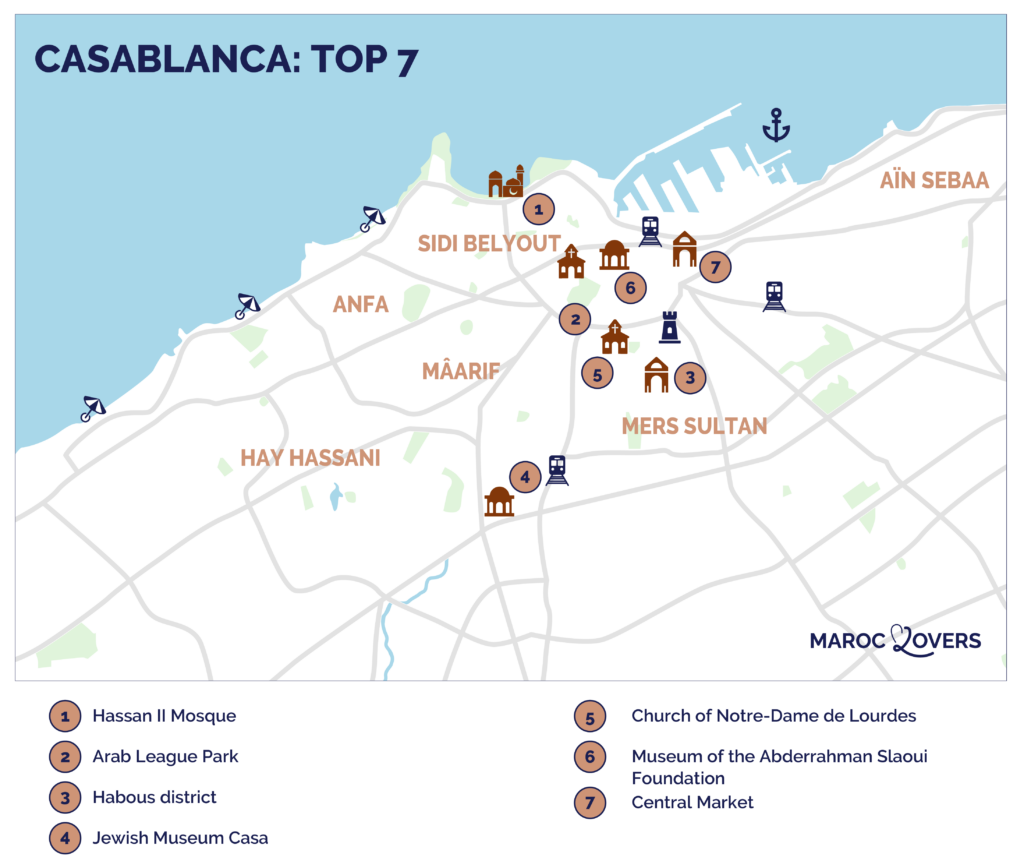
Map of must-see attractions
To help you follow along as you read our itinerary below, here is our map of Casablanca’s main tourist attractions:
Getting Around Casablanca Without a Car
Casablanca has a network of four tram lines (CasaTramway) that serve most of the sites on our itinerary: Line T1 connects Place Mohammed V, Avenue Hassan II, and the Oasis neighborhood, while Line T3 takes you to Les Habous. The city bus network complements this system; for example, the L005 line serves the Hassan II Mosque and the Aïn Diab area. We also recommend the little red taxis—the official color of Casablanca’s taxis—or ride-hailing apps for longer trips, such as the one to the El Hank Lighthouse. A week without a car is entirely feasible using these options, as a car is really only useful for excursions outside the city.

Where to Stay in Casablanca
WHERE TO STAY IN Casablanca
Our favorites: neighborhoods and hotels
Corniche / Aïn Diab –
Four Seasons Hotel – see prices, photos and availability
Gauthier / Sidi Belyout –
Hôtel Le DOGE Relais & Châteaux – see prices, photos and availability

Our Ideal Itinerary: 7 Days in Casablanca
We wanted to strike a balance in this itinerary between religious heritage, working-class neighborhoods, colonial heritage, and the seaside, alternating between days in the city and day trips to the surrounding area.
Day 1 – Hassan II Mosque and the Waterfront
9:00 a.m.–11:00 a.m.: Hassan II Mosque
To kick off this week in Casablanca, head to the Hassan II Mosque, located between the port and the El Hank Lighthouse. A masterpiece built between 1987 and 1993, it boasts one of the tallest minarets in the world, rising to 210 meters. We were impressed by the monumentality of the site and the meticulous craftsmanship: Agadir marble, Atlas cedar wood, traditional tadelakt, and zellige adorn every corner. Did you know that this is one of the few mosques in the world that allows non-Muslims to visit? The guided tour lasts one hour, followed by a stroll through the esplanade and the media library. Book your ticket now!

2:00 p.m.–6:00 p.m.: Corniche and Aïn Diab Beach
In the afternoon, head to the Corniche, an 8-kilometer-long promenade lined with palm trees along the Atlantic Ocean Boulevard. We enjoyed the colors of the sunset and the pleasant scent of the ocean that accompanied our walk. The 2-kilometer-long Aïn Diab Beach is the most iconic on the Casablanca coastline: we keep coming back for its lively, down-to-earth atmosphere, filled with strollers, families, and soccer games on the sand. It’s not the quietest beach, but it really captures the city’s seaside vibe. A bike path runs along the waterfront for a more active ride.

Day 2 – Habous, Delicacies, and Art Deco Architecture
10:00 a.m.–12:30 p.m.: Habous District
Head to the Habous neighborhood, built in the early 20th century and conceived as a “New Medina” by French architects Henri Prost and Albert Laprade. You’ll immerse yourself in the traditional atmosphere of Morocco, among narrow streets lined with arcades, artisan shops, and peaceful inner courtyards. We love this neighborhood for its colors and authenticity, a far cry from the labyrinthine layout of the old medinas. As you stroll through the neighborhood, you’ll catch a glimpse of the Al-Mohammadi Mosque, whose carved minaret is inspired by the Koutoubia in Marrakech, as well as the Dar Al Ala Museum, dedicated to Moorish-Andalucian music. It’s best to plan your visit for the morning: some shops are closed on Fridays and Sundays.

Before leaving the neighborhood, stop by Pâtisserie Maison Bennis, founded in 1930, which has been carrying on the art of Moroccan pastry-making for four generations. We stop by every time we’re in the area! There, you can sample gazelle horns, sesame cookies, or the famous Ghriyba Bahla, a melt-in-your-mouth Moroccan cake.

2:00 p.m.–5:00 p.m.: In the Footsteps of Art Deco
The afternoon is devoted to the city’s rich colonial past. Mohammed V Square, built in 1920 and known for its pigeon fountain, is a beautiful showcase of Art Deco style, as are the Post Office—also dating from 1920—and the Courthouse, built in 1925. We were captivated by the Rialto Cinema, designed in 1930, whose dome rises 14 meters high. You’ll also appreciate the blend of modern architecture and Neo-Moorish style visible on the façade of Bank Al Maghrib on Boulevard de Paris.

OUR TIPS FOR RENTING A CAR IN MOROCCO
- Compare prices on our preferred platform: DiscoverCars – one of the best rated sites.
- Not too wide
- A good engine
- For more choice, book early.

Day 3 – Central Market and Historic District
9 a.m.–11 a.m.: A Day at the Central Market
Built between 1918 and 1919 by architect Pierre Bousquet, the Marché Central blends functionality with Moorish charm in its elegant arcades. We were captivated by the lively atmosphere in the aisles, amid stalls selling fruit, flowers, and fresh fish. You can explore the central rotunda reserved for fishmongers and admire the zellige fountains that keep the market cool and well-ventilated. Numerous small eateries also let you sample new flavors and chat with the vendors. We’ve ranked it among the best markets in Casablanca here!
Let yourself be tempted by a culinary tour of the market with tastings and lunch!

2:00 p.m.–5:00 p.m.: United Nations Plaza and Bab Marrakech
Continue on to Place des Nations-Unies, formerly Place de France, which was designed in 1915 by architect Joseph Marrast. It is home to the Hôtel Excelsior, a fine example of Art Deco architecture, and the Galeries Modernes. We were struck by the contrast between the colonial architecture and the quintessentially Moroccan bustle of the neighborhood. Nearby, the old medina of Bab Marrakech, built in 1770, reveals itself through its pedestrian-only alleys and the grand entrances to its souk, which is currently undergoing renovation. Take the time to admire its cut-stone arches and ornamental motifs.

End your day just a few minutes away at the former Sacré-Cœur Church, which was restored and reopened in November 2023 as a cultural space. Built between 1930 and 1953, it combines Art Deco, Neo-Gothic, and Neo-Moorish styles. We loved its decorative buttresses and modernist stained-glass windows, which are now showcased through a regular cultural program.

A LITTLE MORE PATIENCE
All the photos, maps, information and addresses you need to make your stay at Maroc a success will soon be available in a single ebook!
Coming soon!
Day 4 – Excursion to Rabat, the capital and imperial city
9 a.m.–12 p.m.: Kasbah of the Oudayas and Hassan Tower
Just a 1-hour drive or 1-hour train ride away, Rabat is, in our opinion, the top day trip to consider from Casablanca: it’s close by, rich in heritage, and a pleasure to explore. Founded by the Almoravids and fortified by the Almohads in the 12th century, the Kasbah of the Oudayas is the historic heart of the city. You’ll wander through its white and blue alleyways and its Hispano-Moorish-inspired garden before enjoying the view of the Atlantic from its ramparts. We appreciated the more relaxed atmosphere compared to Casablanca, which makes the visit particularly enjoyable.

Continue on to the Hassan Tower and the Mohammed V Mausoleum, the capital’s most iconic landmark: the tower is an unfinished 12th-century minaret that was intended to be the tallest in the Muslim world.

2:00 p.m.–6:00 p.m.: Chellah and the Medina of Rabat
To add an archaeological dimension to your day, visit Chellah, the ancient Roman city of Sala Colonia that later became a Merinid necropolis: gardens teeming with storks, the remains of a forum, a triumphal arch, and ancient thermal baths all tell part of the city’s history. Next, head to the medina of Rabat—less hectic than those of Marrakech or Fez—where you can stroll among ornate gates and artisan shops. We recommend ending your tour with a walk along the Bouregreg River, with the Kasbah on one side and the medina of Salé on the other—a particularly beautiful sight at sunset. You can reach Rabat by train via the ONCF network or on a guided tour that includes transportation. Book your guided tour to Rabat from Casablanca!

Day 5 – Museums and Cultural Heritage
10 a.m.–12 p.m.: Museum of Moroccan Judaism
The first museum of its kind to open in the Arab world in 1997, the Museum of Moroccan Judaism is located in the Oasis neighborhood. We loved the diversity of the exhibits, ranging from traditional religious artifacts to finely crafted jewelry, as well as the life-size bridal gowns that showcase the unique characteristics of each Moroccan city. The permanent collection was expanded in 2019 with a major art donation from opera singer and actor David Serero. Allow 1 to 2 hours for your visit, depending on your interest; the ticket also grants access to the El Mellah Museum on the same day (located in the medina).

2:00 p.m.–6:00 p.m.: Abderrahman Slaoui Museum, Arab League Park, and Notre-Dame de Lourdes Church
In the afternoon, treat yourself to an immersion in Moroccan art and crafts at the Abderrahman Slaoui Foundation Museum, located across from the former Sacré-Cœur Church. We were captivated by the richness of its private collection: paintings, posters from the colonial period, jewelry, and ceramics. Finish your visit with a break at the café on the top floor, surrounded by vintage posters and offering a beautiful view of the former church. In fact, we’ve listed it among the best museums in Casablanca here.

Nearby, let yourself be surprised by the Arab League Park. Completely restored, it’s well worth a visit and is located just a 10-minute walk from the Abderrahman Slaoui Foundation Museum. A green oasis in the heart of the city, we recommend it for a stroll under the palm trees, a family outing, or simply to take a breather between exploring the city’s sights. This 30-hectare landscaped park, considered one of the most beautiful in Morocco, offers a welcome respite in a city as densely populated as Casablanca. If you’d like, you can also spend half a day or a full day exploring the park, which features a children’s playground and a picnic area!

Finally, a 15- to 20-minute walk (or less than 10 minutes by car) away, the Church of Notre-Dame de Lourdes left us in awe with its spectacular stained-glass windows by the painter Gabriel Loire, which are among the largest in the world due to their vast surface area. You’ll also discover a faithful reproduction of the grotto in the Hautes-Pyrénées, a testament to the connection between France and Morocco.

Day 6 – El Hank Lighthouse and the coastal beaches
10 a.m.–12 p.m.: El Hank Lighthouse
Overlooking the Atlantic coast, the El Hank Lighthouse was restored by architect Albert Laprade in 1916. We were interested to learn that it played a crucial role in the city’s economic development by making access to the harbor—once considered dangerous—safer. It emits three grouped flashes every 15 seconds, with a range of 30 nautical miles, or 55 km. For the more adventurous, you can climb the 256 steps leading to the upper platform and enjoy a panoramic view of the ocean and the city. There is no tram nearby, so it’s best to take an official taxi or a ride-hailing service to get there.

2:00 p.m.–6:00 p.m.: Lalla Meryem Beach
Continue on foot to Lalla Meryem Beach, north of the Aïn Diab neighborhood, where the golden sand stretches for several kilometers along a waterfront free of dense development. We were struck by this unspoiled setting—a rarity so close to a major metropolis. During our visit, the mist enveloping the El Hank Lighthouse created a rather striking scene. The beach is well-suited for families thanks to its comprehensive facilities: showers, restrooms, changing rooms, and lifeguards during peak season. At the end of the day, the sunsets over the Atlantic are often spectacular.

Day 7 – Excursion to El Jadida, a Portuguese city
10 a.m.–1 p.m.: The Portuguese Quarter and the Cistern
To wrap up the week, let’s head to El Jadida, a 1-hour-and-15-minute drive from Casablanca. This coastal city is home to a collection of Portuguese architecture that’s unique in North Africa. We recommend this excursion to anyone looking to get off the beaten path: the city is accessible, largely untouched by mass tourism, and offers unexpected architectural discoveries. The highlight of the visit is the Portuguese quarter, whose well-preserved ramparts encircle an inner city with quiet, 16th-century alleyways. The Portuguese Cistern is usually the highlight of the tour, but access is currently restricted due to ongoing restoration work. Please check its opening status before planning your visit.

2:00 p.m.–5:00 p.m.: Sidi Bouzid Beach
In the afternoon, beyond the city walls, Sidi Bouzid Beach is a pleasant way to wind down the day on the fine sand. Be careful if you go swimming there: the waves and currents can be quite strong. A full day is enough to explore the Portuguese city and enjoy the beach. El Jadida is accessible by train or car; driving is the most convenient option, especially if you want easy access to Sidi Bouzid Beach. Book your private excursion to El Jadida from Casablanca!

Option 1: A week in Casablanca with the kids
Several activities on our itinerary are already family-friendly: the Hassan II Mosque offers a guided tour suitable for children ages 4–5, and the Museum of Moroccan Judaism is also a great place for families to explore. To make the most of your week, we suggest adding Anfa Park—a 50-hectare green space with playgrounds, fountains, and fun workshops—or Sindibad Park, near the Corniche, which offers a variety of attractions for all ages. The Tamaris Bowling and Aquaparc in Dar Bouazza is the perfect way to round out a fun-filled day with bowling, games, and a water park. AMUZEUM Park, also in Dar Bouazza, and the Bouskoura Forest, on the road to the airport, offer nature-based activities and educational games. Finally, the Papers Club cultural café offers brunch and family-friendly cultural activities.

Option 2: A “Best of Casablanca” Day Tour
If you’re short on time, here’s how to pack the highlights into a single day: start early with a guided tour of the Hassan II Mosque, continue with a stroll through the Habous district—including a culinary stop at Maison Bennis—and then head to the Central Market for lunch. End the afternoon with a stroll along the Corniche to Aïn Diab Beach to enjoy the sunset over the Atlantic. This condensed itinerary lets you experience the city’s many facets without taking any day trips.

Option 3: with more excursions
Casablanca is an excellent starting point for exploring further into the country. If you have extra time, Marrakech—the “Red City”—is a 3-hour drive or train ride away and is home to a UNESCO-listed medina, the Majorelle Garden, and Jemaa El-Fna Square. Fez, 3 hours and 15 minutes away, is home to the world’s oldest medina and the famous Chouara Tannery. Tangier, the gateway between Europe and Africa, is a 2-hour ride on the Al-Boraq high-speed train. Chefchaouen, the blue pearl of the Rif, is a 5-hour drive away and is ideal for an overnight stay. Essaouira, 4 hours and 30 minutes away, charms visitors with its UNESCO-listed medina and lively fishing port. Finally, Meknes, less crowded than Fes or Marrakech, is worth a visit for its Bab Mansour and Royal Stables; it’s about a 3-hour drive and is often combined with a visit to the archaeological site of Volubilis.
Find all our ideas for day trips from Casablanca in this article.

Option 4: A Day at the Beaches Around Casablanca
If relaxing is your priority, there are several beaches worth visiting outside the city’s Corniche. Tamaris Beach, to the southwest, charms visitors with its long stretches of sand and restaurants where you can dine with your feet in the sand. Dar Bouazza Beach, about a 40-minute drive away, is one of the best-equipped beaches in the region, with lounge chairs, umbrellas, and restaurants offering ocean views. For a more rugged setting, Madame Choual Beach—unsupervised and undeveloped—is popular with surfers and joggers. To the north, toward Rabat, the beaches of Bouznika and Skhirat offer a more spacious and peaceful setting than Casablanca’s urban beaches, less than an hour’s drive away.

It’s time to book!
Compare everything: companies, prices, schedules and availability.
What You Need to Know for Your Week in Casablanca
Where to eat in Casablanca
You’ll find that Casablanca’s culinary scene is rich and varied! We especially recommend Rick’s Café, which offers high-end cuisine in a legendary setting inspired by the 1940s American film *Casablanca*, and Gare aux Gorilles, featuring an innovative bistronomic menu in a colorful setting. If you’re looking for a gourmet dining experience, head to Table III, where Chef Fayçal Bettioui will treat your taste buds to a multi-course feast. For traditional Moroccan cuisine in the heart of the old city’s ramparts, head to Restaurant and Café Maure La Sqala. We also enjoy the Papers Club cultural café, located across from the Mohammed V Stadium—a welcoming space for gatherings, readings, and workshops where you can soak up culture as well as local cuisine. On the Corniche, the Cabestan Ocean View Restaurant, which specializes in seafood and fish, as well as La Ola Restaurant and Le Basmane Restaurant, are the perfect way to round out a day spent in the Aïn Diab neighborhood. Our article listing all our top dining spots in Casablanca is available here

The Weather in Casablanca
In winter, Casablanca enjoys a generally mild climate, with daytime temperatures rarely falling below 15°C (59°F) or rising above 22°C (71.6°F). We enjoyed being able to explore the sights without the summer heat, even though there can be a few rainy days. The city can be a bit humid and sometimes windy due to its coastal location, but the sun still shines during the day. As for swimming, the season generally runs from June to September, when the sea is at its calmest and the beaches are patrolled.
The Crowds in Casablanca
Beaches like Tamaris and Dar Bouazza are very popular in the summer, especially with families from the nearby residential neighborhoods. We recommend arriving early on weekends and during school breaks to take advantage of the parking spots along the waterfront, which fill up quickly. Outside of the summer season, the atmosphere remains calmer along the entire coastline.

Adjusting Your Itinerary When It Rains
Rainy days in Casablanca are rare, but they offer a chance to go shopping at malls such as the Twin Center, Anfa Place, or the Morocco Mall. You can also enjoy cultural events at the Mohammed VI Theater, the Studio des Arts Vivants, the Rif Cinema, or the French Institute of Casablanca. Traditional markets like the Habous or the Central Market are often covered, offering a good alternative in case of rain, as do the city’s museums: the Museum of Moroccan Judaism and the Abderrahman Slaoui Museum are easy to visit while staying dry.
PLAN YOUR TRIP TO Morocco
- Best of
Top Destinations
Must-See Places in Morocco
Most Beautiful Riads
Most Beautiful Cities
Most Beautiful Medinas
Morocco’s Most Beautiful Landscapes
Most Beautiful Gardens
Best Museums
Morocco’s Most Beautiful Beaches

- Practical advice
When to go?
How to rent a car in Morocco
Driving tips

- The must-dos
Marrakech
Casablanca
Fez
Meknes
Chefchaouen
Essaouira
Rabat
Tangier
Tetouan
Agadir
The Sahara Desert

