
Marrakech is home to many museums that reflect the city’s rich history. Ancient palaces adorned with zelliges, riads transformed into exhibition spaces, funerary sites. Here, the building is often as beautiful as the collections it reveals. We discovered exhibitions covering everything from fashion to music, photography and intangible heritage.
Here’s our selection of the best museums in Marrakech, with our helpful tips in pictures!
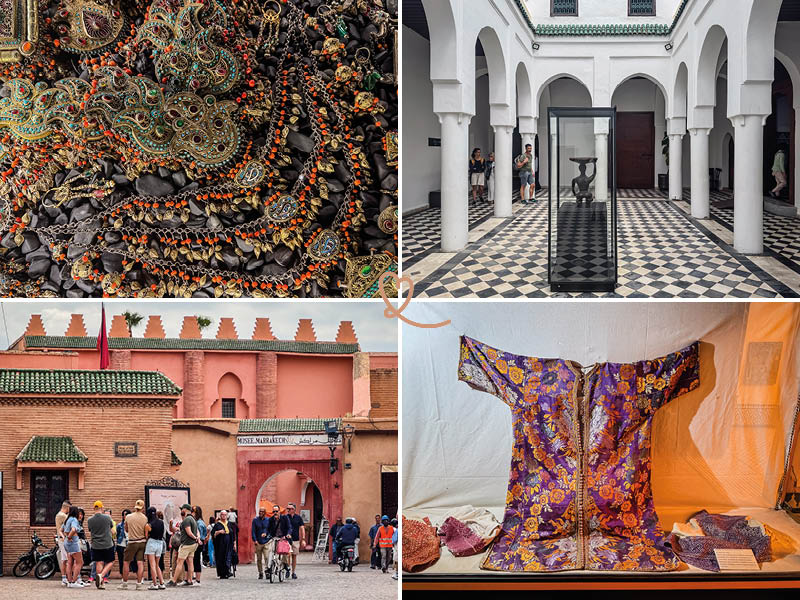
This opinion is completely independent, based on our experiences. We visited the region anonymously, making our own choices and paying our bills in full.
The best museums in Marrakech: tips + map
In Marrakech, you’ll find a wide variety of museums: palaces steeped in history, contemporary museums, spaces dedicated to traditional music, photography or traditions. But there’s much more to do in and around the city: see our article on what to do in Marrakech.
If you only need to do 3, we recommend it:
- Musée des Arts Berbères Pierre Bergé (in the Jardin Majorelle): a collection of Berber art and finery in an exceptional architectural setting – ticket combining the Musée Pierre Bergé + Jardin Majorelle + Musée Yves Saint Laurent
- Musée Yves Saint Laurent: a fashion museum in a remarkable contemporary building a stone’s throw from the Jardin Majorelle – combined ticket for Musée Pierre Bergé + Jardin Majorelle + Musée Yves Saint Laurent
- Palais de la Bahia: a late 19th-century palace with painted cedar ceilings and courtyards decorated with zelliges, a must-see in the Medina – book your guided tour now to save time!
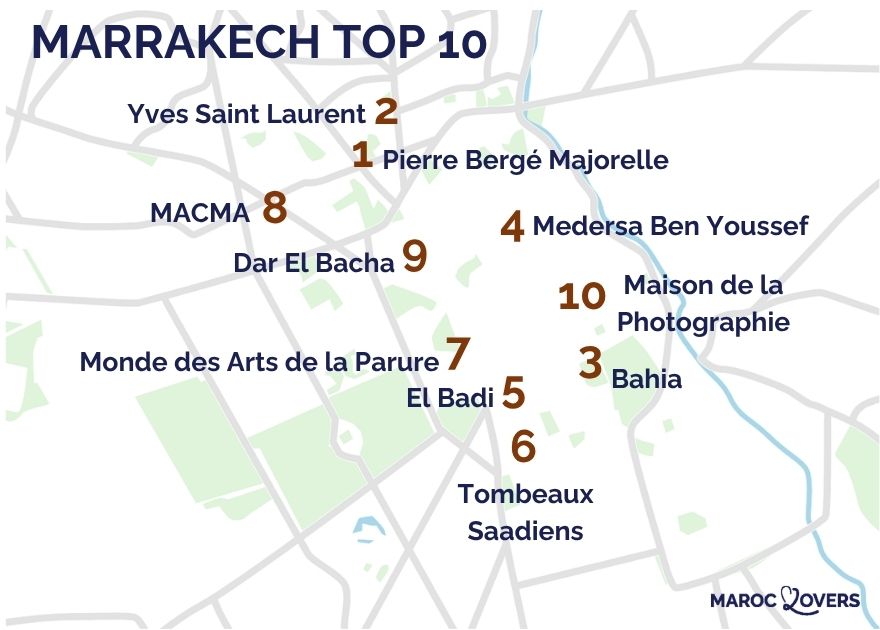
To help you find your way around, here’s a map of the best museums in Marrakech:
WHERE TO STAY IN Marrakech
Our favorites: neighborhoods and hotels
In the Medina
Riad Kbour & Chou – See prices, photos and availability
In the Kasbah, an ancient fortified quarter
Riad Jonan & Spa – See prices, photos and availability
Luxury Hotel
Royal Mansour Hotel – See prices, photos and availability

1. Pierre Bergé Berber Museum

Why visit it? Our review
Nestled in the heart of the Jardin Majorelle, this small museum devoted to Berber arts is one of our favorite spots in Marrakech. The collection, assembled by Pierre Bergé, features hundreds of pieces: chased silver jewelry, hand-woven carpets, embroidered garments, pottery and musical instruments that testify to the richness of the Amazigh cultures of Morocco, the Sahara and the Sahel. We found the scenography particularly meticulous, with lighting that highlights each object. The building itself, painted in Majorelle’s famous cobalt blue, is an architectural showcase. We heartily recommend this museum as an excellent introduction to Berber culture. A superb introduction to a stay in Marrakech!

Our 3 favorite moments
- Berber jewelry and ornaments: an impressive selection of silver, amber and coral pieces, some of which were worn during major tribal ceremonies.
- Carpets and textiles: hand-woven pieces whose geometric patterns reveal the identity codes of the various Amazigh tribes.
- The architectural setting: Majorelle’s cobalt villa, surrounded by the Majorelle garden

Useful tips
- Located in the Jardin Majorelle, Guéliz district, rue Yves Saint Laurent
- Length of visit: 30 minutes for the museum alone, 1h30 combined with the Jardin Majorelle and the Musée Yves Saint Laurent
- Photos of unauthorized collections
- Full adult fare: included in the combined Jardin Majorelle + Musée des Arts Berbères ticket at 230 DH
- Opening hours: daily from 8am to 6pm
- Accessible to people with reduced mobility, no strollers or bulky backpacks allowed
- Visit the official website for more info here.
- Read our article on the subject here.
- Tickets must be booked in advance; tickets cannot be purchased on site!
- Book your combination ticket now!
OUR TIPS FOR RENTING A CAR IN Maroc
- Compare prices on our preferred platform: DiscoverCars – one of the best rated sites.
- Adapt your choice of vehicle to your itinerary!
- For more choice, book early.

Read our tips (coming soon)
2. Yves Saint Laurent Museum

Why visit it? Our review
The Yves Saint Laurent Museum in Marrakech is one of two museums in the world dedicated to the French couturier, alongside the one in Paris. Inaugurated in 2017, it is housed in a beautiful contemporary building designed by Studio KO, whose façade is clad in a concrete mesh reminiscent of Moroccan embroidery patterns. We really appreciated the beauty of the place. The permanent and temporary exhibitions are also very beautiful, if a little small. You’ll discover haute couture dresses, original sketches, photographs and archives illustrating the work of one of the 20th century’s greatest couturiers. The museum boutique is also worth a visit, as is the café.

Our 3 favorite moments
- Haute couture dresses: emblematic pieces displayed in a superb scenography
- Sketches and archives: working documents that reveal the designer’s creative process
- Temporary exhibitions: regularly renewed, they deal with different themes (not always related to Yves Saint Laurent).

Useful tips
- Located on rue Yves Saint Laurent, a stone’s throw from the Jardin Majorelle in the Guéliz district.
- Tour duration: 1h to 1h30
- Photos of haute couture collections not authorized
- Full adult price: 140 DH. Combined tickets with the Jardin Majorelle are available.
- Opening hours: daily except Wednesday, 10am to 6:30pm
- Accessible to people with reduced mobility
- No strollers or bulky backpacks allowed
- Visit the official website for more info here.
- Read our article on the subject here.
- Tickets must be booked in advance; tickets cannot be purchased on site!
- Book your combined ticket now to save time!
3. Bahia Palace

Why visit it? Our review
The Palais de la Bahia is one of Marrakech’s most visited monuments, and for good reason: this late 19th-century palace, built for the Grand Vizier Ba Ahmed, is an exceptional example of traditional Moroccan architecture. Its richly decorated rooms feature painted cedar ceilings, walls covered in colorful zelliges and interior courtyards. Unfortunately, the garden was under construction at the time of our visit. The name “Bahia” means “shining one” in Arabic. We strolled through its vast spaces, admiring the main courtyard paved with Carrara marble and surrounded by galleries with finely sculpted columns. Our advice: opt for a private guided tour with an outside guide, as the site itself does not offer one. The visit is far more enriching than being merely contemplative. It also avoids the sometimes long queues.

Our 3 favorite moments
- The courtyard of honor: a monumental 1500m² space paved with Carrara marble, whose proportions and decoration illustrate the splendor of Moroccan palatial life.
- The private apartments: intimate rooms adorned with delicate moucharabiehs and marble fountains, revealing the refinement of daily life in this palace.
- Painted cedar ceilings: works of craftsmanship of remarkable precision, whose geometric and floral motifs bear witness to the skills of the craftsmen of the time.

Useful tips
- Located on rue Riad Zitoun el Jdid, in the Mellah-Kasbah district
- Tour duration: 1 to 2 hours
- Partially suitable for children; some rooms have steps
- Full adult fare: 100 DH
- Don’t forget to bring cash for admission, even if you opt for a guided tour.
- Opening hours: daily 9am to 5pm
- Visit the official website for more info here.
- Book your guided tour now to save time!
A LITTLE MORE PATIENCE
All the photos, maps, information and addresses you need to make your stay at Maroc a success will soon be available in a single ebook!
Coming soon!
4. Medersa Ben Youssef School

Why visit it? Our review
The Médersa Ben Youssef, founded in the 14th century and rebuilt in the 16th century by the Saadians, is considered one of the most accomplished examples of Moroccan religious architecture. It welcomed up to 900 students from all over the Maghreb to study theology, law and science. We were very impressed by the quality of the architectural details: finely chiselled stucco, elaborate cedar woodwork and a white marble basin reflecting the facades of the central patio. The 130 student cells spread over two floors contrast in austerity with the decorative richness of the common areas. We enjoyed wandering around, immersing ourselves in the students’ studious past. To get the most out of your visit, we recommend hiring a private guide or opting for the audioguide. Don’t forget to bring cash if you choose a guide who pays the entrance fee for you, so you don’t have to queue!

Our 3 favorite moments
- The central patio: a white marble basin framed by sculpted arcades, whose symmetry and decoration are among the finest examples of Almohad and Saadian art.
- The cedar woodwork: extraordinarily precise carved panels, some of whose geometric and calligraphic motifs required years of work.
- Student cells: small, uncluttered rooms that remind us that this was first and foremost a living and learning space for hundreds of young students from all over the Maghreb.

Useful tips
- Located on rue Assouel in the Medina
- Visit duration: 45min to 1h
- Accessible to children; a guided tour or audioguide is highly recommended to bring the visit to life.
- Full adult fare: 50 DH
- Opening hours: daily 9am-7pm (closes at 6pm during Ramadan). Audioguide available in several languages.
- Stairs to upper floors; limited access for the mobility-impaired
- Visit the official website for more info here.
- Book your guided tour now!

5. El Badi Palace

Why visit it? Our review
The Palais El Badi, built in the 16th century by the Saadian sultan Ahmed al-Mansour, was nicknamed “l’Incomparable” for its legendary magnificence. It comprised 360 rooms adorned with Italian marble, onyx and porphyry columns. Stripped of its riches by the Alawite sultan Moulay Ismaïl in the 17th century, the site nonetheless impressed us with its colossal dimensions and monumental basins. The underground Koutoubia minbar, a masterpiece of 12th-century woodwork, is well worth a visit. As with the Palais de la Bahia, a private guided tour will greatly enhance your understanding of the site, as the site itself does not offer one. It also means you don’t have to queue! You’ll need to bring some cash for the entrance fee if the guide takes it.

Our 3 favorite moments
- The Koutoubia minbar: preserved underground, this 12th-century masterpiece of woodwork is one of the most precious objects in Morocco’s heritage.
- The view from the central courtyard: a panoramic view of the palace, the pool, the orange tree gardens, an emblematic view of Marrakech.
- An exhibition dedicated to archaeological discoveries

Useful tips
- Place des Ferblantiers, Mellah-Kasbah district
- Tour duration: 1 to 2 hours
- Uneven terrain; difficult access for people with reduced mobility and baby carriages
- Full adult fare: from 100 DH
- Opening hours: daily 9am to 5pm
- Visit the official website for more info here.
6. Saadian tombs

Why visit it? Our review
The Saadian Tombs, rediscovered in 1917 after being walled up for centuries, are one of the jewels of Moroccan funerary architecture. These 16th-century mausoleums house some sixty members of the Saadian dynasty, including Sultan Ahmed al-Mansour. We were particularly impressed by the Hall of the Twelve Columns, a true architectural masterpiece. After waiting in line, we were able to admire the carved cedar dome supported by Carrara marble columns, the chiselled stuccoes and the gilded kufic inscriptions. The flower-filled garden, where other tombs are scattered, offers a welcome counterpoint to the opulence of the interior halls. A private guided tour is highly recommended here, as queues can be very long. If you come without a guide, we strongly recommend that you arrive at the opening or 30min before closing time to avoid waiting in line.

Our 3 favorite moments
- The Hall of the Twelve Columns: the centerpiece of the tombs, whose carved cedar dome and white marble columns make up one of Marrakech’s most beautiful interiors.
- The Dome of Princess Lalla Massouada: another funerary space in honor of a princess
- Stucco and zellige: stunningly precise geometric decorations, enhanced by gilded kufic inscriptions all along the walls.
Useful tips
- Located on rue de la Kasbah, near the Moulay El Yazid mosque, in the Kasbah district.
- Visit duration: 30min to 45min
- Full adult fare: 100 DH
- Opening hours: daily 9am to 5pm
- Visit the official website for more info here.
- Book your guided tour now to save time!
7. World Museum of Decorative Arts

Why visit it? Our review
The Musée du Monde des Arts de la Parure is a singular address in Marrakech’s museum landscape. Dedicated to traditional finery from around the world, it brings together jewelry, headdresses, body ornaments and accessories from a wide variety of cultures, with Moroccan and African traditions at the heart of the collection. We found the museum’s approach particularly interesting: by bringing together pieces from several continents, it invites us to rethink the universal relationship that human societies have with finery. You’ll be amazed by the richness of the collections and the diversity of materials used: silver, coral, amber, bone, feathers and semi-precious stones all come together in the same space. Finally, we were won over by the architecture of the building and its rooftop restaurant, Shams, one of the best in the city.

Our 3 favorite moments
- Berber and Saharan jewelry: solid silver, amber and coral jewelry whose shapes and symbols carry precise identity codes according to tribe and region.
- The African and Asian collections: pieces from very different cultures that demonstrate the diversity of adornment practices throughout the world.
- Dialogue between the collections: a scenography that compares objects from different cultures around common themes, offering a stimulating, cross-disciplinary reading.

Useful tips
- Located in the Kasbah district
- Tour duration: approx. 1 hour
- Museum fully accessible for wheelchair users (entrance via store), lift available
- Adult fare: 100DH
- Open daily from 10 a.m. to 5 p.m. except Mondays
- Visit the official website for more info here.
8. MACMA (Al Maaden Museum of Contemporary African Art)

Why visit it? Our review
The MACMA is dedicated to contemporary African art and traditional crafts. Housed in the modern Al Maaden complex in the Guéliz district, it offers a different perspective from that of the historic museums in the Medina. We found the venue very appealing and the collections varied. Paintings, sculptures, photographs, video works, ceramics, woodwork and more. It’s an address that’s willingly off the beaten track of classic cultural tourism in Marrakech. For art lovers, the visit provides a welcome counterpoint to the city’s history museums.

Our 3 favorite moments
- The diversity of works: a wide range of media, contemporary and traditional art
- Temporary exhibitions: regularly renewed, they feature contemporary artists
- The setting: a well-designed, brightly-coloured contemporary building, a small, friendly café and an unusual collection of motorcycles.
Useful tips
- Located in the Al Maaden complex, Guéliz district
- Duration of the visit: 1 hour
- Adult fare: 150DH
- Open every day from 10 a.m. to 7 p.m.
- Visit the official website for more info here.
Subscribe to our Newsletter
- Get away from it all with Region Lovers’ beautiful destinations!
- Once a month
- Advertising-free

9. Musée des Confluences Dar El Bacha

Why visit it? Our review
The Musée des Confluences Dar El Bacha is one of our favorite museums in Marrakech, as much for the beauty of its setting as for the quality of its collections. Housed in an early-20th-century palace that once belonged to the pasha Thami El Glaoui, the building’s magnificently restored Almohad architecture surrounds a vast columned patio. Admire the zelliges, chiselled stucco, cedar woodwork and marble fountains. We were also impressed by the interior garden and the famous Café Dar El Bacha, where you can linger over mint tea and Moroccan pastries after your visit. The permanent and temporary collections combine antique objects and contemporary art in a carefully designed scenography. A beautiful museum, not to be missed.

Our 3 favorite moments
- The central patio: a monumental space surrounded by columned galleries, whose architecture illustrates the refinement of Moroccan palatial art in the early 20th century.
- The permanent collections: ancient objects and contemporary works that bring together the great artistic traditions of the Islamic world.
- Café Dar El Bacha: an unmissable stopover after your visit, in an unspoilt setting serving tea, coffee and quality Moroccan pastries.

Useful tips
- Address: 65-69 Riad Laârous, route Dar El Bacha, Médina
- Duration of the visit: 1 hour
- Full adult fare: 60DH
- Entrance fee to café without museum visit: 10DH
- Opening hours: Tuesday to Sunday, 10am to 6pm, closed on Mondays. Phone number: +212 (0) 5 24 38 17 63
- Visit the official website for more info here.
- Guided tours combining a visit to the medina and the Medersa Ben Youssef are available.
10. House of Photography

Why visit it? Our review
The Maison de la Photographie is a modest but high-quality museum housed in a riad in the Medina. We appreciated the richness of its collections of old photographs of Morocco, covering a period from the 19th to the mid-20th century. Prints on albumen paper, glass plates, autochromes: the techniques follow one another through the rooms, offering a fascinating visual panorama of pre-independence Morocco. You’ll see portraits of Berbers, landscapes of the Atlas mountains, scenes of life in the medinas and views of Marrakech at a time when the city bore little resemblance to today. The rooftop café, accessible from the riad’s upper floors, also offers a pleasant view over the Medina rooftops.

Our 3 favorite moments
- Old glass prints: remarkably sharp 19th-century photographic plates, showing Morocco in rarely documented moments of daily life.
- Berber portraits: a selection of ethnographic photographs showing the diversity of Amazigh cultures in Morocco at the turn of the 20th century.
- The rooftop-café: a terrace on the roofs of the Medina where you can extend your visit with a cup of tea overlooking the minarets.
Useful tips
- Located in the Medina, near the Medersa Ben Youssef
- Tour duration: approx. 1 hour
- Adult price: 60DH (the ticket also gives access to the Music Museum)
- Opening hours: daily from 9:30 am to 7 pm
- Visit the official website for more info here.
11. Music Museum

Why visit it? Our review
The Musée de la Musique is one of those almost-secret places we’re delighted to have discovered. Housed in an old riad in the Medina, it boasts a rich and well-documented collection of traditional Moroccan musical instruments. Here we discovered the diversity of Moroccan musical traditions: Gnaoua, Andalucia, Berber, Judeo-Moroccan. Each instrument is accompanied by clear labels that place the practice in its cultural and geographical context. Twice a week, the museum organizes evening concerts in a nearby riad: an experience we warmly recommend if you’re visiting during the week. The rooftop café is also a pleasant place to linger after a visit.

Our 3 favorite moments
- The collection of Gnaoua instruments: metal crotales, guembri and ritual costumes document one of Morocco’s most vibrant musical traditions.
- Instruments of Andalucia music: a selection of string and wind instruments that illustrate the musical heritage of Andalucia in Moroccan culture.
- Evening concerts: held twice a week in a nearby riad, they offer a lively, intimate musical experience that’s the perfect extension of your visit.

Useful tips
- Located in the Medina of Marrakech
- Tour duration: approx. 1 hour
- Full price: 60DH
- Musical evening: 120DH
- Open every day from 10 a.m. to 7 p.m.
- Concerts twice a week in the evening in a nearby riad; ask locally for dates and times.
- Visit the official website for more info here.
12. Jemaa El Fna Intangible Heritage Museum

Why visit it? Our review
Located on the Place Jemaa el-Fna, this museum immerses visitors in the intangible heritage of Morocco’s most famous square, a UNESCO World Heritage site. We were pleasantly surprised by the quality of the scenography, which blends contemporary art, objects linked to oral traditions and interactive digital devices. A digital games room on the museum’s themes makes it one of the most child-friendly addresses in Marrakech. There are also some superb paintings by Majorelle. You’ll leave with a much clearer understanding of what goes on in the square every evening.

Our 3 favorite moments
- Majorelle’s canvases: unexpected works in this context, adding an artistic dimension to the visit
- The digital games room: an interactive space where children can immerse themselves in the museum’s themes in a playful way.
- Objects related to oral heritage: storytellers, Gnaoua musicians, snake handlers: the living traditions of Jemaa el-Fna Square are documented in a precise and lively manner.

Useful tips
- Address: rue Ibn Marine, Place Jamaâ el-Fna, Marrakech
- Tour duration: 1h to 1h30
- Child-friendly thanks to digital playroom
- PRM-accessible museum
- Full adult fare: 40 DH for foreigners, 20 DH for Moroccan adults and residents, 10 DH for under-18s and students.
- Opening hours: Tuesday to Sunday, 10am to 6pm, closed on Mondays.
- Visit the official website for more info here.
13. Almoravides dome

Why visit it? Our review
The Almoravid Dome is one of Marrakech’s oldest architectural remains, dating back to the 12th century. This small, carved stone pavilion is very beautiful, with its arabesques, interlacing and kufic inscriptions carved with a precision that prefigures later developments in Almohad and Merinid art. Let’s be frank: today, the site is dilapidated and the interior offers little to see. We believe that the most important things can be seen from the outside, without the need to pay admission. On the other hand, if the visit is part of a guided tour that includes several Medina sites, then it takes on its full meaning. A competent guide will be able to place this building in the history of Moroccan architecture and reveal its full significance. Ideally combined with the nearby Musée de Marrakech.

Our 3 favorite moments
- The exterior decoration of the dome: arabesques and geometric interlacing carved into the stone in the 12th century, a rare example of Almoravid art in Marrakech.
- The site’s heritage value: one of the few remaining Almoravid buildings in Marrakech, giving it considerable historical importance.
- Combine with the Marrakech Museum: the two sites are ideal for a half-day visit to the Medina.

Useful tips
- Located in the Medina, close to the Marrakech Museum and the Ben Youssef Medersa.
- Visiting time: 15min to 20min; the main part can be seen from the outside
- Adult fare: 100DH
- Opening hours: daily 8.30am-6pm, closed Saturday and Sunday
- Of particular interest to architecture and history buffs; not suitable for young children.
- Visit the official website for more info here.
14. Marrakech Museum

Why visit it? Our review
The Musée de Marrakech occupies the former Palais Mnebhi, a palatial residence dating from the late 19th century, whose central patio is without doubt the highlight of the visit. Under an impressive wrought copper lantern, this open-air space offers a striking architectural setting. We have to be honest: the general state of the museum today is rather dilapidated. Lighting is inadequate in several rooms, labels are missing or incomplete, and maintenance leaves something to be desired in places. That said, the collections remain interesting and varied, covering Moroccan craftsmanship and the decorative arts. You can also combine your visit with that of the nearby Coupole des Almoravides or the Medersa Ben Youssef, just a few steps away.

Our 3 favorite moments
- The central patio: a majestic space dominated by a large copper lantern, which forms the architectural heart of the palace.
- Handicrafts collections: despite the museum’s generally poor condition, some pieces in chased metal, carved wood and ceramics are worthy of special attention.
- The proximity of the Médersa Ben Youssef: the two sites are ideal for visiting together

Useful tips
- Located in the Medina, near the Medersa Ben Youssef
- Visit duration: 45min to 1h
- Adult fare: 50DH
- Opening hours: daily from 9:30 am to 6 pm
15. Museum of Moroccan Elegance

Why visit it? Our review
The Musée de l’Élégance Marocaine is an original address in the city’s cultural landscape. Dedicated to traditional Moroccan clothing and accessories through the ages, it provides a lively, accessible gateway to the history of fashion and costume in Morocco. We found it particularly well-suited to families: the collection of dolls dressed in traditional regional outfits is both educational and visually appealing for younger children. Adults, meanwhile, will find interesting documentation on the evolution of dress codes according to region and occasion. It’s a colorful and entertaining visit.

Our 3 favorite moments
- The doll collection: figurines dressed in traditional regional costumes, particularly popular with children and useful for visualizing the diversity of Moroccan costumes.
- Regional documentation: a perspective on dress codes in Morocco’s cities and regions, revealing the country’s cultural diversity.
- The riad that houses the museum: rooms with carved woodwork and zellige floors, a café and rooftop store.

Useful tips
- Located in the Medina of Marrakech
- Tour duration: 30min to 1h
- Adult fare: 50DH
- Opening hours: daily from 9:30 am to 6:30 pm
- Child-friendly with a collection of dolls in regional costumes
- Visit the official website for more info here.

It’s time to book!
Compare everything: companies, prices, schedules and availability.
Other museums in Marrakech
We’d also like to mention some of Marrakech’s other, lesser-known museums, which are well worth a visit depending on your interests:
- Musée de l’Art Culinaire: a small exhibition in a beautiful setting, which we especially appreciated for its tea room, rooftop restaurant, boutique and cooking classes.
- Musée du Parfum: a space dedicated to the history of oriental scents and Moroccan perfumery, for lovers of the genre.
- Dar Si Saïd Museum: housed in a former palace, it showcases collections of Moroccan handicrafts. Open Tuesday to Sunday, 10am to 6pm. Adult price: 30 DH. Find out more here.
- Musée de la Palmeraie Benchaabane Foundation: a space dedicated to botany and art, located in Marrakech’s palm grove. Find out more here.
- Musée Mohammed VI pour la Civilisation de l’Eau au Morocco (Aman): an original museum focusing on the history and techniques of water management in Morocco over the centuries. Find out more here.

Frequently asked questions
Do I need to book museum tickets in advance in Marrakech?
For the Jardin Majorelle, the Musée Yves Saint Laurent and the Musée des Arts Berbères Pierre Bergé, online booking is compulsory– you can’t buy tickets on the spot! For busy sites such as the Saadian Tombs or the Palais de la Bahia, we recommend that you take a private guided tour with a queue cutter: guides generally have passes that act as queue cutters, avoiding sometimes long waits.
Which museums in Marrakech are suitable for children?
The Musée du Patrimoine Immatériel Jemaa El Fna is the most child-friendly address, thanks to its digital games room: quizzes and puzzles on the exhibition. The Musée de l’Élégance Marocaine, with its popular collection of dolls in regional costumes, is also suitable for families. The Musée Yves Saint Laurent also occasionally organizes activities for children in its auditorium (but strollers are not allowed). Find out more here.

Which museums are accessible to people with reduced mobility?
The Musée Berbère Pierre Bergé, the Musée Yves Saint Laurent and the Jardin Majorelle are accessible to people with reduced mobility. The Musée du Monde des Arts de la Parure and the Musée du Patrimoine Immatériel Jamaa El Fna are also accessible. The main parts of the Musée des Confluences Dar El Bacha are also accessible. On the other hand, many of the Medina’s historic sites present major constraints: cobbled streets, staircases and narrow passageways. These include the Saadian Tombs, the Palais El Badi and the Médersa Ben Youssef.

PLAN YOUR TRIP TO Morocco
- Best of
Must-See Places in Morocco
Most Beautiful Riads
Most Beautiful Cities
Most Beautiful Medinas
Morocco’s Most Beautiful Landscapes
Most Beautiful Gardens
Best Museums
Morocco’s Most Beautiful Beaches

- Practical advice
When to go?
How to rent a car in Morocco
Driving tips
Where to Stay in Morocco

- The must-dos
Marrakech
Casablanca
Fez
Meknes
Chefchaouen
Essaouira
Rabat
Tangier
Tetouan
Agadir
The Sahara Desert

