
Marrakech, the pearl of southern Morocco, invites you to discover its lively souks, sumptuous palaces, lush gardens and enchanting atmosphere. Between tradition and modernity, the red city offers a unique experience combining culture, gastronomy and relaxation.
In this article, we’ve put together an itinerary for a week in Marrakech, combining the must-sees of the medina, excursions to the Atlas Mountains, and suggestions for making the most of the Marrakesh atmosphere. Our itineraries will guide you through Marrakech. Optimize your stay and make up your own mind about this destination with our practical tips and plenty of photos!
This opinion is completely independent, based on our experiences. We visited the region anonymously, making our own choices and paying our bills in full.
Practical tips for a 7-day visit to Marrakech
What can you see in Marrakech in a week? Is it long enough?
A week in Marrakech lets you discover the treasures of the medina while exploring the surrounding area. You can stroll through the colorful souks, visit historic monuments such as the Koutoubia and the Saadian Tombs, relax in the Majorelle gardens, and even organize excursions to the Atlas Mountains or the desert. This time also gives you the chance to live at a more leisurely pace, enjoying authentic riads and immersing yourself in the local culture without rushing. We appreciated this length of time, which allowed us to alternate cultural visits with moments of relaxation.
Read our article on the best attractions in Marrakech.

Getting around Marrakech
Small red cabs are the most practical way of getting around Marrakech. Insist on the use of the meter or negotiate the price before departure. Traditional horse-drawn carriages offer a romantic alternative for tourist trips. In the Medina, walking is a must, as many alleyways are inaccessible to vehicles. City buses serve the outlying districts, but remain inconvenient for visitors. For excursions, large cabs or organized tours make it easy to get around.

Where to sleep in Marrakech
Marrakech offers a wide choice of accommodation, from traditional riads nestling in the medina to modern hotels in the Guéliz district. We particularly appreciated the experience of riads, typical Moroccan houses organized around a central patio, offering calm and authenticity in the heart of the bustling medina. For those seeking more contemporary comfort and convenience, the Hivernage and Guéliz districts offer establishments with swimming pools and restaurants. If you want to be close to Jemaa el-Fna Square, choose accommodation in the medina, even if it means carrying your luggage through the narrow streets. Whatever your preference, booking in advance is always advisable, especially during busy periods.

WHERE TO STAY IN Marrakech
Our favorites: neighborhoods and hotels
In the Medina
Riad Kbour & Chou – See prices, photos and availability
In the Kasbah, an ancient fortified quarter
Riad Jonan & Spa – See prices, photos and availability
Luxury Hotel
Royal Mansour Hotel – See prices, photos and availability

Our ideal itinerary: a week in Marrakech
Day 1 – Discover Marrakech
A stroll through the Medina
Marrakech’s Medina, a UNESCO World Heritage site, is the historic heart of the city. We wandered through its narrow streets lined with traditional riads and colorful boutiques, where Arabo-Andalusian architecture reveals all its splendor. The ochre walls are home to architectural treasures such as carved fountains, finely crafted cedar wood doors and courtyards adorned with zellij. You’ll be transported to a world where craftsmen perpetuate age-old skills, from tanners to coppersmiths, to weavers who create magnificent fabrics on their traditional looms.

Visit to the Marrakech Museum
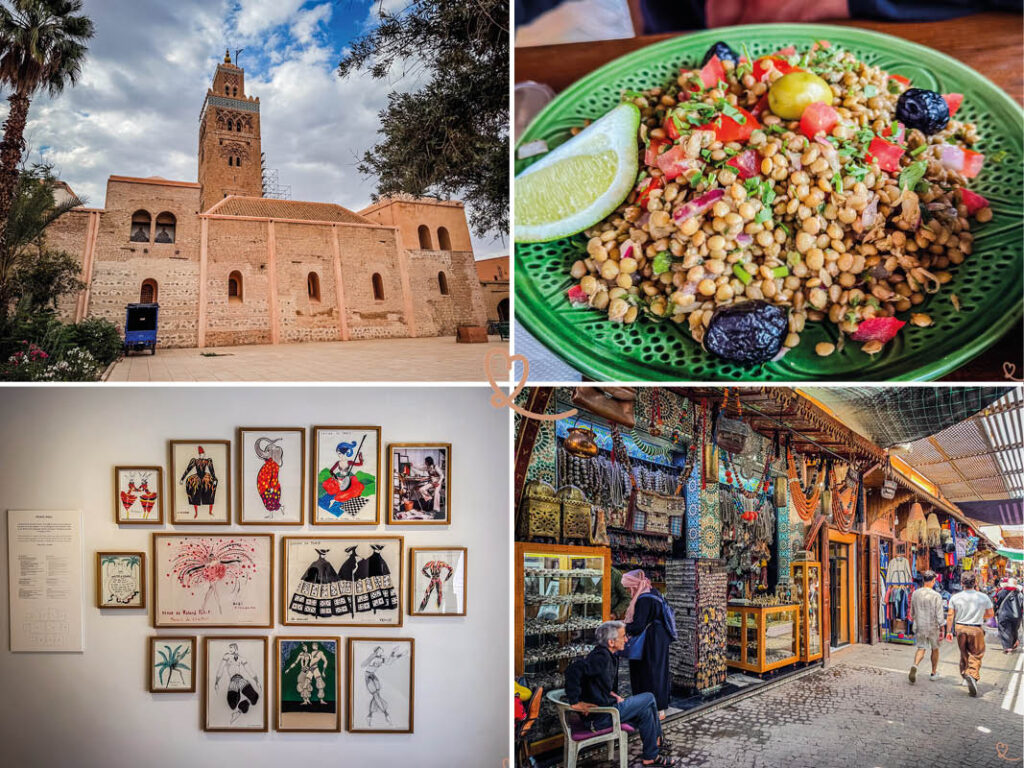
The Musée de Marrakech, housed in the sumptuous 19th-century Palais Mnebhi, is well worth a visit for both its architecture and its collections. We loved its rich collection of traditional Moroccan art, including ceramics, textiles, Berber jewelry, Koranic manuscripts and ancient weapons. You’ll also discover temporary exhibitions of contemporary Moroccan and international art, reflecting the dialogue between tradition and modernity. The rooms, adorned with zellige, carved woodwork and chiselled stucco, are a magnificent showcase for the works on display. We recommend taking the time to observe the architectural details of the palace itself, a true masterpiece of Moroccan craftsmanship. The tour lasts around 1 hour and is an ideal cultural complement to understanding the history and artistic traditions of Marrakech. Ideal at the beginning of your stay!

Take a break for lunch or a snack at Café Clock
Housed in a traditional medina house, this establishment offers a fusion of Moroccan specialties and international influences. We particularly appreciated the friendly atmosphere of the place, with its light-filled inner courtyard and terraces overlooking the rooftops of the medina. The menu features classics like the camel burger, which has become the restaurant’s signature specialty, as well as revisited tagines, fresh salads and excellent homemade desserts. In addition to food and drink, Café Clock regularly organizes cultural events: Gnaoua music concerts, calligraphy workshops, Moroccan cooking classes and film screenings. You can also take advantage of their library and wifi connection.

Dinner on Jemaa El-Fna Square
Place Jemaa El-Fna, a veritable open-air theater, has embodied the soul of Marrakech since the 11th century. We were captivated by this mythical square, which transforms itself throughout the day: in the morning, it welcomes orange juice vendors and snake tamers, while in the evening, it becomes a huge open-air food court with stalls serving local cuisine. Traditional storytellers perpetuate the age-old art of the halqa, a circle of spectators around the narrator, while Gnaoua musicians sound their metal crotales. You can sample local specialities at the numbered stalls, while admiring the acrobats and snake charmers who enliven this unique site, listed as part of humanity’s oral and intangible heritage.

OUR TIPS FOR RENTING A CAR IN MOROCCO
- Compare prices on our preferred platform: DiscoverCars – one of the best rated sites.
- Not too wide
- A good engine
- For more choice, book early.

Day 2 – Diving into the heart of Marrakech
Strolling through the Menara Gardens
The Menara Gardens, nestled against the Atlas Mountains, were created in the 12th century by the Almohads. They offer a green escape to the west of Marrakech. We enjoyed the peace and quiet of this 100-hectare olive grove. We also discovered its ingenious system of khettaras: an irrigation system made up of underground canals carrying water from the Atlas Mountains. The 12th-century Saadian pavilion is reflected in the vast rectangular pool, creating one of Marrakech’s most emblematic images, with the snow-capped mountains in the background. You can stroll under the centuries-old olive trees where Marrakchis come to picnic with their families, especially at sunset when the golden light illuminates the pavilion. The gardens were once a place of pleasure for the sultans, who came to refresh themselves and contemplate the exceptional panorama of the Atlas Mountains.

Discover the Koutoubia Mosque
The Koutoubia Mosque, just a few minutes’ walk from the Menara Gardens, is a jewel of 12th-century Almohad architecture. Its 69-m-high minaret dominates Marrakech. Did you know? It’s the city’s largest mosque! We admired this architectural masterpiece whose name means “booksellers’ mosque”, in reference to the manuscript souk that once surrounded it. The minaret, decorated with green earthenware and geometric motifs, served as a model for the Giralda in Sevilla and the Hassan Tower in Rabat. You can contemplate the gardens surrounding the mosque, planted with orange and palm trees, offering a haven of peace just a stone’s throw from the hustle and bustle of Jemaa el-Fna Square. The call to prayer that resounds five times a day from this emblematic minaret sets the pace for life in the Ochre city.

Recharge your batteries at the Naranj restaurant
Housed in a traditional riad with a clean, elegant decor, this establishment stands out for its high-quality Lebanese and Mediterranean cuisine, offering a refreshing alternative to Moroccan dishes. We particularly appreciated the freshness of the mezzés served in abundance: creamy hummus, fragrant tabbouleh, unctuous moutabal and stuffed vine leaves. The shady courtyard, with its orange and lemon trees, creates a relaxing atmosphere in which to linger. The menu also offers tasty grills, generous salads and delicate oriental desserts accompanied by mint tea or Turkish coffee. Take advantage of the upstairs terrace for unobstructed views of the surrounding area. Reservations are recommended, especially at weekends, as the address is popular with travelers and Marrakech residents alike.
Shopping in the souks of Marrakech
The souks of Marrakech form a fascinating labyrinth where each artisan guild has occupied its own quarter for centuries. We explored these traditional markets organized by trade: the dyers’ souk, where skeins of wool dry in the sun, the babouches souk, with its thousands of colorful shoes, and the spices souk, with its heady scents of saffron and ras el-hanout. Here, craftsmen perpetuate ancestral techniques, from copper hammering to natural leather dyeing. You can haggle over hand-woven Berber carpets, wrought-iron lanterns, Fez pottery or chased silver jewelry. The art of negotiation is an integral part of the experience, turning every purchase into an authentic cultural exchange.

Fine dining at Restaurant Le Bistro Arabe
Nestled in a magnificently restored riad, this restaurant offers an intimate atmosphere with its salons decorated with Berber carpets, wrought-iron lanterns and a courtyard adorned with fountains. We were won over by the menu, which offers refined Moroccan cuisine that revisits the classics with creativity and elegance. Tagines are prepared with fresh produce and carefully balanced spices, while pastillas reveal delicate, balanced flavors. You can choose to dine in one of the cosy lounges or on the terrace to enjoy the warmth of the Marrakchi evenings. We recommend booking in advance, especially for terrace dining. However, we would like to draw your attention to the prices; this establishment is quite refined and offers prices commensurate with the service provided.

A LITTLE MORE PATIENCE
All the photos, maps, information and addresses you need to make your stay at Maroc a success will soon be available in a single ebook!
Coming soon!
Day 3 – Discover one of Morocco’s most beautiful gardens
Visit to the Jardin Majorelle and the Yves Saint-Laurent and Pierre Bergé Museums (Berber Arts)
The Jardin Majorelle, created by painter Jacques Majorelle in the 1920s, offers an oasis of freshness in the heart of the Guéliz district. We were captivated by the intense cobalt blue that adorns the buildings, now known worldwide as “Majorelle blue”, and by the exceptional collection of cacti and exotic plants. The garden is home to over 300 plant species from 5 continents, including giant bamboos, palms and bougainvillea.

You’ll also discover the Musée des Arts Berbères Pierre Bergé, with its remarkable collection of traditional objects, and the nearby Musée Yves Saint Laurent, dedicated to the famous couturier who saved this garden from destruction in 1980. We were won over by this institution, which celebrates the work of the French couturier with elegance and modernity. The architecture of the building itself is a work of art, while the permanent and temporary collections offer a fascinating journey into theworld of haute couture. In our opinion, this is one of the best things to do in Marrakech.

Discover the Guéliz district
After your visit to the museums and the Garden, take the opportunity to discover the neighborhood in which they are nestled. Guéliz is Marrakech’s modern district, built during the French protectorate. With its wide avenues, international boutiques and trendy cafés, it offers a striking contrast to the traditional Medina.

Gourmet break at Restaurant Sahbi Sahbi
This establishment offers generous, tasty traditional Moroccan cuisine at very affordable prices. We were won over by the authenticity of the dishes served in a simple, friendly setting, far removed from the touristy restaurants of the medina. The menu offers a wide choice of tajines simmered to perfection, traditional couscous on Fridays, fragrant grilled meats and fresh Moroccan salads. This address is a welcome break from the daily grind of Moroccan cuisine, in an authentic, unpretentious atmosphere.

Late afternoon – Departure for the Agafay Desert
The Agafay Desert, just 30km from Marrakech, offers a desert experience without having to travel hundreds of kilometers to the Sahara. We were amazed by this stony desert with its lunar landscapes, punctuated by rocky hills and arid plateaus offering spectacular panoramas of the Atlas Mountains. The changing colors of the landscape, from beige to red ochre depending on the light, create a mystical atmosphere conducive to contemplation. You’ll experience bivouacking under the stars in luxurious Berber camps, dining in caïdal tents and savoring a traditional méchoui accompanied by Gnaoua music.
- Book now your night under the stars in the Agafay desert with traditional meal and show (without camel ride)

- Important: There are many camel rides on offer. We therefore recommend that you be vigilant and consider what your visit to the Agafay Desert represents. It’s important to consider the impacts of wildlife tourism, and to ensure that such a visit is in line with your values. For this reason, we have decided not to include any links to this type of activity on our site.
A LITTLE MORE PATIENCE
All the photos, maps, information and addresses you need to make your stay at Maroc a success will soon be available in a single ebook!
Coming soon!
Day 4 – Return from the desert and an afternoon of culture or relaxation
Morning – Return from your desert excursion
After your wonderful night in the desert, you’ll be back in Marrakech in the morning. For the rest of the day, we offer a program that can be adapted to suit your mood and energy. You could go and relax in a traditional hammam and/or visit a palace and/or museum, the choice is yours:
Option 1 – Take the time to be pampered in a traditional spa
Pampering yourself in a hammam is an age-old Moroccan ritual of well-being. We tested several establishments, from popular hammams frequented by locals to luxurious riad spas. The traditional ritual comprises several stages: passage through progressively heated rooms, scrubbing with black soap and kessa glove, then rinsing with lukewarm water. You’ll appreciate the argan oil massage that usually concludes the session, leaving the skin soft and revitalized. Historic hammams like the one in Quartier Mouassine retain their traditional architecture, with vaulted ceilings pierced by oculi allowing light to filter through.
Don’t wait to book a special time at one of Marrakech’s many traditional spas and hammams!

Option 2 – Visit to the Dar Said Museum
The Dar Si Said Museum is often less crowded than other tourist attractions, but it’s a great place to discover Moroccan craftsmanship in all its splendor. Housed in a 19th-century palace that once belonged to the brother of the Grand Vizier Ba Ahmed, the building itself is well worth a visit, with its wood-panelled rooms, painted ceilings and peaceful courtyards. We were impressed by the richness of the collections showcasing the popular arts and traditions of southern Morocco: Berber carpets with colorful geometric patterns, chased silver jewelry, decorated ancient weapons, traditional pottery and cedar wood doors carved with remarkable finesse. The tranquil atmosphere makes for a contemplative visit, far from the hustle and bustle of the nearby souks. The tour lasts around 1 hour and can be perfectly combined with a visit to the nearby Bahia Palace.
Option 3 – Visit to the Bahia Palace
The Bahia Palace, built at the end of the 19th century for the Grand Vizier Ba Ahmed, bears witness to the splendor of traditional Moroccan architecture. We wandered through its richly decorated rooms, admiring the painted cedar wood ceilings, walls adorned with colorful zelliges and courtyards planted with orange trees. The name “Bahia” means “shining one” in Arabic, in homage to the vizier’s favorite wife. You’ll marvel at the 1,500m² main courtyard, paved with Carrara marble and surrounded by galleries with finely sculpted columns. The private apartments reveal the refinement of palatial life, with their delicate moucharabiehs and fountains murmuring in every patio.

Recharge your batteries with dinner at Restaurant La Famille
Nestled in a traditional riad transformed into a lush garden, this establishment stands out for its vegetarian approach and creative dishes made from fresh, local produce. We particularly appreciated the soothing, bohemian atmosphere of the place, with its inner courtyard overgrown with vegetation. The menu changes regularly according to the seasons and market arrivals, offering inventive salads, creamy soups, tasty quiches and vegetarian dishes with Mediterranean and Oriental influences. You can also take advantage of the upstairs terrace with views over the medina rooftops.

Day 5 – Discovering the Marrakech region
Option 1 – Wonder in the Atlas Mountains

The Atlas Mountains, a majestic range peaking at over 4,000m, offer a refreshing escape just 1 hour’s drive from Marrakech. We took the winding roads through Berber villages clinging to the mountainsides, where the traditional way of life has endured for centuries. The Ourika valley, dotted with waterfalls and terraced gardens, reveals lush vegetation contrasting with the aridity of the plain. You’ll discover colorful weekly markets where Berber women sell saffron and hand-woven carpets, as well as argan oil cooperatives. Hikes lead to breathtaking panoramas of snow-capped peaks, including Toubkal, North Africa’s highest peak. The villages of Imlil and Asni serve as bases for trekking tours suitable for all levels, enabling you to meet the Amazigh people in their unspoilt environment.

- Allow at least 1 hour’s drive from Marrakech
- Important: There are many camel rides on offer. We therefore recommend that you be vigilant and consider what your visit to the Agafay Desert represents. It’s important to consider the impacts of wildlife tourism, and to ensure that such a visit is in line with your values. For this reason, we have decided not to include any links to this type of activity on our site.
Option 2 – Explore the verdant Imlil Valley
The Imlil Valley, nestled at the foot of Mount Toubkal, offers a haven of coolness at 1740m altitude. We followed the mule trails through Berber villages with their stone and adobe houses. The terraced fields bear witness to the ingenuity of the local population in cultivating walnut, apple and vegetable trees on the steep slopes. You can hike to the Irhoulidene waterfalls or simply enjoy a mint tea in front of the mountain panorama. Local guides are happy to share their knowledge of alpine flora and fauna, as well as the Amazigh traditions preserved in this remote valley.
Plan your getaway in the Moroccan mountains!

Option 3 – Escape to the picturesque fishing port of Essaouira
Essaouira, the ancient Mogador, is a 2h30 drive from Marrakech on the Atlantic coast. We strolled through this white and blue medina, a World Heritage site, lulled by the constant trade winds. The 18th-century ramparts, designed by French architect Théodore Cornut, offer ocean-view promenades. Enjoy grilled fish and seafood right in the harbor, where colorful trawlers return every morning. A haven for artists and musicians, the town hosts the Gnaoua Festival, which transforms its squares into giant musical stages. The immense beaches are ideal for water sports, especially kitesurfing, which is popular because of the steady winds.
Choose a day trip to Essaouira, with pick-up and drop-off in Marrakech


Day 6 – A quiet, cultural day
Explore El Badi Palace

The Palais El Badi, built in the 16th century by the Saadian sultan Ahmed al-Mansour, was nicknamed “l’Incomparable” for its legendary magnificence. We strolled through the imposing ruins of this palace, which boasted 360 rooms adorned with Italian marble, onyx and porphyry columns. Although stripped of its riches by the Alawite sultan Moulay Ismaïl in the 17th century, the site still impresses with its colossal dimensions and monumental basins. You can climb the ramparts to admire the panoramic view of the Medina and the storks nesting on the walls. Today, the underground passages house the minbar of the Koutoubia, a masterpiece of 12th-century cabinet-making, while the central courtyard hosts the Marrakech Film Festival, bringing these grandiose remains back to life.
Visit the Saadian Tombs

The Saadian Tombs, rediscovered in 1917 after being walled up for centuries, are a hidden gem of Moroccan funerary architecture. We were dazzled by the decorative richness of these 16th-century mausoleums, where some sixty members of the Saadian dynasty are laid to rest. The Hall of the Twelve Columns, a true architectural masterpiece, houses the tomb of Sultan Ahmed al-Mansour under a carved cedar dome supported by Carrara marble columns. Admire the extraordinarily fine chiselled stucco, the intricate geometric zellige and the gilded kufic inscriptions on the walls. We liked the flower garden where other graves are scattered. It offers a haven of peace, contrasting with the opulence of the interior rooms which bear witness to the past grandeur of this dynasty.
Day 7 – Taking to the skies
Morning – Experience sunrise from a hot-air balloon overlooking the landscape
The area around Marrakech lends itself perfectly to adventure activities offering unique perspectives on the landscape. Let yourself be tempted by the magical experience of a sunrise hot-air balloon flight over the Palmeraie and Berber villages, with the Atlas Mountains in the background. Quad excursions take you through palm groves, dry wadis and desert plateaus, offering thrills and spills in a variety of settings. You can also opt for buggy rides in the Agafay desert or horseback rides at sunset. These activities allow you to explore areas inaccessible to conventional vehicles, while enjoying adrenalin-filled moments in grandiose landscapes.

Afternoon – Explore the Médersa Ben Youssef
The Medersa Ben Youssef, founded in the 14th century and rebuilt in the 16th, represents the pinnacle of Moroccan religious architecture. We explored this former Koranic school, which welcomed up to 900 students from all over the Maghreb to study theology, law and science. The central patio, surrounded by finely sculpted arcades, houses a rectangular white marble pool reflecting the façades adorned with delicate stucco and elaborate cedar woodwork. You’ll discover 130 student cells spread over 2 floors, austere in contrast to the decorative richness of the common areas. The prayer room impresses with its carved marble mihrab. Every architectural detail testifies to the skill of Moroccan craftsmen and the importance of education in Arab-Andalusian civilization.

Late afternoon – Relax at Café & Spa Kénaria
The Café & Spa Kénaria is the ideal place to escape the hustle and bustle of the medina and recharge your batteries in an elegant, soothing setting. Set in a beautifully restored riad, this establishment harmoniously combines dining space and wellness center, offering a complete relaxation experience. We were seduced by the Zen atmosphere that reigns here, with its comfortable lounges, inner courtyard adorned with fountains and shady terrace ideal for relaxing. The café offers a light, refined menu including fresh salads, homemade pastries, detox juices and a selection of aromatic teas, perfect for a gourmet break between visits. The spa offers a full range of treatments: argan oil massages, black soap scrubs, body wraps and facials using natural Moroccan products. The treatment rooms are tastefully decorated and the therapists are professional and attentive. You can also take advantage of the traditional hammam for an authentic purification experience. We recommend that you book your treatments in advance, especially in the late afternoon, and allow plenty of time to relax in the café afterwards.

Alternative 1: with more culture and history
If you’d like to take your cultural and historical discovery of Marrakech a step further, replace a day of relaxation with a visit to the Musée de Marrakech, housed in the Palais Mnebhi, which showcases collections of traditional and contemporary Moroccan art. Continue with a visit to the El Badi Palace, former residence of 16th-century Sultan Ahmad al-Mansur. Although in ruins, this palace allows us to imagine the past splendor of Saadian architecture. We also recommend a visit to the Maison de la Photographie, which exhibits historical photographs of Morocco from the 19th and 20th centuries. To complete this cultural immersion, attend a Gnaoua music show or a traditional performance in one of the medina’s cultural riads.

Alternative 2: with excursions to the desert and Essaouira
For a more adventurous week, replace one or two days with excursions to iconic destinations. The excursion to the Agafay desert, 40 minutes from Marrakech, allows you to discover a stony desert landscape without going as far as the Sahara. You can spend a day or a night in a Berber camp to admire the sunset and the starry sky. Another option is to visit Essaouira, a charming World Heritage-listed coastal town 2h30 away. We enjoyed its relaxed atmosphere, its ramparts facing the Atlantic Ocean, its medina with its white and blue facades, and its lively fishing port. One day is enough to explore Essaouira, although an overnight stay allows you to take full advantage of its bohemian atmosphere and fresh fish restaurants.
Alternative 3: with activities for children
Marrakech lends itself well to a family trip, with a few adaptations to the itinerary. The Jardin Menara, less crowded than the Jardin Majorelle, offers vast spaces where children can run freely around the large pool. The nearby Oasiria amusement park offers pools and waterslides, ideal for hot summer days. We also recommend a visit to the Boucharouite Museum, dedicated to colorful Berber carpets, a fun activity thanks to interactive explanations. Dromedary rides in the Palmeraie are usually a delight for youngsters. When it comes to meals, opt for restaurants offering adapted dishes such as kebabs, French fries or pizzas, as not all children are used to Moroccan spices. Finally, the shows in Place Jemaa el-Fna, including acrobats and musicians, will captivate children’s attention in the early evening.

Alternative 4: Golf and sports activities
Marrakech has become a popular destination for golfers, with numerous courses of international quality. If you’re a golf enthusiast, you can fit in a day or two on the greens of the Royal Golf Club, Assoufid Golf Club or Palmeraie Golf Palace. These courses offer modern facilities in green settings contrasting with the surrounding aridity. For those who enjoy a more challenging hike, the Toubkal massif, culminating at 4167m, is a 2-hour drive away. Even without climbing the summit, valley villages such as Imlil offer great day hikes. Mountain biking in the Palmeraie or around Marrakech is another option for discovering the region in a different way. Last but not least, a number of equestrian clubs offer horseback riding in a variety of landscapes, from the surrounding countryside to the foothills of the Atlas Mountains.

Subscribe to our Newsletter
- Get away from it all with Region Lovers’ beautiful destinations!
- Once a month
- Advertising-free

What you need to know for your week in Marrakech
The weather in Marrakech
Marrakech enjoys a semi-arid climate with significant seasonal variations. Spring (March to May) and autumn (September to November) offer ideal conditions, with pleasant temperatures ranging from 20° to 28°. We particularly appreciated these periods when it was possible to walk in the medina without suffering from the heat. Summer (June to August) can be extremely hot, with temperatures regularly exceeding 40°, making daytime visits a real challenge. If you’re coming in summer, it’s best to visit early in the morning and late in the afternoon, spending the hottest hours in air-conditioned riads, shady gardens or swimming pools. Winter (December to February) remains mild during the day (15 to 20°), but nights can be chilly. Make sure you wear appropriate clothing, as riads are not always equipped with efficient heating systems.
Crowds in Marrakech
Marrakech is very busy all year round, with peaks during the European school vacations (Easter, summer, Christmas). Popular sites such as the Majorelle Gardens, the Bahia Palace and the Saadian Tombs can be very busy, especially in the middle of the day. We recommend that you visit early in the morning when it opens, to enjoy the more peaceful atmosphere. Place Jemaa el-Fna is always bustling, but the atmosphere changes according to the time of day: calm in the morning, crowded in the late afternoon and evening. To avoid the crowds in the souks, explore them during the week rather than at weekends when the Moroccans themselves come to do their shopping. Ramadan is a special time when the city’s rhythms change: monuments remain open but restaurants close during the day, and activity intensifies after sunset. It’s advisable to book your accommodation and restaurants in advance, especially during the high season.

Adapt your itinerary when it rains
Although rain is rare in Marrakech, it can occur mainly between November and March. When the weather is rainy, opt for visits to covered museums and monuments. The Musée de Marrakech, the Musée Boucharouite, the Maison de la Photographie and the Musée Yves Saint Laurent offer sheltered tours. Palaces such as the Bahia and Medersa Ben Youssef offer interesting covered galleries, although some courtyards are still open-air. The covered souks are still passable in the rain, even if some of the alleyways become slippery. We also recommend taking advantage of the hammams and spas for an extended wellness experience. The cafés with covered terraces around Place Jemaa el-Fna are a great way to keep dry and watch the hustle and bustle. Last but not least, some riads organize workshops in Moroccan cooking or Arabic calligraphy, perfect activities for taking shelter while discovering the local culture.
PLAN YOUR TRIP TO Morocco
- Best of
Top Destinations
Must-See Places in Morocco
Most Beautiful Riads
Most Beautiful Cities
Most Beautiful Medinas
Morocco’s Most Beautiful Landscapes
Most Beautiful Gardens
Best Museums
Morocco’s Most Beautiful Beaches

- Practical advice
When to go?
How to rent a car in Morocco
Driving tips

- The must-dos
Marrakech
Casablanca
Fez
Meknes
Chefchaouen
Essaouira
Rabat
Tangier
Tetouan
Agadir
The Sahara Desert

