
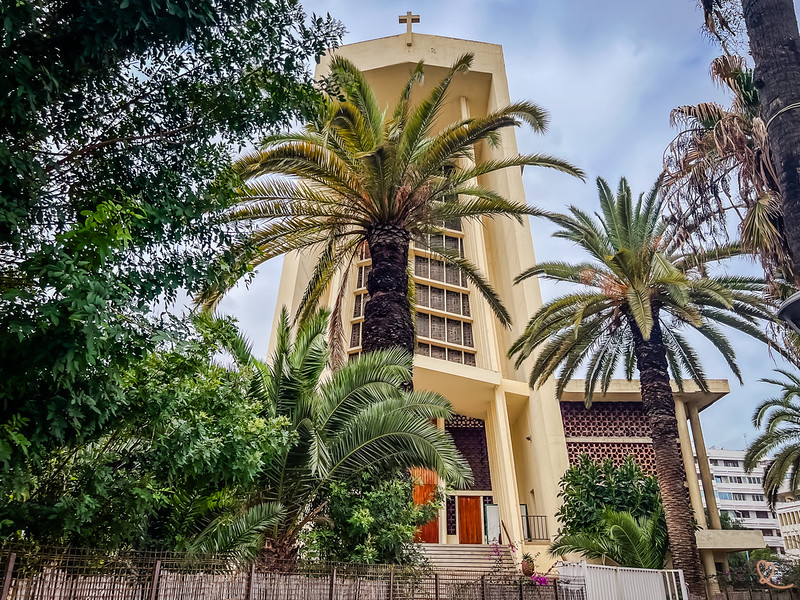
Taking a stroll through downtown Casablanca? Step inside the Notre-Dame-de-Lourdes Church, a modernist Catholic building constructed in the 1950s. We were struck by the contrast between its simple concrete facade and the explosion of color inside, brought to life by Gabriel Loire’s monumental stained-glass windows. In this article, check out our photos and all our tips for making the most of your visit to the Notre-Dame-de-Lourdes Church.
This opinion is completely independent, based on our experiences. We visited the region anonymously, making our own choices and paying our bills in full.
Why visit the Church of Our Lady of Lourdes?
Is the church worth it? Our opinion:
Yes, the Church of Our Lady of Lourdes is worth a visit, even if only a brief one. We loved the contrast between its simple exterior and its spectacular interior: 850 square meters of stained-glass windows by Gabriel Loire transform the nave into a bright and colorful space—a real visual treat the moment you walk in.
It’s one of the best things to do in Casablanca.

Why is the church famous?
The Church of Notre-Dame-de-Lourdes owes its fame above all to its collection of stained-glass windows, created by Gabriel Loire, a French painter and master glassmaker based in Chartres, France. Using the glass-and-cement panel technique, he designed approximately 51 windows, totaling nearly 850 square meters of stained glass. These stained-glass windows depict religious and Marian scenes, among other subjects, and form one of the most impressive collections of modern stained glass in Casablanca. This monumental collection is also among the most spectacular we have seen in a modern church.

Our favorite moments
Here are what we think are the highlights you shouldn’t miss during your visit:
- The contrast between the understated exterior and the spectacular interior
- Gabriel Loire’s stained-glass windows—truly impressive
- The colored light flooding the nave
- Modernist architecture, distinct from Casablanca’s other landmarks
- A replica of the Lourdes Grotto, on the left as you enter
- The vibrant character of the place, which is both religious and cultural

WHERE TO STAY IN Casablanca
Our favorites: neighborhoods and hotels
Corniche / Aïn Diab –
Four Seasons Hotel – see prices, photos and availability
Gauthier / Sidi Belyout –
Hôtel Le DOGE Relais & Châteaux – see prices, photos and availability

History in brief
Here are the major milestones in the history of the Church of Our Lady of Lourdes:
- The building is generally dated to 1954
- The building was completed around 1956 (at the end of the French protectorate)
- Designed by architect Achille Dangleterre and engineer Gaston Zimmer
- Stained-glass windows created by French master glassmaker Gabriel Loire
- Installation of a replica of the Lourdes Grotto within the grounds

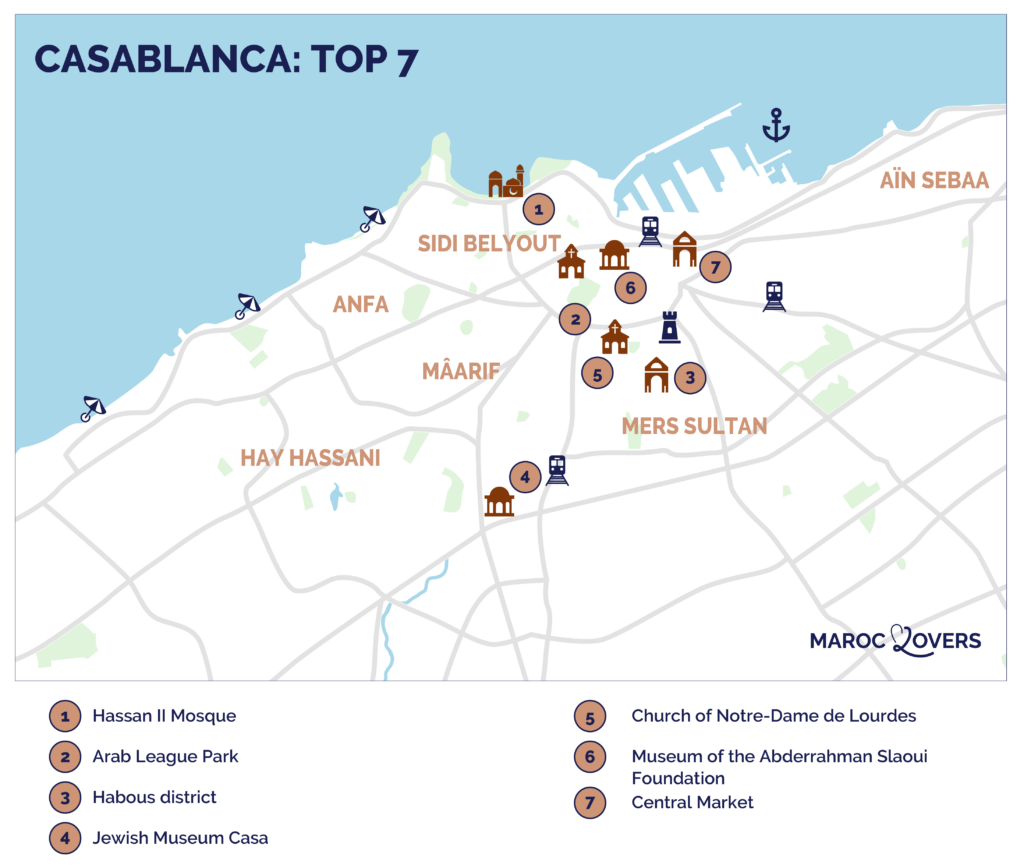
Directions: Notre-Dame-de-Lourdes Church, Casablanca
Where is the Church of Our Lady of Lourdes located?
- In downtown Casablanca
- At the Rond-point d’Europe on Boulevard de la Résistance
- A 5-minute drive from Mohammed V Square and 15 minutes from the Arab League Park
- A 10-minute walk from the Avenue Hassan II tram stop
OUR TIPS FOR RENTING A CAR IN MOROCCO
- Compare prices on our preferred platform: DiscoverCars – one of the best rated sites.
- Not too wide
- A good engine
- For more choice, book early.

How to get there?
The Notre-Dame-de-Lourdes Church is easily accessible by tram: the T1 line stops at Avenue Hassan II, about a 10-minute walk from the church. You can also walk there if you’re staying downtown, or take a taxi if you’d rather not walk.

Parking
Parking is available on the adjacent streets, depending on availability at the time. There is also a paid parking lot near Place Mohammed V, about a 15-minute walk from the church. As is often the case in Casablanca, it’s best to allow extra time, as parking availability can vary depending on the time of day and how busy it is.

Useful tips: duration, schedules, eating…
Best time to visit
We recommend visiting during the day, when the light streams through the stained-glass windows and reveals the full spectrum of colors in the nave. If your visit is primarily for sightseeing, please avoid mass times if possible out of respect for the congregation and the services.

Length of visit and main difficulties
Allow between 30 minutes and 1 hour to visit the church. 30 minutes is enough to explore the nave, the stained-glass windows, and the Grotto of Lourdes, while 1 hour will give you more time to take in the details and the play of light. There are a few steps to climb to enter the nave, but the floor is level once inside. We recommend checking on-site for accessibility for people with limited mobility.

Advice on how to visit
There is no set route for the tour. We simply suggest that you start with the replica of the Lourdes Grotto, located on the left as you enter, before heading toward the nave to fully enjoy the surprise created by the stained-glass windows.

A LITTLE MORE PATIENCE
All the photos, maps, information and addresses you need to make your stay at Maroc a success will soon be available in a single ebook!
Coming soon!
Visiting with children
The tour is short and easy to navigate, making it ideal for families. The replica of the Lourdes Grotto is sure to capture the attention of younger visitors, as are the bright colors of the stained-glass windows.

Schedules and rates
The church is listed as open Monday through Sunday from 8:30 a.m. to 7:00 p.m. These hours may vary depending on services or events, so if possible, check the Mass schedule before your visit. Admission is generally free, but respectful behavior is expected since this is an active place of worship.

To avoid disturbing the congregation, be sure to check the Mass schedules with the diocese before you visit. Visit the official website here for more information.
Guided tours
The Church of Our Lady of Lourdes can also be visited as part of a guided tour of Casablanca, which often includes the city center, Art Deco architecture, and the city’s major landmarks.
Catering
Eating is not permitted inside the church. There are several places nearby where you can extend your visit with a meal. We enjoyed our meal at Restaurant Gare aux Gorilles, which serves French cuisine with bistronomic influences. The Papers Club, a cultural café near the Mohammed V Stadium a little further away, serves home-style cooking and a traditional Moroccan brunch. Finally, Restaurant Bulles offers a contemporary atmosphere with international cuisine featuring grilled dishes and tapas. Find all our restaurant recommendations here.

Before the light, the simplicity of concrete
At first, we were surprised by the simplicity of the exterior of the Notre-Dame-de-Lourdes Church. The building, constructed toward the end of the French Protectorate and generally dated to 1954, with completion around 1956, features simple, almost austere forms. Concrete dominates, forming geometric lines that offer absolutely no hint of the visual shock of the interior. It’s this contrast that makes the visit interesting from the very start. Inside the building, on the left as you enter, you’ll find a replica of the Grotto of Lourdes, dedicated to the Virgin Mary. We paused for a moment in front of it before pushing open the door to the nave, with no idea what awaited us on the other side.

Before you even enter the church, take a moment to stop inside the grounds, on the left as you pass through the gate. There you’ll find a replica of the Grotto of Lourdes, dedicated to the Virgin Mary. We found this sight quite surprising in the heart of Casablanca: it creates a direct link to the shrine in the Hautes-Pyrénées region of France, after which the church is named.

This brief stop adds a more intimate dimension to the visit. After the austere concrete exterior, the grotto immediately sets a different tone: one of contemplation, devotion, and religious remembrance. It also helps visitors understand that Notre-Dame-de-Lourdes is not just a remarkable modernist building, but a place of faith that is still very much alive.

We recommend starting with this step before stepping into the nave. The contrast will be all the more striking: first, a calm and symbolic outdoor space; then, just a few moments later, the dazzling display of light from Gabriel Loire’s stained-glass windows. Please note that photography is prohibited inside the grotto. That is why you will not find any photos in this article.
A wall of light designed by Gabriel Loire awaits you as you step through the doors of this modernist church. It’s only upon entering that the visit truly comes into its own. We were captivated by the colorful light that envelops the nave, projected by the immense array of stained-glass windows created by Gabriel Loire, a French painter and master glassmaker based in Chartres. Created using the glass-and-cement panel technique, they cover approximately 51 windows, totaling 850 square meters of glass, with blue, red, yellow, and green as the dominant colors.

The concrete, which seems rather austere at first glance, almost serves as a backdrop for these colors. You’ll be able to recognize several religious and Marian scenes, provided you take the time to look closely at each window. We recommend that you slow down here: this is the heart of the tour, and it’s worth spending a few extra minutes on.

A place of faith and culture that is still inhabited
Did you know that the Church of Our Lady of Lourdes is still a living church? It remains an active place of worship, not just a monument to admire. Christian religious festivals are still celebrated there. Some locals and visitors sometimes call it Notre-Dame d’Afrique, but its official name remains the Church of Notre-Dame-de-Lourdes. We loved how the atmosphere changed depending on the time of our visit: more contemplative during services, more open the rest of the time.

We remind you that appropriate attire is recommended, and it is best to avoid photographing worshippers, especially during Mass. Concerts and cultural events are sometimes held here, bridging the gap between heritage, spirituality, and culture. You’ll discover a more unexpected side of Casablanca, where modern architecture meets vibrant religious life.

This stop also reminded us of the cultural and religious openness of Casablanca—and, more broadly, of Morocco. It is a destination where historical heritage and places of worship continue to coexist in the heart of its cities.

It’s time to book!
Compare everything: companies, prices, schedules and availability.
Frequently asked questions
Is the Church of Our Lady of Lourdes the same as Our Lady of Africa?
No. Some residents and visitors sometimes refer to it as Notre-Dame d’Afrique, but its official name remains the Church of Notre-Dame-de-Lourdes.

How much time should I allow for a visit to the Church of Our Lady of Lourdes?
Allow between 30 minutes and 1 hour. Half an hour is enough to explore the nave, the stained-glass windows, and the Grotto of Lourdes, while an hour gives you more time to take in the details and the play of light.

PLAN YOUR TRIP TO Morocco
- Best of
Top Destinations
Must-See Places in Morocco
Most Beautiful Riads
Most Beautiful Cities
Most Beautiful Medinas
Morocco’s Most Beautiful Landscapes
Most Beautiful Gardens
Best Museums
Morocco’s Most Beautiful Beaches

- Practical advice
When to go?
How to rent a car in Morocco
Driving tips

- The must-dos
Marrakech
Casablanca
Fez
Meknes
Chefchaouen
Essaouira
Rabat
Tangier
Tetouan
Agadir
The Sahara Desert

