
Are you planning a trip to Fez? Great idea: Morocco’s former imperial capital boasts a medina listed as a UNESCO World Heritage Site, Merinid madrasas, and one of the country’s most renowned culinary traditions.
Here are our answers to your question: Is Fez safe?
You’ll also find all our tips for enjoying the city with peace of mind.
This opinion is completely independent, based on our experiences. We visited the region anonymously, making our own choices and paying our bills in full.
Is Fez safe? Quick answer
Yes, overall, Fez is a safe destination for travelers. Violent crimes against tourists are rare there. For our part, we didn’t encounter any problems during our stay in Fez and were able to enjoy the city with complete peace of mind.
The main things to watch out for are more related to everyday life: fake guides trying to solicit business, pickpockets in crowded alleys, finding your way through the labyrinth of the medina, and a few sites without protective barriers, such as the Merinid Tombs.
Fez is a city in Morocco where Moroccan laws apply. Islam is the official state religion there, which means there are certain rules to follow, particularly regarding places of worship.

What to Do in Case of an Emergency in Fez?
Before discussing the risks, it’s best to know the right steps to take. In Morocco, dial 19 to reach the police in cities, 177 for the Royal Gendarmerie outside urban areas, and 15 for the fire department and emergency medical services. From a cell phone, dialing 112 will also connect you to emergency services.
As the country’s third-largest city, Fez has a university hospital, the Hassan II University Hospital, as well as several private clinics. However, we recommend that you purchase travel insurance before departure, as private clinics often require an upfront payment.
In the event of theft, we recommend that you go to a police station to file a report and obtain a document that will be useful when filing a claim with your insurance company. Fez also has a tourist police unit that is experienced in assisting visitors. If your passport has been stolen, contact your consulate or embassy to find out what steps to take.
Getting lost in the Medina of Fez: the main challenge

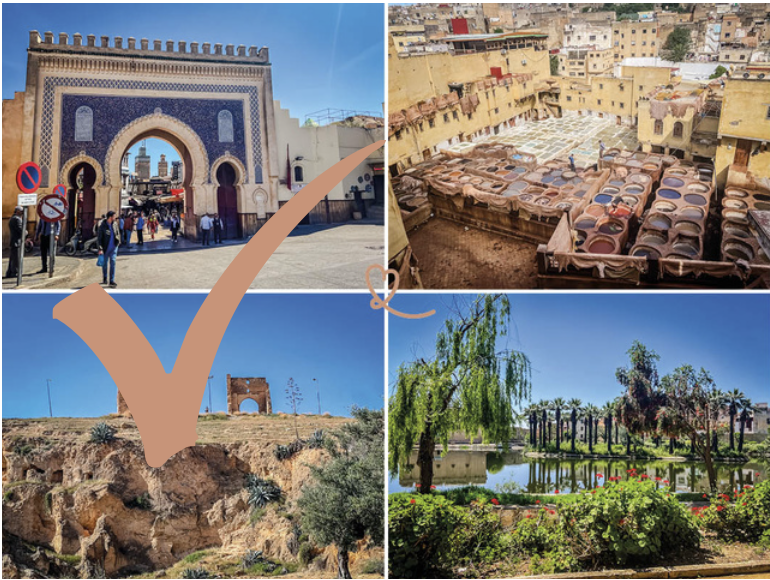
Fès el-Bali, considered the oldest medina in the world, has more than 14,000 listed buildings scattered throughout a maze of narrow alleys. Getting lost there is almost part of the experience, and we, too, found ourselves wandering off course. The risk is minimal: the medina is equipped with surveillance cameras, and the locals are happy to point you in the right direction—though some may then offer to guide you for a fee. To find your way around, remember the two main thoroughfares, Talaa Kbira and Talaa Sghira (“big and small ascents” in Arabic), which lead down from Bab Boujloud toward the historic center. We also found it helpful to download an offline map, since GPS can sometimes be inaccurate between the high walls.
Advice:
- Explore the medina during the day to get your bearings and enjoy the sights
- Wear sturdy shoes with non-slip soles: the cobblestone streets are uneven, and some alleys are quite steep
- Be aware that the very narrow passages may be uncomfortable for people with claustrophobia
- Memorize the major gates, such as Bab Boujloud or Bab Chorfa, which serve as landmarks
- For your first visit, opt for a half-day guided tour of the Fes Medina with a local guide
Fake guides and solicitations

This is the most common area to watch out for in Fez. Near Bab Boujloud and in the alleys close to popular sites, people will offer to accompany you, show you a shortcut, or warn you that a street is closed. These fake guides then expect payment or lead you to shops that pay them a commission. We recommend that you decline politely but firmly, without stopping. These situations are more a matter of persistence than of danger. For our part, we hired an official guide for our first visit, which spared us from these solicitations.
The Chouara Tannery is a good example of how this works. Access to the observation decks is through the leather goods shops: admission is free, but a tip or a purchase is expected. During our visit, we were given a sprig of mint to help mask the smell of ammonia. We found the sight of the colorful vats fascinating—provided you agree on the tip in advance. Please also note that these terraces have a few flights of stairs and are not suitable for children due to the odors.
Advice:
- Politely decline any offer of assistance that you did not request
- Choose official guides who wear a badge, or book through a reputable platform
- Agree on the price before any service is provided, even for a simple directions
- Visit the Chouara Tannery with a multilingual local guide
WHERE TO STAY IN FES
Our favorites: neighborhoods and hotels
In Fès El-Bali (old medina)
Hotel Riad Dar Lys – See prices, photos and availability
Hotel Riad Dar Laura – See prices, photos and availability
Fès El-Jdid (near the Royal Palace)
Palais Faraj Suites & Spa Hotel – See prices, photos and availability

Theft and Pickpocketing

As in any tourist city, pickpocketing can occur in crowded areas: around Bab Boujloud, on Talaa Kbira, or in the souks during peak hours. Crowds reach their peak in May, during the Festival of Sacred Music of the World. We recommend carrying your bag in front of you and carrying only the essentials. As for your car, don’t leave anything visible inside the vehicle, and opt for a paid, monitored parking lot. We found the one located behind Bab Boujloud particularly convenient for getting to the medina.
Advice:
- Keep a copy of your passport on your phone and keep the original in a safe place
- Divide your cash among several pockets
- In crowded alleys, put your phone away between photos
A LITTLE MORE PATIENCE
All the photos, maps, information and addresses you need to make your stay at Maroc a success will soon be available in a single ebook!
Coming soon!
Traveling Alone in Fez as a Woman
Fez welcomes many solo female travelers. Traveling alone in Fez is entirely feasible, but certain precautions are advisable. Female travelers may be subjected to comments or persistent advances, particularly in tourist areas. We advise you to firmly decline unsolicited offers and to stick to busy streets, especially in the evening. We recommend wearing clothing that covers your shoulders and knees, which facilitates interactions and respects local customs. In the evening, we suggest taking a taxi back to your riad or asking your accommodation to pick you up at the entrance to the medina, as the narrow streets empty out and become harder to navigate. We didn’t have any issues during our stay.
Respect sacred sites and local customs

Fez has 137 mosques in its medina alone, and several major sites remain active places of worship. The interiors of the Al-Qarawiyyin University Mosque and the Mausoleum of Moulay Idriss II, the city’s 9th-century founder, are reserved for Muslims. We admired them from outside the doors, keeping a low profile so as not to disturb the worshippers’ devotion. You’ll also hear the call to prayer five times a day from the minarets. On Fridays, the day of the main prayer, some businesses adjust their hours or close, even though it is not an official holiday. During Ramadan, we recommend that you avoid eating, drinking, or smoking in public during the day, out of respect for those who are fasting.
Advice:
- Wear modest clothing when visiting the shrines
- Ask for people’s permission before taking their picture; at the Nejjarine Museum, photography of exhibits is prohibited
- The Royal Palace is not open to the public: admire its gates from the sidewalk and follow the instructions of the royal guard
- On weekends, some shops are closed on Saturday—particularly those owned by the Jewish community—and others are closed on Sunday
OUR TIPS FOR RENTING A CAR IN MOROCCO
- Compare prices on our preferred platform: DiscoverCars – one of the best rated sites.
- Not too wide
- A good engine
- For more choice, book early.

At-Risk Sites: The Merinid Tombs and South Borj

The Tombs of the Marinids, the necropolis of the dynasty that ruled Morocco from 1269 to 1465, offer one of the most beautiful views of the city. However, the site requires extreme caution: there are no safety barriers or supervision, and the ground is sloped and covered with gravel. We recommend visiting during the day, never at night, when visibility is zero. The access road, which is winding and full of sharp turns, also requires extra caution at the end of the day. We do not recommend this site for young children. Finally, please be aware that it is forbidden to take stones from the site.

Fort Borj Sud, built in the 16th century, is easier to visit. Its ramparts are accessible with a few precautions; the path is paved and has a few small steps. The fort is open Monday through Saturday from 9 a.m. to 5 p.m. In either case, be sure to bring water and snacks: there are no places to eat nearby.
Advice:
- Keep children close to you and stay away from the edges
- Wear shoes suitable for gravel and slopes
- Head back down from the Merinid Tombs before nightfall
Subscribe to our Newsletter
- Get away from it all with Region Lovers’ beautiful destinations!
- Once a month
- Advertising-free

Dangers of Heat and Sun Exposure

In the summer, the heat can be intense in Fez, which is located inland. Outdoor sites such as the Merinid Tombs or the Borj Sud ramparts offer almost no shade. We prefer to explore these sights early in the morning or in the late afternoon. For a cool break, the Jnan Sbil Gardens—open Tuesday through Sunday from 8 a.m. to 7 p.m.—feature large shaded areas and fountains. We stopped there for a welcome break between visits to the medina.
In winter, the situation is reversed. Temperatures range from 15°C (59°F) to 18°C (64.4°F), rain makes the cobblestones slippery, and snow may fall in the Middle Atlas Mountains, about a 1.5-hour drive away.
Advice:
- Bring a hat, sunglasses, and sunscreen
- Drink regularly, even if you’re not thirsty
- In winter, bring a waterproof jacket and shoes with good traction on wet cobblestones
Is it dangerous to drive in Fez?

Not particularly, as long as you plan ahead. Fez is connected to Rabat (2 hours and 30 minutes) and Casablanca (3 hours and 15 minutes) via the A2 highway, and then to Tangier (4 hours and 15 minutes) via the A5—all of which are in good condition. The main challenge is in the city itself, where traffic is heavy and parking is difficult around the city walls. Since vehicles are not allowed in the medina, we recommend parking in an official parking lot across from Bab Chorfa or behind Bab Boujloud, then continuing on foot. We also liked the paid parking lot near the Jnan Sbil Gardens, in the Fès Jdid neighborhood.
Renting a car isn’t essential for visiting Fez, but it’s convenient for getting to Meknes, the Middle Atlas Mountains, or the village of Moulay Idriss. In winter, check the condition of the mountain roads before setting out. If you’d rather not drive, opt for a guided tour of Volubilis.
As a pedestrian, stay alert as well. Traffic can be heavy around the city walls, and drivers do not always yield at crosswalks. Near the medina, be especially careful of motorcycles and vehicles traveling through the narrow streets. We recommend that you take your time when crossing, even when you have the right of way.
Getting Around Safely in Fez

- Small taxis: recognizable by their red color, they operate in the new city and around the medina. The meter must be used during the day, and a higher flat rate applies at night: ask the driver to turn on the meter right from the start
- Ride-hailing services and transportation apps: Some platforms allow you to book a ride, but their regulatory status in Morocco remains unclear. For peace of mind, we recommend using official taxis or transfers arranged by your lodging.
- Shared taxis: These white shared taxis connect Fez to nearby towns and villages quickly and affordably
- Train: The ONCF network serves Fez from Casablanca, Rabat, Marrakech, and Tangier. Trains run frequently and are comfortable and safe
- Bus: The CTM and Supratours companies offer the most economical option for travel to major cities
- Air: Fez-Saïss International Airport is about a 30-minute drive from downtown— see available flights
You’ll also come across horse-drawn carriages around the medina. However, this mode of transportation raises concerns about animal welfare: we recommend walking or taking a taxi.
Is it safe to drink the tap water in Fez?
Tap water is treated in Fez, but its quality may vary depending on the water system. To minimize the risk of digestive problems during your stay, we recommend drinking bottled water with a seal or properly filtered water. However, its taste and composition differ from what your body is used to, which may cause minor digestive issues during the first few days. We therefore recommend bottled mineral water, which is available at all grocery stores; be sure to check that the cap is properly sealed.
DISCOVER Fez

Eating Without Worries in Fez

Fez’s cuisine is among the finest in Morocco, and it’s easy to eat well there. To avoid any unpleasant surprises, stick to popular spots and well-cooked dishes, such as tagines or harira. We tried several restaurants during our stay and recommend the Café-Restaurant Moulay Idriss on Talaa Kbira for traditional cuisine. For a gourmet meal, we enjoyed the Gayza Restaurant at the Riad Fès Relais & Châteaux; for bistronomy, the Ishq Restaurant showcases local ingredients. For families, Le Bistrot des Saveurs offers healthy and affordable cuisine. Discover all our top picks Where to Eat in Fez!
Fez with Children or People with Limited Mobility
Fez is a great place to visit with the family, but some sites require a bit of planning. The cobblestone, sloping alleys of the medina make strollers impractical: we recommend a baby carrier, especially at the Nejjarine Museum, where the upper floors are accessible only by stairs. The Chouara Tannery and the Merinid Tombs are not suitable for young children. For people with limited mobility, access to the medina remains limited. The Jnan Sbil Gardens, equipped with ramps and wide walkways, as well as the Bab Boujloud Gate, which is accessible at ground level from the parking lot, are more convenient options. Finally, we recommend checking accessibility with your riad, as many have narrow staircases.
Want to plan the rest of your trip? Check out our 15 ideas for exploring Fes and our article on the village of Moulay Idriss.
PLAN YOUR TRIP TO Morocco
- Best of
Top Destinations
Must-See Places in Morocco
Most Beautiful Riads
Most Beautiful Cities
Most Beautiful Medinas
Morocco’s Most Beautiful Landscapes
Most Beautiful Gardens
Best Museums
Morocco’s Most Beautiful Beaches

- Practical advice
When to go?
How to rent a car in Morocco
Driving tips

- The must-dos
Marrakech
Casablanca
Fez
Meknes
Chefchaouen
Essaouira
Rabat
Tangier
Tetouan
Agadir
The Sahara Desert

