
Planning a trip to Morocco? Fez, the ancient imperial capital founded in the 8th century, is home to one of the best-preserved medinas in the Arab world, a UNESCO World Heritage Site since 1981. Its ancestral tanneries, Marinid medersas and gastronomy, reputed to be the finest in Morocco, make it a destination in a class of its own. First step: organize your arrival. Plane, train, bus, car… Here are all the practical options for getting to Fez, depending on your travel preferences.
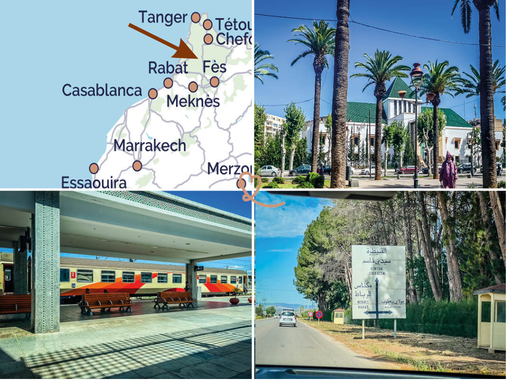
This opinion is completely independent, based on our experiences. We visited the region anonymously, making our own choices and paying our bills in full.
How to get to Fez: quick answer
There are several options for getting to Fez:
- By plane: Fès-Saïss Airport (FEZ), 15km from the city center, has direct flights from Paris, Lyon, Brussels, Madrid and other European cities – see available flights
- By train: the ONCF network links Fez to Casablanca (approx. 3h), Rabat (approx. 2h35), Tangiers (approx. 4h) and Meknes (approx. 40min) – see timetables
- By bus: the CTM and Supratours companies serve Fez from the main Moroccan cities – a good-value, well-organized option.
- By car: the A2 freeway links Fez directly to Rabat (2h30) and Casablanca (3h30); you can also rent a car at the airport or in town.
- From nearby towns: Meknes is a 45-minute train ride away; guided day trips from Casablanca, Rabat or Marrakech are also available for added peace and quiet.
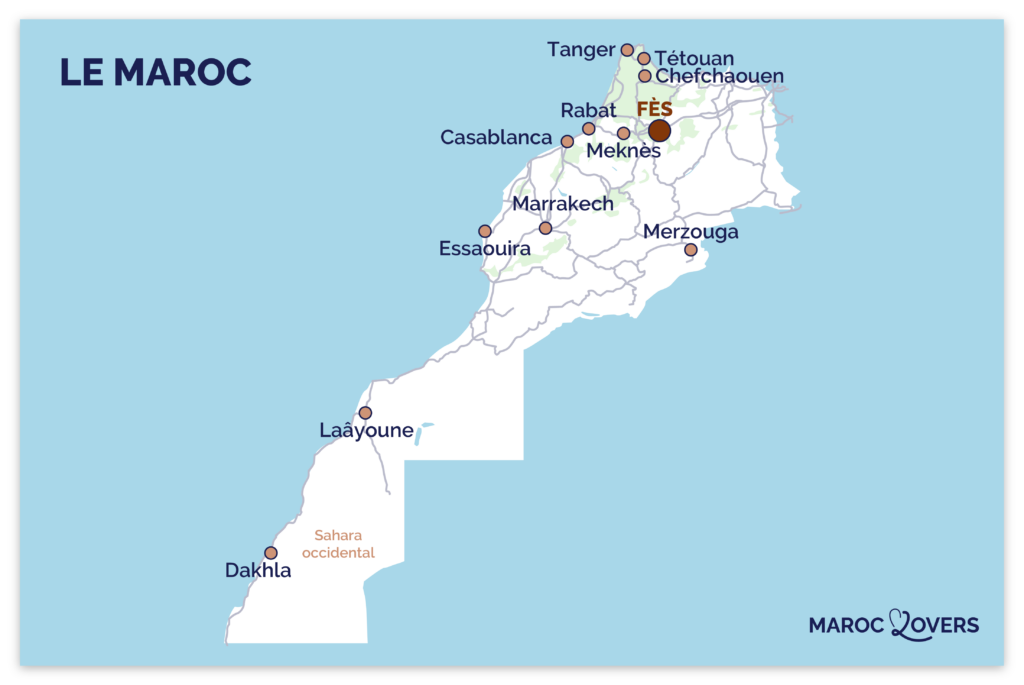
Here’s a map to help you locate Fez in northern Morocco:
WHERE TO STAY IN FES
Our favorites: neighborhoods and hotels
In Fès El-Bali (old medina)
Hotel Riad Dar Lys – See prices, photos and availability
Hotel Riad Dar Laura – See prices, photos and availability
Fès El-Jdid (near the Royal Palace)
Palais Faraj Suites & Spa Hotel – See prices, photos and availability

Option 1: by plane
- Fès has its own international airport:Fès-Saïss Airport (FEZ), located 15km south of the city center, about 20-25min by car from downtown.
- Direct flights from Europe are mainly seasonal (April-October), although some connections from France and Belgium operate year-round. Outside this period, transit viaCasablanca’s Mohammed V Airport (CMN) is often more convenient – there are far more connections there, and a domestic flight from Casablanca to Fez takes around 1h.
- Once in Fès-Saïss, there are several ways to get to the city center: cab, n°16 bus, or private transfer booked in advance – Book a private transfer from Fès airport

Main air connections from Fez: Paris-Orly, Paris-CDG, Lyon, Marseille, Bordeaux, Nantes, Toulouse (Royal Air Morocco, Transavia, easyJet, Ryanair); Brussels-Zaventem and Brussels-Charleroi (Ryanair, TUI fly); Geneva (easyJet, Royal Air Morocco); Madrid, Barcelona (Iberia Express, Ryanair, Vueling); London-Stansted (Ryanair, seasonal). From Morocco, domestic flights all year round from Casablanca, Marrakech and Agadir (Royal Air Morocco). Find your flight here.
It’s time to book!
Compare everything: companies, prices, schedules and availability.
Option 2: by train
- The train is often the best option for getting to Fez from Morocco’s major cities. The ONCF rail network is one of the most developed in Africa: punctual, air-conditioned and comfortable.
- The Fez train station is located in the heart of the New Town, just a few minutes from the center by cab – a real advantage for reaching your accommodation without difficulty.
- Allow 20 to 45min from Meknes depending on the train, 2h35 from Rabat, 3h from Casablanca (departure from Mohammed V airport or Voyageurs station), and around 4h from Tangiers. From Marrakech, the journey takes 7h-8h with a change in Casablanca – the bus may be more direct for this connection.
- In high season, Friday evening and Sunday trains are very busy. We recommend booking in advance on the ONCF website or via the app, especially for 1st class journeys – the difference in comfort is real for a modest extra cost.
- TheAl Boraq, the high-speed train inaugurated in 2018 between Tangier and Casablanca, does not yet serve Fez directly – but its future development towards the city is planned.
- Consult timetables and book on the ONCF website

Subscribe to our Newsletter
- Get away from it all with Region Lovers’ beautiful destinations!
- Once a month
- Advertising-free

Option 3: by bus
Buses are an economical and practical alternative, especially on routes not covered directly by the train – Marrakech being the first. The CTM company is the national benchmark: air-conditioned vehicles, punctual timetables, tickets bookable online. Supratours, an ONCF subsidiary, completes the offer from certain cities.
The CTM bus station in Fez is located in the Ville Nouvelle, just a few minutes from the center by cab.
- Casablanca → Fez: 4h-4h30, several departures per day
- Marrakech → Fez: 6h-7h – often more direct than the train for this route; night departures available to save an overnight hotel stay
- Agadir → Fez: approx. 9 hours, with overnight departures
- Tangier → Fez: approx. 5h
- Oujda → Fès: approx. 4h – useful connection for travellers from eastern Morocco
See times and bookings on the CTM website.
Good to know: in high season, CTM tickets go fast. We recommend booking 2-3 days in advance, especially for Friday and Sunday departures. Night buses from Agadir or Marrakech are a common option among budget travelers – you arrive early in the morning, ready to start the day.

Option 4: by car
The car will give you appreciable freedom to integrate Fez into a wider circuit – to the other imperial cities (Meknes, Rabat, Marrakech), the Dades gorges, the Merzouga desert or the cedar forests of the Middle Atlas. The Moroccan motorway network is well maintained between major cities, with frequent but affordable tolls. We like this option for travelers who want to explore the region freely: compare offers here.
- From Casablanca: approx. 300km, 3h30 via the A2 freeway
- From Rabat: about 200km, 2h30
- From Tangier: approx. 330km, 3h30 (A1 then A2)
- From Marrakech: approx. 500km, 5h30-6h (A7, A3 then A2)
- From Meknes: about 60km, 45min on the N6 – fast link through the Saïss plain

Please note: driving in Morocco requires particular vigilance in city centers – two-wheelers, pedestrians and village crossings all require you to slow down. On freeways, the rules are similar to those in Europe: 120km/h speed limit, frequent fixed and mobile speed cameras. The medina of Fès el-Bali is entirely pedestrianized, making it impossible to drive. We recommend parking in one of the guarded parking lots at the gates of the medina – opposite Bab Chorfa, behind Bab Boujloud, or the Ain Zleten parking lot on rue Talaa Kbira – and then continuing on foot.
OUR TIPS FOR RENTING A CAR IN Maroc
- Compare prices on our preferred platform: DiscoverCars – one of the best rated sites.
- Adapt your choice of vehicle to your itinerary!
- For more choice, book early.

Read our tips (coming soon)
Option 5: excursions from nearby towns
If you’re already staying in another Moroccan city, Fès can be visited by the day from many points in the country. Its central position in the north makes it a natural stopover on the route to the imperial cities. That said, the richness of the medina deserves at least two nights’ stay, so you don’t have to rush to enjoy it.
- From Meknes: the two cities form an obvious duo. We recommend spending one night at each site rather than trying to do two in one day – see guided excursions from Meknes.
- From Casablanca: technically possible by the day if you leave early, but this leaves little time on site – 5 to 6 hours in the medina, not enough to see everything – see excursions from Casablanca
- From Rabat: the connection is frequent and comfortable; allow at least one night to avoid flying over the medina – see guided options from Rabat
- From Marrakech: the distance makes a day trip exhausting; we recommend a multi-day tour combining the two cities instead – see options from Marrakech

A LITTLE MORE PATIENCE
All the photos, maps, information and addresses you need to make your stay at Maroc a success will soon be available in a single ebook!
Coming soon!
Getting around Fez
Once in Fez, there are several modes of transport for getting around the city and the surrounding area:
- On foot: the medina of Fès el-Bali is entirely pedestrianized – it’s the only way to get around. Bring good shoes with non-slip soles and be prepared to get lost in the 14,000 listed buildings: this is often where the best discoveries are made.
- By cab: Official “small cabs” (red in Fez) operate in the new town and around the medina. They are practical and inexpensive (meter required during the day, more expensive at night). VTC services are also available as a safe option.
- Grand cabs: these shared cabs (often white 6-seater cars) connect Fez with other towns and villages in the surrounding area, such as Meknes or Moulay Yacoub – fast and affordable for inter-city journeys.
- By rental car: not very useful for visiting the medina itself, but handy for touring the region – Volubilis, Ifrane, Azrou or the Middle Atlas. Compare available offers.
- With a local guide: to better understand the medina and avoid going round in circles in this labyrinth of alleyways, hiring an official guide is an excellent idea, especially on a first visit. See guided tours of the medina.
You’ll also see horse-drawn carriages in town and around the medina, but this mode of transport is not ideal in terms of animal welfare. Walking or taking a cab are the most suitable and respectful options.

And once in Fez…
Once there, the change of scenery is immediate. The medina of Fès el-Bali, some of whose alleyways date back to the 9th century, is one of the largest pedestrianized medinas in the world. It requires time and a good pair of shoes. The Ville Nouvelle is also well worth a visit! Here’s a little appetizer to give you an idea:
- The Medina of Fès el-Bali with its two main thoroughfares (Talaa Kbira and Talaa Sghira), 137 mosques and 23 public hammams
- The Chouara Tanneries, to be seen from the terraces of the surrounding leather factories – know-how handed down from generation to generation for centuries.
- The Médersa Attarine and Médersa Bou Inania, masterpieces of 14th-century Merinid architecture, with their remarkable zelliges, carved woodwork and finely crafted stuccowork.
- Al Quaraouiyine University, founded in 859 by Fatima Al-Fihri, considered the world’s oldest active university
- The Merinid Tombs on the north hill, for a 360° panoramic view of the entire imperial city
- The Jnan Sbil Gardens, a 19th-century haven of greenery opposite the Royal Palace, with its 3,000 plants and fountains – ideal for a break between two visits.
Read our article on the best attractions in Fez

PLAN YOUR TRIP TO Morocco
- Best of
Must-See Places in Morocco
Most Beautiful Riads
Most Beautiful Cities
Most Beautiful Medinas
Morocco’s Most Beautiful Landscapes
Most Beautiful Gardens
Best Museums
Morocco’s Most Beautiful Beaches

- Practical advice
When to go?
How to rent a car in Morocco
Driving tips
Where to Stay in Morocco

- The must-dos
Marrakech
Casablanca
Fez
Meknes
Chefchaouen
Essaouira
Rabat
Tangier
Tetouan
Agadir
The Sahara Desert

