
Driving in Morocco lets you explore the country at your own pace, especially its mountainous regions, valleys, and villages. But traffic conditions vary greatly depending on the route. Here are our tips for planning your trips, understanding the main rules, and driving with greater peace of mind.
- Safety and driving difficulties
- Rules of conduct
- Road conditions
This opinion is completely independent, based on our experiences. We visited the region anonymously, making our own choices and paying our bills in full.
Driving in Morocco: What You Need to Know
If you don’t want to read the whole article, at least read this short summary of the essential points to know:
- Driving is on the right side of the road.
- The minimum age to drive is 18, but rental agencies often require drivers to be at least 21 and to have held a driver’s license for several years.
- Seat belts are required for front-seat passengers in built-up areas and for all passengers outside built-up areas.
- The legal limit for driving under the influence of alcohol is 0.2 g per liter of blood. The simplest solution is to avoid drinking altogether.
- Speed limits are indicated by a red circle, and speed cameras are common.
- Police and gendarmerie checkpoints are common, particularly at the entrances and exits of towns.
- Toll roads are generally well-maintained.
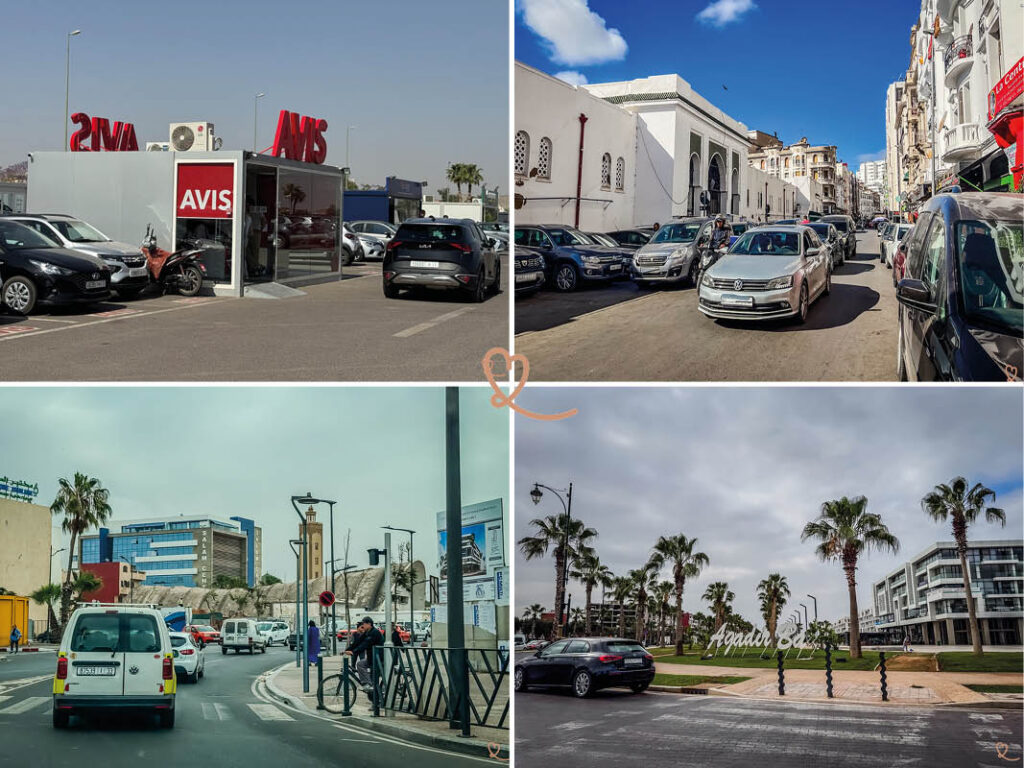
- In large cities, traffic requires constant vigilance: motorcycles, pedestrians, and taxis all share the road (and sometimes carts are added to the mix near the souks and in rural areas).
- Avoid driving at night outside of cities.
- In case of an accident: 19 for the police in town, 177 for the gendarmerie outside town, and 15 for the fire department.
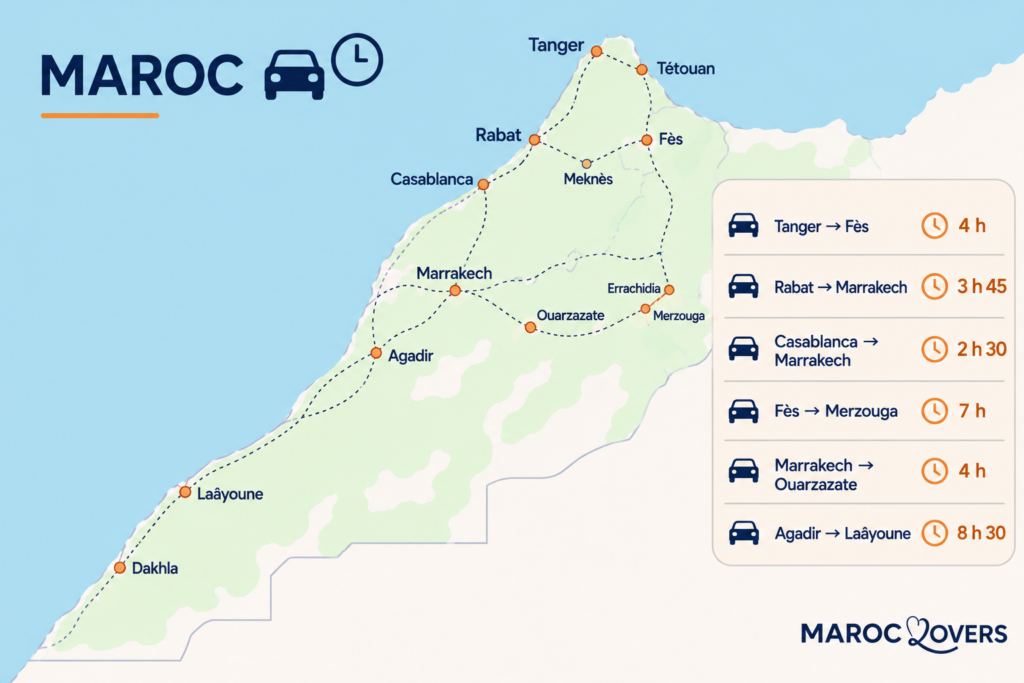
Here are the driving times in the region, to give you an idea of how to get around:
A LITTLE MORE PATIENCE
All the photos, maps, information and addresses you need to make your stay at Maroc a success will soon be available in a single ebook!
Coming soon!
1. Renting the Right Car in Morocco
To make driving easier, it’s best to choose a car that’s suited to the types of roads and conditions. In Morocco, we recommend:
- Not too big, because the streets in old towns and some villages are narrow, and parking is limited there
- A powerful engine, if you plan to drive over the High Atlas mountain passes
- An automatic transmission if possible, since city traffic involves frequent stops. Keep in mind, however, that most rental cars have manual transmissions and that automatics cost more—so book them early.
- A 4WD only if you plan to drive on dirt roads, such as those leading to the desert dunes
Learn more in our article on how to rent a car in Morocco.
>> Check out the great rental deals on our favorite platform

2. Know the rules of conduct
Permit requirements
Foreign nationals may drive in Morocco with a valid national driver’s license issued in their home country for up to one year from the start of their stay. For a tourist visit, a valid French driver’s license is therefore generally sufficient. The French authorities do not require an international driver’s license, but it may be useful for certain procedures. Be sure to check the requirements set by your rental car agency as well.

Age
The minimum age to drive is 18.
However, please note that many rental agencies have additional requirements, often a minimum age of 21 and at least two years of driving experience. A “young driver” surcharge may sometimes apply.
Always keep the vehicle documents, the rental agreement, and a valid form of identification—such as your passport—with you at all times.
General Rules
- In Morocco, people drive on the right side of the road.
- Seat belts are required for front-seat passengers in built-up areas and for all passengers outside built-up areas
- Using a handheld cell phone is prohibited while the vehicle is in motion.
- Children under 10 years of age may not sit in the front seat of the car
- At a roundabout, the “right-of-way” rule applies by default, unless there is a “Yield” sign at the entrance (which is the case at most major intersections). Pay close attention to the signs at each entrance.
- Come to a complete stop at “Stop” signs, especially at police roadblocks

Alcohol and driving
The threshold above which driving under the influence of alcohol is punishable is set at 0.2 g of alcohol per liter of blood (or 0.10 mg per liter of exhaled air).
We recommend that you do not drink at all if you are driving.
Required Equipment in the Car
Before leaving the rental office, check to make sure the following required equipment is present:
- Warning triangle
- High-visibility vest
- Set of replacement bulbs for various signal lights
- “A” sticker on the rear of the vehicle if the driver has held a license for less than two years
A spare tire or repair kit is not included in this list of mandatory equipment under NARSA regulations, but be sure to check that you have one before hitting the road: it will come in handy in case of a flat tire.

Mandatory Insurance
Liability insurance is required to drive in Morocco. If you rent a car there, make sure the vehicle is properly insured and that the terms of coverage are included in your contract.
If you’re bringing your own car, make sure your international insurance card (formerly the “green card”) covers Morocco (code “MA” not crossed out) for the entire duration of your stay. If this is not the case, you must purchase border insurance from an authorized insurer upon your arrival.
WHERE TO STAY IN Morocco
Our independent picks for the accommodation of your dreams:
- Where to stay in Morocco (coming soon)
- The most beautiful riads in Morocco
Select by city:

3. Preparing for different types of road
Highways
The highway network connects the country’s major cities. Highways are generally well-maintained and allow for comfortable travel over long distances. They are toll roads with a speed limit of 120 km/h.

National Highways
Elsewhere, you’ll mainly be driving on national highways, which are often single-lane in each direction. Their condition varies: some have just been repaved, while others have potholes or damaged shoulders.
When driving through villages, you’ll need to slow down, as speed bumps, weekly markets, or children coming out of school can appear without warning.
Overtaking trucks also requires patience: wait for a long, clear stretch of road.
Mountain roads
The High Atlas, the Middle Atlas, and the Rif feature winding, sometimes narrow roads dotted with sharp hairpin turns. The Tizi n’Tichka Pass, on the N9 between Marrakech and Ouarzazate, rises to about 2,260 meters. The road is wide and well-maintained, but there is heavy truck and bus traffic.
The Tizi n’Test Pass is much narrower and requires more experience. We recommend it only for drivers who are comfortable on mountain roads, and we suggest leaving early to avoid traffic.
In winter, snow may temporarily close certain mountain passes: check before you leave.

Desert Trails and Roads
In the south, paved roads lead to the main destinations, but some dirt roads branch off toward isolated villages or the dunes.
A standard car should not venture onto these roads, and most rental agreements prohibit off-road driving.
Sand may also cover the road in some places after a strong wind: slow down as soon as visibility decreases.
After heavy rains, wadis (often dry riverbeds) can overflow and block the road. Never attempt to cross a flooded section.

In cities and medinas
In major cities such as Casablanca, Marrakech, or Fez, traffic can be heavy, especially during rush hour. You’ll be sharing the road with cars, taxis, motorcycles, and pedestrians. Changing directions, frequent stops, and crossing the street require extra caution. If you’re not used to this type of traffic, take the time to adjust and, if possible, avoid driving in city centers.
In the medinas, many alleys are pedestrian-only or too narrow for cars. We recommend that you check whether your lodging is accessible by car before you arrive. The easiest option is often to leave your car in a nearby parking lot and continue on foot. We’ve also found it more relaxing to leave the car in the parking lot while spending a few days in a big city.

4. Understanding signs and tolls
Speed limits
- Speed limits are indicated on circular signs with red borders.
- They are expressed in kilometers per hour
- In built-up areas: 60 km/h as a general rule, with lower or higher limits depending on the road and signage
- On national highways: 100 km/h by default outside built-up areas, often reduced to 80 km/h or 60 km/h depending on the section of road and traffic signs.
- On the highway: 120 km/h
- Speed limits often change as you approach towns, sometimes abruptly. Fixed and mobile speed cameras are located precisely at these spots.

Road signs
The signs comply with international standards. The information is written in Arabic and French, and sometimes in Tifinagh, the Amazigh (Berber) alphabet.
French therefore makes it easier for many travelers to read the signs. We still recommend that you have an offline navigation app, as road signs are less common on smaller roads.

Tolls
Moroccan highways are toll roads. On toll systems with tickets, you take a ticket at the entrance and pay at the exit.
Accepted forms of payment include cash, credit cards, and the Jawaz pass, depending on the lanes and available equipment. Be sure to have dirhams on hand, however.
Lanes marked with the “Jawaz” symbol are reserved for vehicles equipped with this pass. Do not enter these lanes without a pass, unless the lane is explicitly marked as mixed-use.
Police Checkpoints and Speed Cameras
Police and gendarmerie checkpoints are common, especially at the entrances and exits of towns. Slow down as you approach a checkpoint, follow the officers’ instructions, and keep your documents handy.
If you receive a ticket, ask for the specific reason for the violation and an official payment receipt. Never pay a fine without receiving a receipt or a written notice.

Subscribe to our Newsletter
- Get away from it all with Region Lovers’ beautiful destinations!
- Once a month
- Advertising-free

5. Safety: understanding potential hazards
Is driving in Morocco dangerous?
Driving in Morocco isn’t particularly difficult on all routes, but it does require adapting to the conditions you encounter. Highways and major roads are generally the easiest to drive on. However, traffic can be heavy in large cities, and some mountain roads require more experience. Your itinerary, the season, and your driving experience are therefore important factors to consider.

Potential hazards
- Night Driving –
Outside of cities, streetlights are rare. Carts, bicycles, and pedestrians travel without lights, and some vehicles have faulty or insufficient lighting. - Bicyclists and pedestrians –
In the city, they appear from all directions. Anticipate their movements and check your mirrors before changing direction. - Animals –
Donkeys, sheep, goats, or camels may cross the road, especially in rural areas and in the south. - Overtaking –
Some drivers overtake on curves or uphill slopes. Keep a safe distance and pull over to the right if an oncoming vehicle is approaching. - Weather Conditions –
Snow on mountain passes in winter, flash floods in wadis after thunderstorms, and sandstorms in the desert. - Landscapes –
Between the Atlas Mountains and the southern valleys, it’s very tempting to look away from the road. Instead, pull over to a safe spot on the side of the road.

Specific driving tips
First, plan short legs of the trip: the distances on the map may seem short, but travel times can quickly add up on mountain roads.
The horn is used frequently, especially to signal your presence before passing another vehicle or when entering a blind curve. It is generally not a sign of irritation.
During Ramadan, travel patterns may change. At the end of the day, certain roads become busier as the time to break the fast approaches. Allow extra time if you need to hit the road at that time.
Finally, always keep some change on hand for tolls and parking attendants, as well as a few dirham (MAD) bills to pay any official fines on the spot (in exchange for a receipt).

What to do in the event of an accident
If anyone is injured or if there is a dispute, call:
- 19 for the police, in the city
- 177 for the Royal Gendarmerie, outside cities
- 15 for the fire department
The best order of action is:
- contact the emergency services
- Contact the police or the gendarmerie, who will file a report
- contact your rental provider
6. And the rest: parking, fuel…
Fuels and service stations
- Unleaded gasoline is called “sans plomb,” and diesel is called “gasoil.”
- At the vast majority of gas stations, an attendant will fill your tank for you. A small tip of a few dirhams is customary.
- There are many gas stations on the highways and around cities, but they are fewer and farther between in the south and in the mountains: fill up as soon as the fuel gauge reaches half.
- Be sure to have cash on hand, as smaller gas stations don’t always accept credit cards.

Parking in town
- On the streets, parking attendants—recognizable by their vests—keep an eye on the cars. They expect a small fee when drivers leave: a few dirhams during the day, a little more at night.
- Some city centers have paid parking zones and parking meters.
- At the entrances to the medinas, secure parking lots allow you to leave your car safely while you visit.
- If your lodging is located in a medina (a riad, for example), ask in advance where to park: they’ll often direct you to a nearby parking lot and may send someone to carry your luggage.
- Do not leave any items visible inside the vehicle.

Parking at beaches and attractions
Near tourist sites and beaches, you’ll usually find a parking lot supervised by an attendant. The fee is modest, but be sure to ask about it before parking to avoid any misunderstandings.
During peak season and on weekends, parking lots at beaches near major cities fill up quickly: we recommend arriving early in the morning.

The Most Beautiful Roads in Morocco
In our opinion, some of the most beautiful roads in Morocco include:
- The Tizi n’Tichka Pass, between Marrakech and Ouarzazate (N9)
- The road through the Dades Gorge and its hairpin turns
- The road through the Todra Gorge
- The Tizi n’Test Pass, between Marrakech and Taroudant
- The roads of the Rif Mountains around Chefchaouen
- The road between Fez and the archaeological site of Volubilis
See our more detailed article on Morocco’s most beautiful roads (coming soon).

Frequently Asked Questions
Do you need a car in Morocco?
It depends on your itinerary. For travel between major cities, the train is more than sufficient: the rail network connects Tangier, Rabat, Casablanca, Fes, and Marrakech, and buses serve many other cities. Once you’re there, the medinas are best explored on foot.
To explore the Atlas Mountains, the southern valleys, or the coastal villages, however, we recommend renting a car. We appreciate the freedom it offers to stop in villages and set out early, before the heat sets in.

Is it necessary to rent a 4WD in Morocco?
No, not for most itineraries. The main roads, including the Atlas mountain passes and the Gorges Route, are paved.
A 4WD is only useful for the trails in the south or when approaching the dunes. In these cases, many travelers prefer to entrust this part of the journey to a local driver.

PLAN YOUR TRIP TO Morocco
- Best of
Top Destinations
Must-See Places in Morocco
Most Beautiful Riads
Most Beautiful Cities
Most Beautiful Medinas
Morocco’s Most Beautiful Landscapes
Most Beautiful Gardens
Best Museums
Morocco’s Most Beautiful Beaches

- Practical advice
When to go?
How to rent a car in Morocco
Driving tips

- The must-dos
Marrakech
Casablanca
Fez
Meknes
Chefchaouen
Essaouira
Rabat
Tangier
Tetouan
Agadir
The Sahara Desert

