
Planning a trip to Maroc? Fès, the former imperial capital, fascinated us with its thousand-year-old medina, historic mosques and fine cuisine. A real “coup de cœur” of our stay, we were captivated by this city with its 137 mosques in the medina and its ancestral tanneries perpetuating a unique know-how.
Discover in this article 15 must-see ideas, our photos and all our tips on what to do in Fez!
This opinion is completely independent, based on our experiences. We visited the region anonymously, making our own choices and paying our bills in full.
1. Explore the Medina of Fez, a thousand-year-old labyrinth and the oldest in the world

Why visit?
Fès el-Bali, Morocco’s largest medina, took us back in time. Did you know it’s the oldest in the world? Built in a basin near the Sebou River by Moulay Idriss II, who ruled Morocco in the 9th century, it takes its name from “fès”, which means “pickaxe” in Arabic. We were impressed by this labyrinth of 14,000 listed buildings, where 137 mosques rub shoulders with 23 public hammams. The two main arteries, Talaa Kbira and Talaa Sghira (“big and little rise” in Arabic), will guide you through thisUNESCO world heritage site. Along the narrow streets, you’ll discover such wonders as the 13-window hydraulic clock facing the Médersa Bouanania, the interconnecting terraces and the historic fondouks. This thousand-year-old city is also home to Al-Quaraouiyine University, the world’s leading university and a testament to the intellectual importance of Fez.

Practical advice
- Length of visit: minimum 2 hours to a full day, depending on your interests and the activities you choose.
- Opening hours: accessible 24 hours a day, we recommend a daytime visit to better appreciate all its treasures.
- Difficulties and PRM access: not recommended for claustrophobic people, uneven cobbled floor, narrow and sometimes uphill streets, limited PRM access, secure area with surveillance cameras, wear good shoes with non-slip soles.
- Rates: free access to the medina
- Access: several gateways, Bab Boujloud being the best known
- Parking: outdoor parking lot opposite Bab Chorfa, parking lot behind Bab Boujloud, Ain Zleten parking lot overlooking rue Talaa Kbira
- Dining: numerous options in the medina or in the immediate vicinity, we recommend Restaurant Ishq (bistronomic), Café-restaurant Moulay Idriss (traditional Moroccan), Restaurant Gayza Riad Fès Relais et Châteaux (gastronomic).
- Take a half-day guided tour of the Medina of Fez with a local guide!
2. Discover Al Quaraouiyine University and its mosque, a world heritage site and center of knowledge

Why visit?
Founded in the IXᵉ century by Fatima Al-Fihri, a visionary of her time, Al Quaraouiyine University bears witness to the role of women in the intellectual history of the Arab and Muslim world. Today, it is considered the oldest university still in operation in the world. Inseparable from its mosque, we learned that it is the second largest in Maroc, after the one in Casablanca. From the street, you can see its white minaret, one of the oldest in the country, and its green tiles, a reminder of its link with royal power. Inside, the mosque covers more than 6,000 m² and has 14 doors. It also houses a remarkable library containing rare manuscripts, some written on parchment or gazelle skin. It was here that generations of scholars studied mathematics, medicine, philosophy and astronomy. Although the mosque is reserved for Muslim worshippers, you’ll be able to admire part of it from some of the gates in the medina. As we stopped for a few moments, we felt the force of its history and the importance of this place, which has shaped the intellectual influence of Fès for over a millennium.

Practical advice
- Length of visit: 30min for the exterior
- Opening hours: permanently visible from the outside
- Difficulties and access for wheelchair users: easy outside access, narrow cobbled streets in the medina, wear good shoes with non-slip soles, respect the sacred nature of the site inside and out.
- Prices: free for outdoor viewing
- Access: mosque in operation, interior accessible only to Muslims
- Parking: outdoor parking lot opposite Bab Chorfa, near Bab Boujloud
- Dining: in the medina, Restaurant Le Tarbouche or Café-restaurant Moulay Idriss (traditional Moroccan cuisine)
- This marvel can also be discovered on a guided tour of the medina – More info here
WHERE TO STAY IN FES
Our favorites: neighborhoods and hotels
In Fès El-Bali (old medina)
Hotel Riad Dar Lys – See prices, photos and availability
Hotel Riad Dar Laura – See prices, photos and availability
Fès El-Jdid (near the Royal Palace)
Palais Faraj Suites & Spa Hotel – See prices, photos and availability

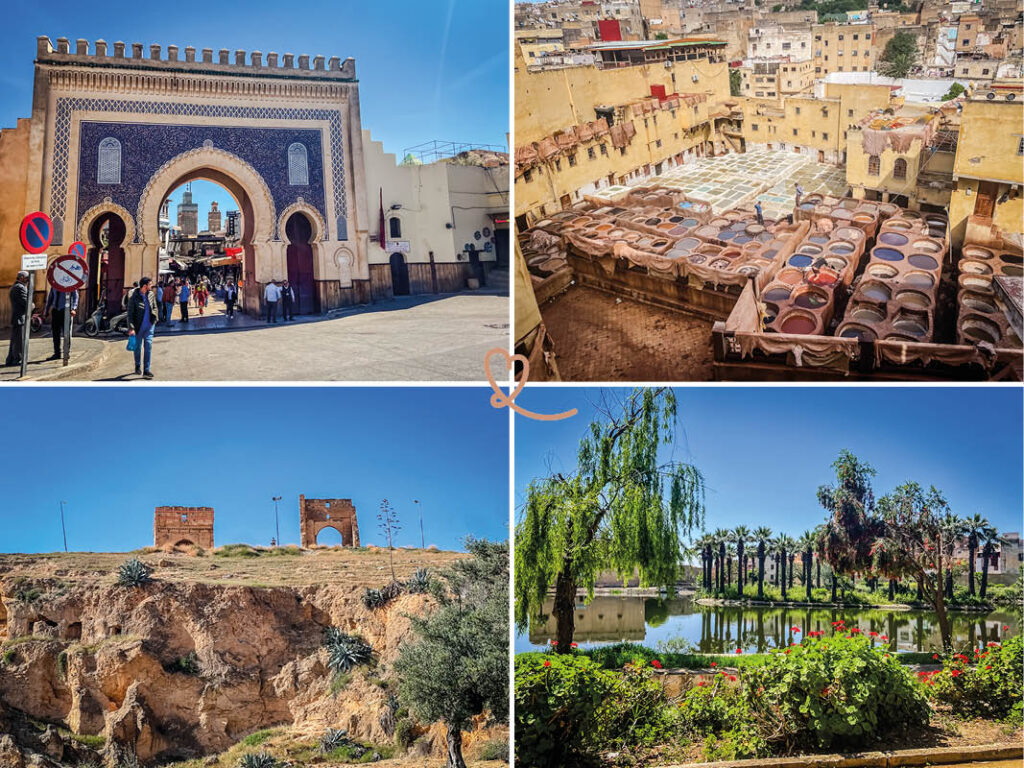
3. Pass under the Bab Boujloud Gate, the medina’s blue emblem

Why visit?
Built in 1913 under the French protectorate, Bab Boujloud is one of the most emblematic entrances to the Fès medina. Take the time to admire its Moorish architecture, with its slender arches, blue zelliges on the outside and green on the inside, making it a highly photogenic site. We appreciated the colorful transition between the modern city and the medieval world that opens up behind the arches. As you pass through the gate, you’ll understand why it has become the icon of the imperial city, photographed by thousands of visitors every day.

Practical advice
- Visiting time: 15min to admire it and take photos
- Opening hours: accessible 24 hours a day, but better visibility during the day
- Handicap access: level access from the parking lot
- Rates: free of charge
- Access: west of the medina, main entrance from the new town
- Parking: Derby Mernissi outdoor parking lot behind the door
- Eating out: 10 minutes’ walk away, we recommend the following options: Restaurant Le Tarbouche or Café-restaurant Moulay Idriss (traditional Moroccan cuisine), Restaurant Gayza (gourmet), Restaurant Ish (bistronomic).
- Would you like to get a closer look, with explanations from a local guide? Book your tour
A LITTLE MORE PATIENCE
All the photos, maps, information and addresses you need to make your stay at Maroc a success will soon be available in a single ebook!
Coming soon!
4. Immerse yourself in the colors of Tanneries Chouara, ancestral know-how

Why visit?
Join us for a fascinating show at the Chouara Tanneries, where ancestral know-how has been passed down for centuries! Did you know that this three-week process begins with the dehairing of hides in lime baths, followed by softening with natural ammonia from pigeon droppings? We observed the natural coloring of the leathers: red from poppy, blue from indigo, orange from henna, green from wild mint, brown from cedar and yellow from saffron or turmeric. More than 250 families work in these tanneries, passing on this know-how from generation to generation. At the start of our visit, we were provided with mint to cope with the strong odors of ammonia during the guide’s explanations. You can observe this colorful ballet from the terraces of the leather goods stores, where craftsmen handle sheep, goat and cow skins with remarkable dexterity. Sunflower oil fixes the colors before drying, transforming the skins into authentic leather.
At the end of our guided tour, we were able to stroll through the store’s shelves to discover the unique leather creations by the artisans.

Practical advice
- Tour duration: 30min to 1h
- Opening hours: according to opening hours of nearby stores
- Difficulties and PRM access: a few stairs, not PRM-accessible, in the middle of the medina in narrow cobbled streets, not suitable for children due to strong ammonia odors.
- Admission: free but tip or purchase expected
- Access: on foot in the medina, access to observation terraces via leather goods stores
- Dining: several restaurants in the medina, we recommend the Café-restaurant Moulay Idriss or the Restaurant Le Tarbouche.
- Parking: various parking lots at the gates of the medina, Bin Imdoun parking lot 5 minutes’ walk away.
- Visit the Chouara Tanneries with a local multilingual guide!
5. Visit the Attarine and Bou Inania medersas, masterpieces of Merinid architecture

Why visit?
Built in the XIVᵉ century under the Merinid dynasty, the Médersa Attarine is one of the finest Koranic schools in Fès. Its refined architecture struck us as soon as we entered: colorful zelliges with geometric motifs, intricately carved cedar wood, finely crafted stucco. You’ll notice that every detail testifies to the skill of the craftsmen of the time.
Inside, you’ll discover the small rooms where students from all over the kingdom were housed for religious instruction. The place surprised us by the balance between its educational function and the beauty of its decor. The courtyard, with its central fountain, invites you to relax and contemplate. Although its educational activities have disappeared, the Médersa Attarine remains a living testimony to the artistic and intellectual heyday of medieval Fez. It’s a visit not to be missed if you want to understand the role of medersas in the training and transmission of knowledge.

Practical advice
- Tour duration: 30min to 1h
- Opening hours: Médersa Attarine open daily from 10 a.m. to 5 p.m., Médersa Bou Inania open daily from 9 a.m. to 5 p.m.
- Difficulties and PRM access: no elevator, some stairs, narrow corridors
- Rates: Médersa Attarine 20 dhs (MAD) per person, Médersa Bou Inania 10 dhs (MAD) per person
- Access: in the medina, on the main thoroughfare, rue Talaa Kebira
- Parking: parking lots at the gates of the medina
- Dining: several restaurants in the medina, we recommend the Café-restaurant Moulay Idriss or the Restaurant Le Tarbouche.
- Book your visit to the Fez medersas (madrasas) now
OUR TIPS FOR RENTING A CAR IN Maroc
- Compare prices on our preferred platform: DiscoverCars – one of the best rated sites.
- Adapt your choice of vehicle to your itinerary!
- For more choice, book early.

Read our tips (coming soon)
6. Visit the Mausoleum of Moulay Idriss II, founder of the city

Why visit?
Do you know the Mausoleum of Moulay Idriss II, founder of Fès and son of Moulay Idriss I? It’s a major place of pilgrimage in the heart of the medina, as is the Mausoleum of Moulay Idriss I in the village of the same name, a few kilometers from Fès. This sacred monument impressed us with its magnificent woodwork and huge doors of majestic proportions. Take your time to observe all the architectural details. Do you see them?
From the outside, we admired the large prayer hall that precedes the tomb, adorned with fountains and mosaics. Although the interior is reserved for people of the Muslim faith, you can appreciate the unique architecture of this sanctuary from the outside. The mausoleum bears witness to the spiritual importance of the Idrisid dynasty, which left its mark on the history of Maroc and made Fez a leading religious and intellectual capital. Please note that it is important to respect the sacred nature of the site and the contemplation of the faithful.

Practical advice
- Visit duration: 30min to 1h for the exterior
- Opening hours: accessible from outside at all times, inside reserved for Muslims, open 24 hours a day, 7 days a week
- Difficulties and PRM access: outside access possible, small steps
- Price: free access
- Access: in the medina, 10min walk from Tanneries Chouara and less than 5min from Musée Nejjarine
- Parking: outdoor parking at Bab Boujloud or Bab Chorfa
- Dining options in the medina include the Restaurant du Riad AlMakan, the Café-Restaurant Moulay Idriss or the Restaurant le Tarbouche. For gourmet cuisine, opt for Restaurant Gayza at Riad Relais & Châteaux.
7. Stroll through the Jnan Sbil gardens, a cool oasis in the heart of the medina

Why visit?
Opposite the Palais Royal and a 10min walk from the Bab Boujloud blue gate, the Jnan Sbil gardens plunged us into a large botanical area in a quiet setting, far from the hustle and bustle of the alleyways. Created in the XIXᵉ century, they bring together an astonishing variety of over 3,000 century-old plants and trees. As you stroll along the flower-filled avenues, you’ll come across bitter-orange bigaradiers, tall palm trees and vast shaded areas ideal for sitting for a few moments. Ponds and fountains animate the space with their play of water and light, adding a soothing touch to the stroll. Nicknamed “the garden of lovers”, we were transported to a place that exudes a special poetry. In fact, many Moroccan artists have been inspired by them. More than just a park, Jnan Sbil is a green haven where history and nature meet in the heart of the city. One of our favorites in Fez!

Practical advice
- Length of visit: 30 minutes to half a day, depending on your interests
- Opening hours: Tuesday to Sunday, 8am to 7pm
- Handicapped access: ramps for handicapped access available, wide paved driveways.
- Rates: free access
- Access: avenue de l’Unesco, opposite the Royal Palace, several entrances to the park
- Parking: parking lots near the Palais Royal or pay-and-display parking behind the park
- Catering: picnic facilities in the park, our nearest recommendations Restaurant L’Amandier or Salon de thé at Hôtel Palais Faraj 5min drive or 25min walk
8. Discover the Nejjarine Museum, dedicated to the arts and crafts of wood.

Why visit?
Another curiosity in the Medina of Fez is the Musée Nejjarine, housed in an 18th-century fondouk (or caravanserai), which fascinated us with its collection dedicated to the arts and crafts of wood. We admired the magnificence of the entrance door and the central paved patio with its elegant arches leading to the exhibition rooms. On the first floor, you’ll discover traditional crafts, with objects from the 19th and 20th centuries: cattails from southern Morocco, barrels from Fez, cooper’s tools and an olive press. Explanatory panels in three languages (Arabic, French, English) detail Moroccan wood species: Middle Atlas cedar, which can live up to 2,000 years; mountain cedar, used for marquetry in Essaouira; and eucalyptus, used to dry out soils. On the 2nd floor, you’ll find a more unexpected collection: the “planchettes de droit coutumier”, a centuries-old scriptural tradition in Morocco. Written in traditional ink on palm, olive or poplar boards, they recorded both collective rules (land management, organization of souks, road maintenance) and private deeds (sales, marriages, inheritances). These wood-engraved archives bear witness to the central role of the written word in community life. Finally, our visit ended on the tea room terrace, with one of the finest views of the medina rooftops and the Al Quaraouiyine mosque. A perfect place to take a contemplative break after exploring the rooms!

Practical advice
- Tour duration: 1h to 1h30
- Opening hours: open daily from 10 a.m. to 5 p.m.
- Difficulties and access for wheelchair users: first floor accessible to wheelchair users, upper floors by staircase only, small cobblestones on floor, photos of objects prohibited, signposts indicating direction of visit, baby carrier required if visiting with young children.
- Prices: admission required
- Access: in the medina, access on foot only 10min from Tanneries Chouara and 15min from Porte Bleue Bab Boujloud
- Parking: Bab Boujloud outdoor parking lot or opposite Bab Chorfa
- Catering: tea room on 3rd floor with panoramic view
Subscribe to our Newsletter
- Get away from it all with Region Lovers’ beautiful destinations!
- Once a month
- Advertising-free

9. Climb to the Merinid tombs for a breathtaking view of Fez

Why visit?
For one of the finest panoramic views of Fez and the surrounding mountains of Mont Zalagh, head for the Merinid Tombs! This ancient royal necropolis is dedicated to the Merinid dynasty, which reigned from 1269 to 1465. We were intrigued by the remains of these tombs of former sultans and kings, which bear witness to past grandeur. You’ll discover a historic site dotted with fossils and ancient stones on this hill overlooking the medina. The archaeological site consists of 2 parts: the 1st on your right as you arrive from Avenue Abu Bakr Ibn Al-Arabi, with several tombs and the remains of a gigantic fortress; the 2nd further up Avenue des Mérinides. Adults and children alike are advised to be on their guard, as the site has no protective barriers or surveillance. The winding access road and the many twists and turns require caution, especially at the end of the day. This tour rewards you with breathtaking views of the entire imperial city and surrounding vegetation, in a setting steeped in history. Ideally, you should take a guided tour to learn more about the site.

Practical advice
- Tour duration: 1 to 2 hours
- Opening hours: site open all day, but avoid evenings as there is no visibility and no security barrier.
- Difficulties and Access for wheelchair users: uphill, gravel, not suitable for wheelchair users, hat, sunglasses and sun cream required for protection from the sun as there is no shade, good footwear essential, not suitable for children, no stones allowed.
- Rates: free access
- Access: winding road or stairs from the medina, then uphill on sidewalk
- Parking: possibility of parking on the access road to Avenue Abu Bakr Ibn Al-Arabi, then a small parking lot at the top of Avenue des Mérinides.
- Catering: no catering facilities nearby, please bring water and snacks.
10. Savour the gastronomy of Fez, reputed to be the best in Morocco

Why taste?
If you’re familiar with Moroccan cuisine, you’ve probably already heard of it. Fez is renowned for its refined gastronomy, considered to be the most sophisticated in Maroc. This age-old culinary tradition offers complexly flavored tagines, the famous pastilla with pigeon and almonds, fragrant couscous and the comforting harira soup traditionally eaten to break the fast during Ramadan. We were seduced by delicate pastries such as Kaab el-ghzal (gazelle horns) and khlii (meat preserved in fat – usually beef or mutton), which bear witness to ancestral know-how. Did you know that the Fès-Meknès region also produces excellent wines? We particularly enjoyed the Syrah and Volubilia cuvées. We’re convinced that eating well is an integral part of your trip, and a great way to discover the destination in a whole new way! In the imperial city, you’ll find restaurants to suit all budgets and styles, from popular eateries to gourmet establishments. This culinary wealth reflects Fès’ cosmopolitan history and the influence of the different communities that have enriched its culture.

Practical advice
Here are some of the suggestions we tested during our stay:
- Recommended gourmet restaurants: Restaurant Gayza at Riad Relais & Châteaux, Restaurant at Hôtel Riad Dar Lys
- Recommended traditional Moroccan restaurants: Café-restaurant Moulay Idriss, Restaurant Le Tarbouche, Restaurant du Riad AlMakan
- Recommended bistronomic restaurants: Restaurant Ishq, Restaurant L’Amandier at Hôtel Palais Faraj
- Kid-friendly restaurant for healthy, inexpensive food: Restaurant Le bistrot des saveurs
- Look out for our complete selection of the best places to eat in Fez!
11. Learn the secrets of Moroccan cuisine

Why test?
Renowned for its complexity and refined flavors, why not try a cooking class in Fez for an immersion in Moroccan culinary art? These workshops introduce you to the techniques of preparing tajines, couscous and oriental pastries in historic riads. We enjoyed learning the secrets of spice blending and the preparation of mint tea according to ancestral ritual. These experiences sometimes include food tours of the souks to discover local ingredients and understand how they are used. You’ll leave with authentic recipes and the mastery of culinary gestures handed down from generation to generation. These moments of sharing around the kitchen will help you create lasting memories and bring a little of the Moroccan soul back home with you.

Practical advice
- Tour duration: 3h to 6h depending on package
- Times: usually mornings or evenings, depending on workshop chosen
- Difficulties and PRM access: to be checked with the organizer
- Catering: meals included according to course
- Book your cooking class now for a culinary experience you won’t forget!
12. A traditional evening with dinner and Andalucia music

Why visit?
Fez, the cradle of Arabo-Andalusian music since the 11th century, invites you to discover this refined art during lively evenings. This classical Moroccan musical tradition, the “âla”, is accompanied by a vast repertoire of Sufi-inspired songs, the “amdah” (spiritual songs) in praise of the Prophet Mohammed. We were carried away by these age-old melodies performed by virtuoso musicians. These evenings usually combine traditional gastronomy and musical heritage, and sometimes even dance performances, in an atmosphere that reveals the artistic soul of the city. You’ll enjoy a unique cultural experience that testifies to the rich blend of Arab-Muslim traditions and Andalusian heritage. Fez is also the venue for the annual Festival of Sacred Music, which reinforces the imperial city’s musical reputation around the world.

Practical advice
- Visit duration: 3h to 4h full evening
- Difficulties and PRM access: check with the organizer
- Access: restaurants or riad palaces offering these evenings
- Catering: dinner included
- Reserve your place now for this typical cultural evening.
13. Photographing the majestic gates of the Palais Royal

Why visit?
The Royal Palace, known as “Dar el Makhzen” (which historically refers to the residential palace of power, its outbuildings and the sultan’s civil and military services), impresses with its 80 hectares in the Fès Jdid district. This palatial complex includes the royal palace, a mosque, a medersa and a parade ground, testifying to the grandeur of the Moroccan monarchy. We were dazzled by the enormous gates framed by thousands of small ceramic tiles, dominated by the blue of Fez and the green of Islam. These gates are a masterpiece of Moroccan craftsmanship, with their geometric motifs of remarkable precision. You can admire this spectacular façade, which stands opposite the entrance to the Jnan Sbil park. Because of its large size, this palace was built outside the old medina to mark the royal power in the city’s urban planning.

Practical advice
- Length of visit: 15 to 30 minutes for exterior photos
- Opening hours: outside permanently visible
- Difficulties and access for disabled people: easy outside access, sidewalk and level ground, follow the Royal Guard’s safety instructions.
- Access: palace not open to the public, viewing from outside
- Parking: parking lots near the Jnan Sbil gardens
14. Explore the Palais El Glaoui, a vestige of past splendor

Why visit?
As we lost ourselves in the narrow streets of the medina, we discovered another nugget. The Palais El Glaoui, the second largest palace in the Fès medina, fascinated us with its history and its many rooms adorned with exceptional architectural details. It houses an exhibition of remarkable works of art and antiques: vintage cameras, period posters, old telephones and traditional furniture. We appreciated the diversity of the spaces, with bright patios, a surprising art deco room and gardens adorned with fountains. Abdelkhalek Boukhars, grandson of the Glaoui pasha’s representative and guardian of the palace where he was born, also exhibits his artistic creations. You can follow a signposted tour that reveals the past opulence of this palatial residence and testifies to the influence of the Glaoui family in the history of Maroc.

Practical advice
- Duration of the visit: 1 hour
- Opening hours: open daily from 9am to 7pm
- Difficulties and PRM access: some stairs, sometimes uneven ground, compulsory direction of visit indicated by arrows.
- Rates: 25 dhs (MAD) per adult
- Access: in the medina, 25min walk from Jnan Sbil Gardens and 15min walk from the Batha Museum
- Parking: parking lots at the gates of the medina or a 10-minute walk from the Batha Fountain
- Dining: options in the medina, our recommendations Restaurant Riad Dar Lys or Restaurant Riad Almakan
15. Stroll along the Borj Sud for another panoramic view of the medina

Why visit?
Fort Borj Sud, whose name means “tower” in Arabic, offers a surprisingly alternative view of the Fès medina from its 16th-century ramparts. This fortress, which is currently being restored, bears witness to the military architecture of the period and the desire to protect the imperial city. During our visit, we were intrigued by the caper trees with drooping branches that naturally adorn the facades of this fortification. The site houses a weapons museum, which was being restored at the time of our visit, and is now a cultural attraction open to the public. You’ll enjoy a different panorama from that of the Merinid tombs, with a 360° view over the whole of Fès. Note the crescent emblem on the Moroccan flag, a reminder of the Ottoman heritage that Morocco resisted in the 16th century. This is another great viewpoint of Fez, to be seen at the beginning of your visit to take in the immensity of the medina, or at the end to sum up in a single glance the places you’ve already explored.

Practical advice
- Tour duration: 30min to 1h
- Opening hours: fort open Monday to Saturday, 9am to 5pm and closed on Sundays, Musée des Armes open Wednesday to Monday, 9am to 12pm and 3pm to 6pm.
- Difficulties and PRM access: ramparts accessible with care, cobbled path, a few small steps, bring a hat, sunglasses and sunscreen as there are few shaded areas outside.
- Rates: free outdoor access, paid indoor access to the Musée des Armes 10 dhs (MAD) per person.
- Access: hilltop fort accessible by car
- Parking: free outdoor dedicated parking
- Catering: provide snacks
Best things to do in Fez: other ideas
Other museums
Here are some other museums that were being restored during our visit, but are now open to the public:
- Musée Batha: nestled in a late-19ᵉ century Hispano-Arabic palace, it unveils a fine collection of Moroccan crafts: blue Fez ceramics, Berber carpets, Fassi embroidery, wood carvings and traditional instruments. In addition to the richly filled rooms, its Andalusian garden (orange trees, holm oaks, shady walkways) invites you to a moment of calm contrasting with the atmosphere of the medina – see here
- Musée des Armes: housed in the 16thᵉ century Tour du Borj, it features one of Africa’s largest collections devoted to weaponry. Between swords, spears, rifles and rare pieces such as a five-meter cannon used during the Battle of the Three Kings, the visit allows you to cross different eras and civilizations while enjoying a superb panorama of the medina.

Discover confidential places: the Dar Chergui House
Maison Dar Chergui, nestled in the medina, is a confidential place that perfectly illustrates the Fassi art of living. The refined architecture and decorative details of this traditional residence set it apart from the rest, making it ideal for those who like to explore lesser-known places. Fondouk Barka also offers an immersion in the commercial history of Fès.

Getting lost in the specialized souks
Each alleyway in the medina has its own particular world. You’ll discover dyers manipulating bright colors, spice merchants with fragrant stalls and copper craftsmen still hammering by hand using ancestral techniques. This exploration offers you the opportunity to stroll in authenticity and bring back unique souvenirs.

Relax in a traditional hammam
In Fez, the hammam is an integral part of local daily life. Whether popular or more refined, it offers a unique sensory experience combining soothing heat, deep relaxation and ancestral purification rituals. Experience a moment of traditional Moroccan beauty and book your appointment now!

Discover craft workshops: Fondouk Barka
Fez remains one of Morocco’s great centers of craftsmanship, with workshops in pottery, mosaics, zellige, woodwork and weaving. Many artisans open their doors to visitors to observe their meticulous work and better understand their techniques, handed down from generation to generation. These encounters reveal the city’s creative soul. For example, we were delighted to discover the Fondouk Barka, a former caravanserai in the medina, where cooperatives exhibit their creations.

Observe Dar Al-Magana, the ancient hydraulic clock of Fez
Facing the Médersa Bou Inania, Dar al-Magana intrigues with its small openings lined up along the façade. Built in the XIVᵉ century, this water-powered clock was used to punctuate medina life and daily prayers. Although the mechanism no longer works today, it remains a rare testimony to the scientific ingenuity of the Merinid era.
Vibrate at the Festival of World Sacred Music
Every May, Fez plays host to one of Morocco’s most emblematic cultural events: the Festival of World Sacred Music. The festival offers exceptional concerts, intercultural encounters and magical atmospheres that resonate throughout the medina. It promises a unique moment of dialogue between cultures through universal sacred music. Please note that the city is very popular with tourists on this occasion. Find out more on the official website here
Excursions around Fez
Volubilis, a UNESCO-listed Roman city
Less than an hour’s drive away, this archaeological site impressed us with its perfectly preserved mosaics and vestiges of the Mauritanian Tingitanian period. This ancient Roman capital bears witness to the region’s rich history, and is a not-to-be-missed excursion for understanding Morocco’s ancient roots. Opt for a guided tour if you don’t want to drive!

Moulay Idriss Zerhoun, spiritual village
Perched on the Zerhoun hill, this white village is a major pilgrimage site and home to the tomb of Moulay Idriss I, founder of the Idrissid dynasty. The peaceful atmosphere of this spiritual place makes it an excellent starting point for sampling local produce such as olive oil and Saïs wines. Read our dedicated article

Meknes, the neighboring imperial city
This imperial city seduced us with its monumental gates, its impressive royal granaries and its old town, which is less crowded than that of Fès. Did you know that the Meknes medina is aUNESCO World Heritage Site? Our favorite in Meknes: the Palais Dar Jamaï, built in the 19th century and now the National Music Museum. A must-see in addition to the Bab Mansour Gate and the Mausoleum of Moulay Ismaïl. Discover Meknes by including it in a guided day tour with a local guide.

Wellness interlude at the Moulay Yacoub spa village
A 30-minute drive from Fès, the spa village of Moulay Yacoub promises a rejuvenating break from the hustle and bustle of the medina. Known for centuries for the virtues of its hot sulfurous waters, it attracts curists and travelers alike in search of relaxation. And don’t forget the natural setting, between hills and olive groves, for a moment of suspended animation! You can take advantage of the village’s traditional baths, or treat yourself to a more comfortable time in the modern spa center, which offers pools, treatments and massages. Looking to relax in the thermal waters of northern Maroc? Opt for a half-day excursion to the thermal village of Moulay Yacoub, where you’ll be fully catered for.

The Middle Atlas: Ifrane and Azrou
These destinations offer a radical change of scenery, with their centuries-old cedar forests, their populations of magot monkeys and the surprising architecture of Ifrane, nicknamed “Little Switzerland”. We marveled at the 8-century-old Gouraud Cedar! This mountain getaway offers an interesting contrast to the atmosphere of the medina and reveals the diversity of Moroccan landscapes. Take a day trip to the Middle Atlas and explore the monkey forest!
Useful tips for visiting Fez
Where is Fez?
- Morocco’s third-largest city, located in the north of the country
- From Fez to Rabat: 2h30min drive
- From Fez to Meknes: 1h drive
- Fez to Casablanca: 3h15min drive
- From Fez to Marrakech: 5h45min drive
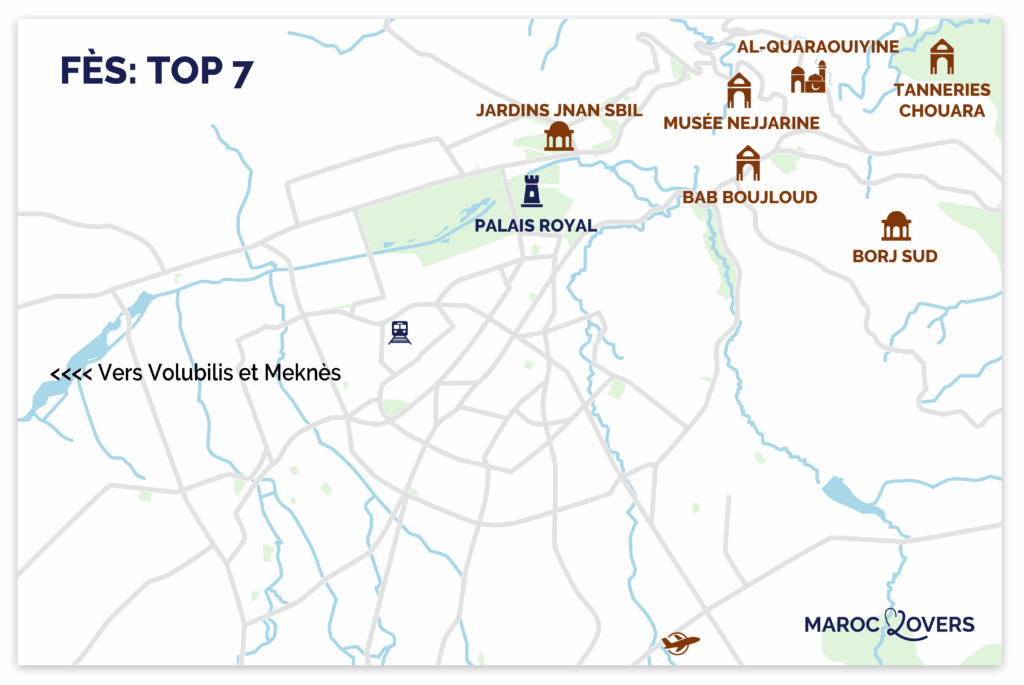
- Here is a map to help you find your way:
How to get to Fez
- By car: Fès is linked by the A2 freeway to Rabat (2h30) and Casablanca (3h15), then Tangiers (4h15) by the A2 and A5 freeways. The roads are good, making it easy to reach the city from the major Moroccan metropolises.
- By train: The ONCF rail network serves Fez from Casablanca, Rabat, Marrakech and Tangier. Trains are frequent and comfortable, a convenient and safe way to travel in Maroc.
- By bus: Companies such as CTM and Supratours link Fès to the main cities. This is the most economical option, with regular departures from Marrakech, Casablanca or Tangiers.
- By plane: Fès-Saïss international airport is a 30-minute drive from the center. It offers direct flights from several European cities (including Paris, Marseille, Lyon, Madrid, Brussels) – See available flights
- Organized excursions or private transfers: If you’re staying in Meknes, Casablanca, Marrakech or Rabat, there are guided tours of one or more days, including transport and visits to Fez.

Parking in Fez
As the medina is car-free, we recommend parking in the official parking lots near the main gates, or choosing accommodation with a parking option. The outdoor parking lot opposite Bab Chorfa and the one behind Bab Boujloud are the most convenient options for visiting the historic center. The new town also offers secure pay parking lots.

Getting around Fez
- On foot: The Fès medina is a veritable labyrinth. Most of the must-see sites can be visited on foot, but bring good shoes and be prepared to get lost: that’s part of the experience!
- By cab or VTC: Official “small cabs” (red in Fès) operate in the new town and around the medina. They are practical and inexpensive (meter required during the day, more expensive at night). VTC services are also available as a safe option.
- By rental car: Renting a car isn’t essential for visiting Fez, but it can come in handy if you’re planning several excursions in the region. Bear in mind, however, that getting around and parking in and around the medina can be tricky: it’s best to park your car in a guarded pay parking lot, and prefer to walk inside the ramparts.
- By large cab: These shared cabs, often white cars, connect Fès with other towns and villages in the surrounding area. It’s a fast, affordable option for long-distance journeys.
- With a local guide: To better understand the medina and avoid going round in circles, hiring an official guide is an excellent idea, especially on a first visit.
You’ll also see horse-drawn carriages in town and around the medina, but this mode of transport is not ideal in terms of animal welfare. We recommend walking or taking a cab, which are more suitable and more respectful.

Where to eat in Fez
Fès abounds in excellent restaurants, from popular gargotes to gourmet eateries set in historic riads. We particularly enjoyed specialties such as pastilla (traditionally served at wedding ceremonies), refined tajines and pastries with honey, almonds and orange blossom water. Some of our suggestions:
- Café-restaurant Moulay Idriss: perfectly executed traditional Moroccan dishes, in an intimate setting on the main Talaa Kebira alley in the medina.
- Restaurant Gayza at Riad Relais & Châteaux: Moroccan cuisine sublimated for a gourmet meal paired with the region’s finest wines in a magical setting.
- Restaurant Ishq: original, colorful bistronomic cuisine featuring local products and artists.

Visiting Fez in winter
Winter is a good time to discover Fès in a different way, with milder temperatures and fewer tourists. You can expect rainy days and lower temperatures between 15°C (59°F) and 18°C (64.4°F). We enjoyed this season for long strolls through the medina and cultural visits without the heavy summer heat. Cool evenings are perfect for enjoying mint tea in traditional riads. If you try your hand at excursions in the region around the Middle Atlas, you may well experience some snowfall. There are several ski resorts in the area, including Michlifen, around 1h30 away.
Other tips
- Islam is the official state religion, so you’ll hear the 5 daily calls to prayer echoing from the minarets of mosques across Maroc.
- Note a particularity of the weekly rhythm: on Friday, the Muslim prayer day, some shops adapt their opening hours or close. But this is not an official holiday.
- On weekends (Saturday and Sunday), some stores close on Saturday, notably those serving the Jewish community, and others on Sunday.
- Maroc remains a modern Muslim country, economically liberal, open to the world, which cultivates a balance between traditions and international dynamics.
Read all our tips for visiting Maroc in our dedicated article – coming soon.
PLAN YOUR TRIP TO Morocco
- Best of
The most beautiful landscapes in Morocco
What to do in Morocco (coming soon)
The most beautiful riads
The most beautiful cities
The most beautiful medinas (coming soon)
The most beautiful gardens (coming soon)
The best museums (coming soon)
The most beautiful beaches in Morocco (coming soon)

- Practical advice
When to go? (coming soon)
How to rent a car in Morocco (coming soon)
Driving tips (coming soon)
Itineraries (coming soon)
Where to stay in Morocco (coming soon)

- The must-dos
Marrakech
Casablanca
Fès
Meknès
Chefchaouen
Sahara Desert (coming soon)

