
Tetouan, nestled between the Mediterranean and the Rif mountains, is a city in northern Morocco whose Andalucia medina, a UNESCO World Heritage Site, is unrivalled anywhere in the country. We were won over by the finesse of its Hispano-Moorish architecture, the wealth of its museums and the uniqueness of this city with its white and green facades. In winter, the city can be discovered in a calm that summer doesn’t always allow.
Here are our tips for visiting Tetouan in winter. In addition, information on how to spend Christmas or New Year in this city at the crossroads of two cultures.
This opinion is completely independent, based on our experiences. We visited the region anonymously, making our own choices and paying our bills in full.
Visiting Tetouan in winter: is it worth it?
Our review
Yes, visiting Tetouan in winter is well worth it in our opinion. We enjoyed discovering this city at a time of year when it regains its daily rhythm, away from the summer tourist flow. You’ll find that the medina can be explored with greater freedom, museums can be enjoyed without queues, and the white and green facades of the Ensanche take on a particularly clear light under the winter sun. The mild Mediterranean climate makes for pleasant strolls, even in January. What’s more, Tetouan is a culturally dense city: between Andalusian heritage, the legacy of the Spanish protectorate, the contemporary art scene and gastronomy rooted in the Mediterranean, you’ll have more than enough to keep you busy for at least two full days. We recommend this destination without hesitation.

Benefits
- The medina and museums can be visited in a calm that summer doesn’t allow.
- The Mediterranean climate remains mild, ideal for daytime strolls.
- Accommodation rates are lower in low season.
- The winter light is remarkable on the city’s white and green facades.
- Museums, galleries and cultural sites remain open and accessible.
- The nearby coast (Martil, M’diq) is ideal for waterside walks.

Disadvantages
- Evenings are cool and damp: bring warm clothing.
- The risk of rain, although moderate, is real in winter.
- The road to Aïn Zarka can be slippery and dangerous in wet weather.
- Swimming in the sea is out of the question for those afraid of the cold (around 16°C – 60.8°F).
- Some shops and tourist hours are reduced in low season.

WHERE TO STAY IN Tetouan
Our favorites: neighborhoods and hotels
By the sea
Sofitel Tamuda Bay Hotel – See prices, photos and availability
St Regis La Bahia Blanca Resort Hotel – See photos and availability
In the Medina
Riad El Reducto Hotel – See prices, photos and availability

Weather, temperatures and conditions
In winter, Tetouan enjoys a mild Mediterranean climate. On the coast, temperatures generally oscillate between 14°C (57.2°F) and 18°C (64.4°F) during the day, dropping to around 8°C (46.4°F) to 10°C (50°F) in the evening. Winter light is clear, especially on the white facades of the medina and the avenues of the Ensanche. Days are shorter, but still long enough to explore the city on foot without the heat.
Make sure you bring a jacket for the end of the day and for the heights of the kasbah, where the wind can make itself felt even in fine weather. Note, however, that the road to the Aïn Zarka waterfall can be slippery in the rain: we advise against going there in wet weather. On the coast, in Martil or M’diq, walks along the water’s edge are still very pleasant even in January.

OUR TIPS FOR RENTING A CAR IN MOROCCO
- Compare prices on our preferred platform: DiscoverCars – one of the best rated sites.
- Not too wide
- A good engine
- For more choice, book early.

What to do in Tetouan in winter
Tetouan has plenty to offer in winter. The absence of crowds of tourists makes cultural discovery enjoyable at this time of year. Here are our suggestions.
Explore the UNESCO-listed medina

Did you know that the medina of Tétouan is unique in Morocco? Entirely shaped by its Andalusian heritage, its white alleyways wind their way up the slopes of the Djébel Dersa with architectural coherence. We were delighted to explore it in winter, enjoying the kind of tranquility that the high season doesn’t allow. The town’s characteristic green and white color scheme – visible on doors, minarets and windows – takes on a special hue under the cold January light. Allow half a day to explore the main arteries and side streets, passing through historic gateways such as Bab el-Okla and Bab Rouah. If you’d like to learn more about Andalucia’s influences and urban organization, opt for a guided tour, including a tasting of Moroccan pastries.
Visit the Dar El Oddi house museum

This is one of our favorites in Tetouan! The Dar El Oddi Museum is a traditional house built in 1927 and patiently restored by the founder’s grandson. Over 2 levels and 7 rooms, you’ll discover paintings, old postcards, rare stamps, family archives and period furniture – all facets of Tetouan memory.

We loved the quiet, intimate patio on the first floor, where the zelliges and furniture create a gentle atmosphere. The top floor offers one of the finest views of the medina rooftops and surrounding mountains. Allow 1h30 to 2h30, depending on your interests. Visit the official website for more info here.
Discover the Archaeological Museum

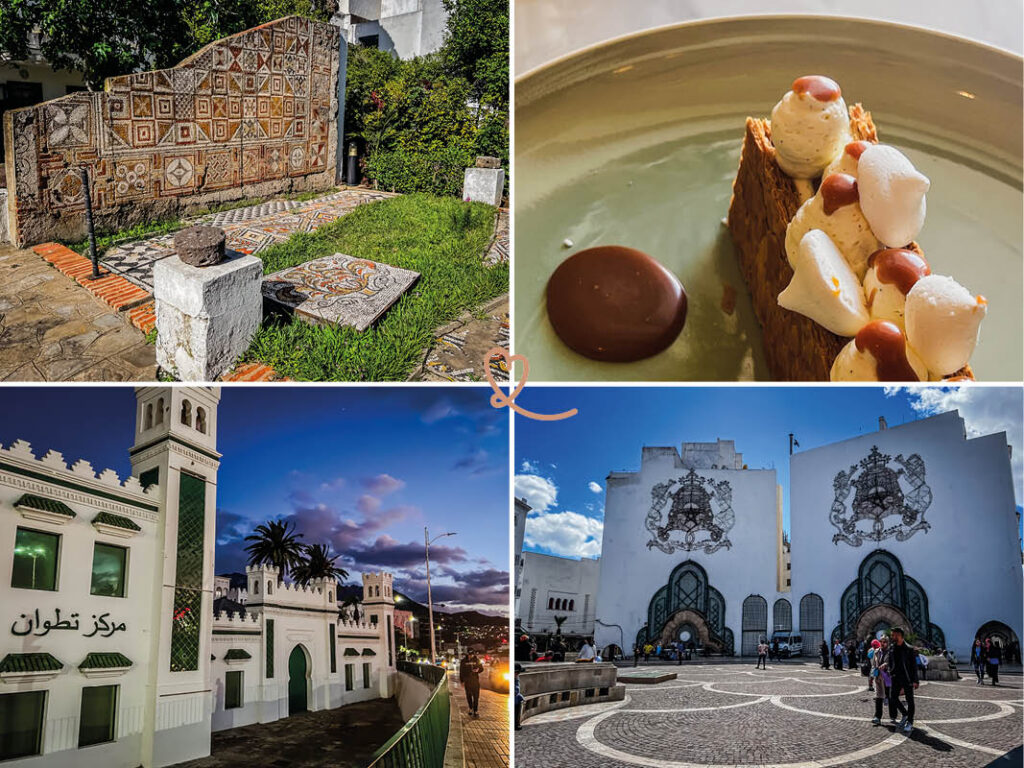
To understand the historical depth of the region, the Tétouan Archaeological Museum is a must. Its collections cover the earliest prehistoric occupations right up to Roman times, with a particular focus on Tamuda, a Mauritanian and then Roman city located just a few kilometers from the center. We admired mosaics, pottery, coins and architectural fragments testifying to the ancient exchanges between northern Morocco and the Mediterranean. The outdoor garden, where other remains stand out among the vegetation, is also well worth a stroll. Visit the official website for more info here.
Immerse yourself in the art scene at the Centre d’art moderne

Housed in the former railway station built in 1918 by Spanish architect Julio Rodríguez Roda, the Centre d’art moderne de Tétouan is both an exhibition venue and a work of art in its own right. The careful restoration of the neo-Moorish style – white facade punctuated with green, semicircular arches – echoes the visual identity of the nearby medina. We also enjoyed the exhibitions exploring the links between Tetouan, the Mediterranean and the artists associated with the city’s School of Fine Arts. In winter, there are no crowds, so you can take your time observing each work. Check out the program before you come on their official page here.
Stroll through the Ensanche district

Designed from 1913 onwards by Spanish urban planners, the Ensanche district is the geometric counterpoint to the medina. Its wide avenues are lined with white buildings accented with aqua green, a chromatic duo found on balconies, shutters and ironwork. In winter, the open sidewalks and low-angled light give this district a particularly pleasant atmosphere for a stroll. We suggest you pass by Place Moulay El Mehdi and the Church of Notre-Dame des Victoires, whose sober neo-Gothic façade is well worth a stop. Cafés, shops and small markets keep this area lively throughout the day. Take a guided tour and learn all about the city and its history!
Admire the kasbah and ramparts

Perched high up, the kasbah offers one of the best views of the medina and the Djébel Dersa hills. We recommend climbing it during the day, to take advantage of the light and observe Tetouan’s clear urban organization: white alleyways running down terraces, minarets punctuating the horizon, mountains framing the city. Be sure to bring good shoes, as the paths are sometimes steep and the steps uneven. In winter, be sure to avoid rainy days, when the ground can be slippery, and bring a jacket or windbreaker.
Visit the Isaac Bengualid synagogue

Located in the new mellah, south of the medina, the Isaac Bengualid Synagogue is an essential place for understanding the religious and cultural plurality that has shaped Tetouan. You’ll be struck by the sobriety and serenity of this restored space, which displays ritual objects, manuscripts and Torah scrolls linked to the city’s Sephardic heritage. At the time the synagogue was built, Tetouan had 16 Jewish places of worship and was one of the most active centers of Sephardic Judaism in Morocco. A visit to be approached in a spirit of respect and listening. Times vary: please contact Elias on +212 6 67 99 21 19.
A nature getaway at the Aïn Zarka waterfall

A 20-minute drive from the center of town, the Aïn Zarka waterfall is a popular nature getaway for Tétouan residents. We found it a welcome spot of tranquillity after a day of cultural sightseeing. In winter, the waterfall’s flow is often more generous and the ochre and green hues of the surrounding landscape particularly beautiful. There’s a café for a break on site, and a small guarded parking lot nearby. The road is winding and sometimes narrow: we advise you to go only in good weather, and to entrust the driving to someone accustomed to mountain roads. Note that there’s a local honey store on site, where you can enjoy a tasting!
Walking in Martil, M’diq and along the coast

In winter, the Mediterranean coast near Tetouan remains accessible and pleasant for walks. Martil, the nearest seaside resort, offers a long, family-friendly beach where you can meet fishermen, strollers and children at play. We appreciated its simple, lively atmosphere, far removed from images of spectacular beaches. Further north, M’diq offers a neat promenade lined with cafés, ideal for a lunch by the sea. These seaside escapades are a great counterpoint to cultural visits to the medina, especially on a fine winter’s day.
Taste the local gastronomy

Tetouan cuisine is intimately linked to the Mediterranean, the gardens of the Rif and the historical movements that have shaped the region. We invite you to try Tetouanese pastilla, grilled fish, harira – a hearty soup served hot, ideal in winter – or morning msemen.

Among our favorites: the Restaurant du Riad El Reducto in the medina, whose historic 17thᵉ century patio combines Moroccan decor and Sevillian tiles; Restaurant La Méditerranée By Robuchon in M’diq, a gastronomic experience on stilts facing the sea; and Brasserie Baie Blanche within the St Regis La Bahia Blanca Resort Hotel in Tamuda Bay, for refined bistronomic cuisine in a contemporary setting. Eating well is also part of the trip!
To find out more, read our full article on what to do in Tetouan!
A LITTLE MORE PATIENCE
All the photos, maps, information and addresses you need to make your stay at Maroc a success will soon be available in a single ebook!
Coming soon!
How to get to Tetouan
There are several options for getting to Tetouan.
- By car: Tetouan is easily accessible by road: from Tangier, allow around 1h15 via the A1 freeway, then the N2 which crosses the Rif foothills; from Chefchaouen, the N2 offers a winding but panoramic route northwards.
The car remains the most flexible option for exploring the surrounding area (Martil, M’diq, Aïn Zarka, archaeological sites…). - By public transport: Regular buses link Tetouan to the main cities in northern Morocco, such as CTM and Supratours, which provide comfortable, air-conditioned connections from Tangiers, Chefchaouen, Ceuta and many other towns in the region. The bus station is located near the Ensanche, making it easy to get to the city center.
- Organized tour: From Tangier or Chefchaouen, opt for a day trip that includes a guided tour of the medina, the main historic sites and free time for strolling or lunch. This is a practical option if you’re looking for a structured first discovery without having to deal with transport logistics. See the options
- By train: Tetouan is not connected to the Moroccan rail network. To get to the region by train, you’ll need to arrive at Tangier-City station (TGV Al Boraq from Rabat, Casablanca, Marrakech; classic trains from Fez and Meknes), then take a cab, bus or rent a car to reach Tétouann.
Read our detailed article on how to get to Tetouan.

Subscribe to our Newsletter
- Get away from it all with Region Lovers’ beautiful destinations!
- Once a month
- Advertising-free

Christmas in Tetouan
Spending Christmas in Tetouan is a singular experience for those seeking to experience the festive season in a different context. The city, which is predominantly Muslim, doesn’t hold Christmas celebrations as such, but the mild winter climate and the serenity of the medina’s alleyways create an atmosphere of calm and contemplation that has its own magic. We loved this different way of experiencing December, in an environment with a multicultural heritage. It’s the perfect time to explore museums, stroll through the Ensanche without the crowds and dine in one of the city’s fine restaurants. Restaurant La Méditerranée By Robuchon in M’diq, overlooking the Mediterranean, is a particularly memorable setting for a festive meal. You can also take advantage of this period to visit the surrounding area, notably Chefchaouen or Tangier, easily reached in less than 2 hours.

New Year in Tetouan
New Year’s Eve in Tetouan offers an original way to end the year. The city doesn’t offer official fireworks displays or large-scale public entertainment, but many restaurants and hotels organize special evenings for the occasion. We recommend that you book in advance, especially at well-known establishments such as the Brasserie Baie Blanche at the Hôtel St Regis in Tamuda Bay, or the Riad El Reducto in the medina. The day after New Year’s Eve, an early-morning stroll through the medina’s still-silent alleyways, or to Martil beach for a breath of sea air, is an excellent way to start the year. You can also take advantage of this low-season period to explore the surrounding area at your own pace, including the Aïn Zarka waterfall or a drive along the Mediterranean coast to M’diq and Fnideq.

DISCOVER Tetouan
