
Do you haveone day to visit Tetouan? Good news—you’ll have plenty of time to explore the main must-see attractions! We especially loved getting lost in the white and green alleyways of its UNESCO-listed medina, before exploring its museums and the neighborhood that dates back to the Spanish Protectorate. With its Andalusian heritage, architecture, and art, the city has some wonderful surprises in store.
Here’s our itinerary for visiting Tetouan in one day, complete with practical tips and a few alternatives to tailor the itinerary to your preferences.
This opinion is completely independent, based on our experiences. We visited the region anonymously, making our own choices and paying our bills in full.
Practical Tips for Visiting Tetouan in 1 Day

What can you see in Tetouan in one day? The must-sees
In just one day, you can already discover the highlights of Tetouan: its Andalucian medina, one or two museums, and the neighborhood that dates back to the Spanish Protectorate. We recommend that you visit at least:
- The Medina of Tetouan, a UNESCO World Heritage Site
- The Dar El Oddi House Museum
- The Ensanche District and Moulay El Mehdi Square
But we also share some alternatives based on your interests. It’s a fairly hilly city, so be sure to wear comfortable shoes and allow enough time to walk between locations so you can get around at a leisurely pace.
To create your own itinerary, check out our selection of the best attractions.

How to get to Tetouan
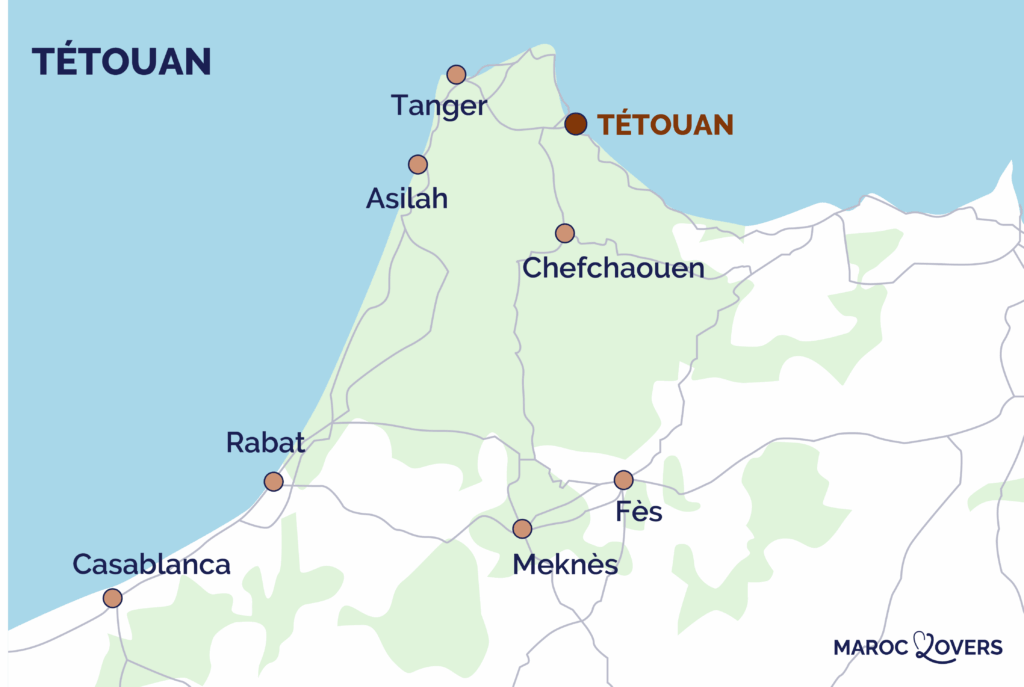
To help you find your way, here is a map showing the location of Tetouan in northern Morocco, between Tangier and Chefchaouen.
By car, it takes about 1 hour and 30 minutes from Tangier, 1 hour and 30 minutes from Chefchaouen, and 1 hour from Ceuta. CTM and Supratours buses also connect the city to the region’s main towns. However, there is no train service to Tetouan; the nearest train station is Tangier-Ville.

And if you don’t want to drive, there are day trips that depart from Tangier— See the options.
This is actually one of the best excursions to take from Tangier—see here.
And if your day is part of a road trip through northern Morocco, check out our article featuring our selection of the best hotels in Tetouan.
Getting around Tetouan
You can explore all of Tetouan on foot. The medina is reserved for pedestrians, and the stops on our itinerary are all within a 15-minute walk of each other. We recommend leaving your car at the paid underground parking garage at Place Feddan or at the Hammadi garage, both a 10- to 15-minute walk from the medina. Be sure to have some change in dirhams (MAD). Nestled against Djebel Dersa, the city is hilly, and the cobblestone streets of the old town often go up and down: sturdy shoes are a must. We haven’t spotted any hop-on, hop-off tourist buses; a car or small taxi will only be useful for getting to the coast or the surrounding mountains.

A LITTLE MORE PATIENCE
All the photos, maps, information and addresses you need to make your stay at Maroc a success will soon be available in a single ebook!
Coming soon!
9:00 a.m.–11:00 a.m.: Explore the Medina of Tetouan, a UNESCO World Heritage Site
Start your day with the Tetouan medina, a UNESCO World Heritage Site. Rebuilt starting in the late 15th century by people from Andalucia, the medina has retained a strong architectural identity. We particularly loved its whitewashed walls and green doors, which add to the charm of Tetouan, nicknamed the “white dove.” You won’t find anything quite like it anywhere else in Morocco. In the morning, the narrow streets remain quiet, and the soft light highlights the facades. We were able to watch artisans opening their workshops and locals running their errands.

To find your way around, keep in mind that major thoroughfares connect the seven historic gates, including Bab el-Okla, Bab Tut, and Bab Rouah. These lead to small squares where fondouks, mosques, zaouias, and artisan shops are clustered. If time permits, take a detour to the Bab Okla Ethnographic Museum, dedicated to local heritage.

- Allow about 2 hours for your first visit.
- Admission is free and open to the public; access is on foot only through the gates of the medina.
- The narrow, steep, cobblestone streets can be slippery in wet weather: opt for a baby carrier instead of a stroller.
- Dress respectfully near places of worship and ask for permission before taking photos of people.
11:15 a.m.–12:45 p.m.: Explore the Dar El Oddi House Museum
In the heart of the medina, the Dar El Oddi House Museum was our favorite spot in Tetouan. Built in 1927, this family home was restored by Jalal El Oddi, the founder’s grandson, and then transformed into a cultural space dedicated to different perspectives on the city. The rooms, spread over two levels, feature paintings and reproductions of works by artists such as Mariano Fortuny and Mariano Bertuchi, as well as antique maps, posters, postcards, and historical documents. We also admired the carved woodwork, the original mosaics, and the 1920s-era tiles. Head up to the terrace, where you’ll enjoy one of the most beautiful panoramic views of the medina’s rooftops and the Rif Mountains.

- Tour duration: 1.5 to 2 hours.
- Admission: 25 dhs (MAD) per person.
- Open year-round Tuesday through Sunday from 10:00 a.m. to 6:30 p.m.; closed on Mondays.
- Steep stairs; no wheelchair access; uncovered terrace—please supervise children. Photos are allowed inside the house but prohibited of the artwork.
- Visit the official website for more information here.

WHERE TO STAY IN Tetouan
Our favorites: neighborhoods and hotels
By the sea
Sofitel Tamuda Bay Hotel – See prices, photos and availability
St Regis La Bahia Blanca Resort Hotel – See photos and availability
In the Medina
Riad El Reducto Hotel – See prices, photos and availability

1:00 p.m.–2:30 p.m.: Lunch in the medina
Tetouan’s cuisine reflects the city’s location between the Mediterranean, Andalucia, and the Rif Mountains. We recommend having lunch in the medina or its surrounding areas, where many restaurants serve home-style cooking. Among the specialties, be sure to try Tetouan-style pastilla, grilled fish, or harira, a hearty soup traditionally served to break the fast during Ramadan. We also enjoyed discovering pastries made from recipes passed down through generations, which can be found in the city’s bakeries and tea rooms.

2:45–3:15 p.m.: Admire the Royal Palace from Place El Mechouar
As you leave the medina through Bab Rouah, you’ll arrive at El Mechouar Square, officially known as Hassan II Square. This vast esplanade connects the old city with the new city. There, we admired the Royal Palace, a fine example of Hispano-Moorish architecture that can only be viewed from the outside. On the left,the Old Palace of the Caliphate, built around 1740 under the name Dar al-Emrat, became the caliph’s residence and the seat of the Spanish protectorate’s administration in 1913.

We found that this square aptly captures the role Tetouan played as the administrative capital of the north during the 20th century. Plan to spend 30 to 45 minutes there. Admission to the square is free, but the two palaces are not open to the public.

OUR TIPS FOR RENTING A CAR IN MOROCCO
- Compare prices on our preferred platform: DiscoverCars – one of the best rated sites.
- Not too wide
- A good engine
- For more choice, book early.

3:15 p.m.–4:45 p.m.: Visit the Archaeological Museum of Tetouan
A 5-minute walk from Bab Rouah, the Tetouan Archaeological Museum traces the history of the region well before the founding of the Andalucian city. Its collections span the period from the earliest prehistoric settlements to Antiquity, with a focus on Tamuda, a Mauritanian and later Roman city located a few kilometers away. There we discovered mosaics, pottery, coins, and inscriptions displayed in simple, well-organized galleries. The exhibit labels helped us understand the techniques and trade routes that connected northern Morocco to the Mediterranean basin. Continue your visit in the garden, where you’ll come across jars, carved stone blocks, and mosaic fragments scattered among the trees.

- Duration of visit: 1 hour to 1 hour and 30 minutes, plus 15 to 30 minutes for the garden.
- Admission: 10 dhs (MAD) per person.
- Open year-round from 10 a.m. to 6 p.m., closed on Tuesdays.
- Only the ground floor is accessible to people with limited mobility; there is no elevator. The garden features dirt and gravel paths.
- Visit the official website for more information here.

5:00–6:15 p.m.: Stroll through the Ensanche neighborhood to the Church of Notre-Dame des Victoires
End your day in the Ensanche Neighborhood, the new city laid out starting in 1913 by Spanish urban planners. Its geometric avenues are lined with white buildings featuring balconies and sea-green shutters, which extend the visual identity of the medina. We loved the lively atmosphere in this area in the late afternoon, when the cafés and shops fill up. On Moulay El Mehdi Square, theNotre-Dame des Victoires Church features a light-colored, neo-Gothic façade; you can go inside to admire its pointed arches and stained-glass windows outside of service times. We found this final stop to be the perfect way to understand how Tetouan blends the old city with the planned city.

- Allow 1 to 1.5 hours to explore the neighborhood and the church.
- It’s a 10-minute walk from Bab Rouah; the sidewalks are wide and the streets are flat, making it easy to navigate with a stroller.
- The church is open to the public free of charge; respectful attire is required; hours vary depending on Mass times. Visit the official website for more information here.

Subscribe to our Newsletter
- Get away from it all with Region Lovers’ beautiful destinations!
- Once a month
- Advertising-free

Option 1: Head up to the Kasbah for a panoramic view of the medina
Instead of the Archaeological Museum, you can climb up to the Kasbah of Tetouan, perched on the city’s hills. We enjoyed the view from the ramparts: the white alleyways of the medina cascade down in terraces, minarets dot the horizon, and the slopes of Djebel Dersa frame the scene. The walls also serve as a reminder of Tetouan’s defensive role, situated between the Mediterranean Sea, the Rif Mountains, and the road to Ceuta. We recommend this climb if you prefer scenic viewpoints to museums, as it allows you to take in the city’s geography at a glance.

Allow 25 minutes to walk from Bab Rouah, then 30 minutes to 1 hour once you arrive. Admission is free. Since signage is limited, plan your route before you go. The steep paths, uneven stairs, and rocky ground make the site unsuitable for people with limited mobility and strollers: be sure to wear sturdy shoes, bring water, and avoid the climb in rainy weather.
Alternative 2: With a culinary tour of the medina
If you’d like to gain a better understanding of the Andalucian influences in the medina, a private guided tour can replace your morning of independent exploration. We found this option helpful for understanding the layout of the neighborhoods, the role of the fondouks, and the history of the gates. The tour ends with a tasting of Moroccan pastries—a great way to sample the local cuisine before lunch. We highly recommend it, especially if this is your first visit to a Moroccan medina.
See details of the gourmet tour

Option 3: Explore the Center for Modern Art in the old train station
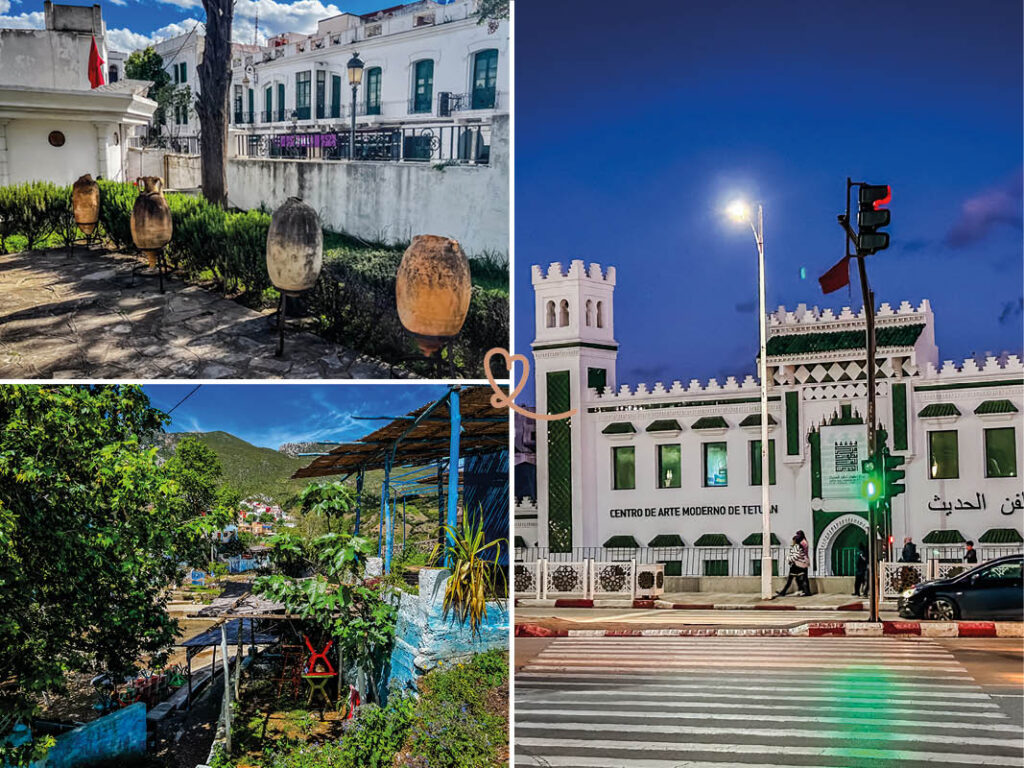
Art lovers may prefer the Tetouan Center for Modern Art to the Archaeological Museum. It is housed in the former train station, built in 1918 by Spanish architect Julio Rodríguez Roda in a Neo-Moorish style: a white façade accented with green, semicircular arches, and clean-lined forms. We explored temporary exhibitions featuring paintings, photographs, and installations, most of which are by artists associated with the Tetouan School of Fine Arts. International artists are also invited to exhibit there. We recommend checking the program before your visit, as each series offers a different perspective on the Moroccan art scene.
- Tour duration: 1h30 to 2h
- Open Tuesday through Saturday from 10 a.m. to 2 p.m. and from 3 p.m. to 6:30 p.m., and on Sunday from 10 a.m. to 4 p.m.; closed on Mondays. A 15-minute walk from Place Feddan, with ground-level access and rooms accessible to people with disabilities.
- Visit the official website for more information here.

Option 4: End the day by the sea in Martil
If you’re driving, you can skip the stroll through the Ensanche and instead take a quick trip to Martil, the closest beach resort to Tetouan, a 15-minute drive away. We enjoyed its family-friendly atmosphere and its long promenade along the Mediterranean, which is popular with locals in the late afternoon. In the summer, the beach is supervised, and a quick dip is a great way to cool off after sightseeing. We found restrooms, playgrounds, and numerous cafés along the coastal road. Parking is available in the paid lots along the waterfront; be sure to have change on hand for the attendants. This applies only if you’re traveling by car.

OUR TIPS FOR RENTING A CAR IN MOROCCO
- Compare prices on our preferred platform: DiscoverCars – one of the best rated sites.
- Not too wide
- A good engine
- For more choice, book early.
What You Need to Know for Your Day in Tetouan

The Crowds in Tetouan
Summer sees the highest number of visitors, particularly along the coast, where Moroccan and international travelers flock. Major religious holidays and festivals also drive up bookings, particularly the Mediterranean Film Festival—which usually takes place in October or November, depending on the year—and the International Andalucian Music Festival, held between late November and early December. We recommend booking your accommodations in advance during these periods. We also prefer spring and fall, when the weather is milder for walking. Finally, check the day of your visit: Dar El Oddi is closed on Mondays and the Archaeological Museum on Tuesdays, while some shops adjust their hours on Fridays.

DISCOVER Tetouan
Adjusting Your Itinerary When It Rains
When it rains, the cobblestones in the medina become slippery, and climbing up to the Kasbah is not recommended. Fortunately, Tetouan has several indoor attractions. We suggest you extend your visit to the Dar El Oddi House Museum and the Archaeological Museum, and then add the Center for Modern Art or the Bab Okla Ethnographic Museum. In the new mellah, the Isaac Ben Walid Synagogue sheds light on the city’s Sephardic heritage; its hours vary depending on the caretakers. We finally found theNotre-Dame des Victoires Church A pleasant spot for a quiet break, away from the offices. Access to the interior is not guaranteed at all times of the day.

PLAN YOUR TRIP TO Morocco
- Best of
Top Destinations
Must-See Places in Morocco
Most Beautiful Riads
Most Beautiful Cities
Most Beautiful Medinas
Morocco’s Most Beautiful Landscapes
Most Beautiful Gardens
Best Museums
Morocco’s Most Beautiful Beaches

- Practical advice
When to go?
How to rent a car in Morocco
Driving tips

- The must-dos
Marrakech
Casablanca
Fez
Meknes
Chefchaouen
Essaouira
Rabat
Tangier
Tetouan
Agadir
The Sahara Desert

