
Tetouan is a city in northern Morocco, nestled between the Mediterranean Sea and the Rif mountains. We were seduced by the uniqueness of its Andalucia-style medina, the sober elegance of its architecture and the diversity of cultural heritages that coexist in its streets. In this article, we share with you 8 reasons to visit this fascinating city.
This opinion is completely independent, based on our experiences. We visited the region anonymously, making our own choices and paying our bills in full.
Is Tetouan worth a visit?
Yes, Tetouan is well worth a visit. We found a rare cultural richness in this city, supported by a UNESCO-listed medina, distinctive Hispano-Moorish architecture and a museum scene that’s richer than you’d expect. For us, it’s one of the most interesting cities in northern Morocco for travelers attracted by heritage and history.
We list the reasons in more detail below. You can also take a look at our selection of the city’s top attractions.

Reason 1 – The Andalucia medina, the only one of its kind in Morocco
The medina of Tétouan occupies a special place in the Moroccan heritage landscape. Listed as a UNESCO World Heritage site, it is the only one in the country to bear such a clear imprint of the Andalucia refugees who largely rebuilt it after the Spanish Reconquest. Spread out over the slopes of the Djébel Dersa, it reveals a coherent, legible urban fabric: main arteries link the main historic gateways – Bab el-Okla, Bab Tut, Bab Rouah – to open spaces where fondouks, mosques and craftsmen’s workshops are concentrated. We were fascinated to explore the narrow streets, sensitive to the logic of circulation that emanates from them. Its visual identity is also unique: the white and green duo found on facades, doors and minarets is one of Morocco’s most recognizable visual signatures. Nicknamed “the white dove”, Tetouan gradually adopted green as a distinctive marker, particularly under the Spanish protectorate. If you want to understand Andalucia influences and urban organization in detail, you can opt for a private guided tour with Moroccan pastry tasting.

WHERE TO STAY IN Tetouan
Our favorites: neighborhoods and hotels
By the sea
Sofitel Tamuda Bay Hotel – See prices, photos and availability
St Regis La Bahia Blanca Resort Hotel – See photos and availability
In the Medina
Riad El Reducto Hotel – See prices, photos and availability

Reason 2 – A unique Hispano-Moorish architectural heritage
Tetouan is more than just its medina. Within its compact perimeter, the city reveals several architectural strata that bear witness to its complex history. The most striking example is Place El Mechouar – known to locals as Place Hassan II. It brings together the Royal Palace, a remarkable example of Hispano-Moorish architecture that is admirable from the outside, and the former Palace of the Khalifaat, whose current appearance dates back to the Spanish protectorate. The latter, named Dar al-Emrat when it was founded in the 18th century, became the Khalifa’s residence and administrative headquarters for the northern zone in 1913. We were struck by the symbolic dimension of this esplanade, at once a daily crossroads and a strong marker of the city’s political history. The Ensanche district, laid out by Spanish urban planners from the start of the Spanish protectorate in 1913, features geometric avenues lined with white buildings highlighted with aqua green. This chromatic duo – found on balconies, ironwork and shutters – plays a key role in Tetouan’s visual identity. The architecture here combines neo-Moorish lines, Mediterranean influences and the sober decorative details characteristic of this period of urban planning.

Reason 3 – A varied museum scene
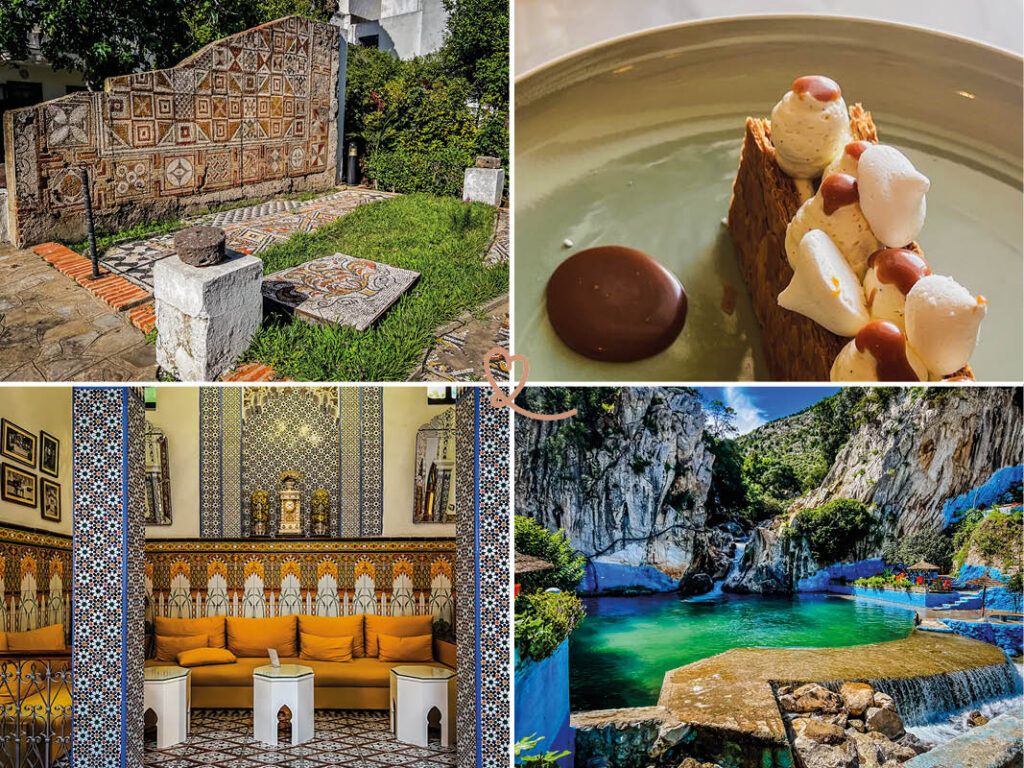
Tetouan has a richer-than-expected museum scene in store for culture lovers. Our favorite is the Dar El Oddi Museum, a traditional house built in 1927 and patiently restored by the founder’s grandson. On two levels, seven rooms display paintings, old postcards, posters, rare stamps, historical maps and original furniture – including paintings by Mariano Fortuny, Mariano Bertuchi and Paul Emil Gabel. The top floor offers one of the finest panoramic views over the rooftops of the medina. We appreciated the intimate atmosphere and the finesse of the architectural work: carved woodwork, original mosaics, modernist tiling and restored ironwork. The Archaeological Museum is a useful complement to this visit, placing the region in the context of a long history, from the earliest prehistoric occupations to the Roman periods, through the remains of Tamuda. Its mosaics, pottery and coins bear witness to the ancient exchanges between northern Morocco and the Mediterranean basin. Finally, the Centre d’art moderne, housed in the former railway station built in 1918 by Spanish architect Julio Rodríguez Roda, offers a program focusing on Moroccan artists associated with the École des Beaux-Arts de Tétouan, as well as international exhibitions. The building, typical of the neo-Moorish style, is a must-see in its own right.

OUR TIPS FOR RENTING A CAR IN MOROCCO
- Compare prices on our preferred platform: DiscoverCars – one of the best rated sites.
- Not too wide
- A good engine
- For more choice, book early.

Reason 4 – An ideal location between the Mediterranean Sea and the Rif mountains
Tetouan’s geography is one of its great strengths. The city grew up between the foothills of the Rif mountains and the Mediterranean, just a few kilometers from the coast. This dual proximity gives it a remarkable natural setting, which is evident from the heights of the kasbah: the white streets of the medina slope down in terraces, framed by the relief of the Djébel Dersa and the sea horizon. We loved this striking contrast between dense city and open landscape. The nearest seaside resort is Martil beach, a 15-minute drive away in good traffic conditions. It’s popular for its lively, family-friendly atmosphere, flat promenade, seaside cafés and Mediterranean waters, making it a natural extension of a day’s cultural exploration. If, on the other hand, you’re looking for peace and quiet, opt further south for M’diq, with its well-groomed promenade and restaurant-lined beach, while Fnideq offers a lively local atmosphere with its small ports and open horizons. You can also explore Tetouan and the surrounding area without a car by opting for an organized tour from Tangier.

Reason 5 – A cuisine combining Andalucia, Morocco and the Mediterranean
Tetouan cuisine bears traces of all the influences that have passed through the city. We savored a cuisine intimately linked to the sea, the surrounding gardens and the region’s history. Among the must-tries: Tetouan pastilla, grilled fish, spice-scented harira – a hearty soup traditionally served to break the fast – and morning msemen, the Moroccan pancakes found in bakeries and tearooms. Traditional family pastries complete the picture. We tested several restaurants and selected three addresses, each reflecting a different face of the region. The Restaurant du Riad El Reducto, in the medina, is housed in a former 17th-century Arab palace renovated in 1948: the harmony between Moroccan decoration and Spanish touches – notably the carefully preserved Sevillian tiles – is also reflected in the dishes. Restaurant La Méditerranée By Robuchon, in M’diq, offers gourmet cuisine on stilts overlooking the sea, where Moroccan and French flavors converse with subtlety. The Baie Blanche Brasserie at the St Regis La Bahia Blanca Resort in Tamuda Bay, meanwhile, offers meticulously-crafted bistronomy rooted in seafood and local produce.

A LITTLE MORE PATIENCE
All the photos, maps, information and addresses you need to make your stay at Maroc a success will soon be available in a single ebook!
Coming soon!
Reason 6 – A city open to many religious and cultural heritages
Tetouan is a city where several religious and cultural histories still coexist legibly. We were touched by this plurality, which can be seen in the streets and monuments. The Isaac Ben Walid Synagogue, located in the new mellah south of the medina, is one of the most moving examples. It owes its name to Rabbi Isaac Ben Walid, a major figure in the Sephardic community and author of the two-volume Vayomer Yitzhak. At the time it was built, Tetouan had sixteen synagogues and was one of the most active centers of Sephardic Judaism in Morocco. The restored space exhibits ritual objects, manuscripts and Torah scrolls.

Equally indicative of this crusader heritage, the Church of Notre-Dame des Victoires stands on Place Moulay El Mehdi, in the heart of Ensanche. This still-active Catholic place of worship, with its sober neo-Gothic architecture, is a reminder of the role played by the Spanish protectorate in the construction of the modern city. We suggest you extend your visit by strolling through the geometric streets of Ensanche, where each facade illustrates a dialogue between tradition and planned modernity. Taken together, these places give Tetouan a rare cultural depth.

Reason 7 – Accessible nature just a stone’s throw from the city
Tetouan is not always thought of as a nature destination, and yet this is one of its discreet qualities. A 20-30min drive from the center, the Aïn Zarka waterfall offers a welcome break for the locals. It’s a good idea if you’re looking for a natural spot away from the off-season crowds. We loved the tranquility of the setting and the green and ochre hues of the surrounding landscape. The site can be visited with no expectation of the extraordinary: it’s above all a local breath of fresh air, an immersion in a calm and accessible natural setting. There’s a café on site where you can take a break, and a store selling local honeys – where we were treated to a welcome tasting – completes the stopover. Note that the winding and sometimes narrow road requires caution: we recommend a daytime visit and confident driving. More widely, the Rif foothills that frame the town offer accessible walks, including the climb to the ramparts and the kasbah, which offers a panoramic view of the medina and surrounding hills. But most hikes require a vehicle to reach the starting points. This vantage point enabled us to grasp the geography of Tetouan at a glance: white terraced streets, minarets punctuating the horizon and mountains in the background. For lovers of the great outdoors, Mount Jebel Moussa, accessible from the surrounding area in around 1h15min by car from Tetouan, offers spectacular panoramic views of the Strait of Gibraltar.

Reason 8 – An ideal base for exploring northern Morocco
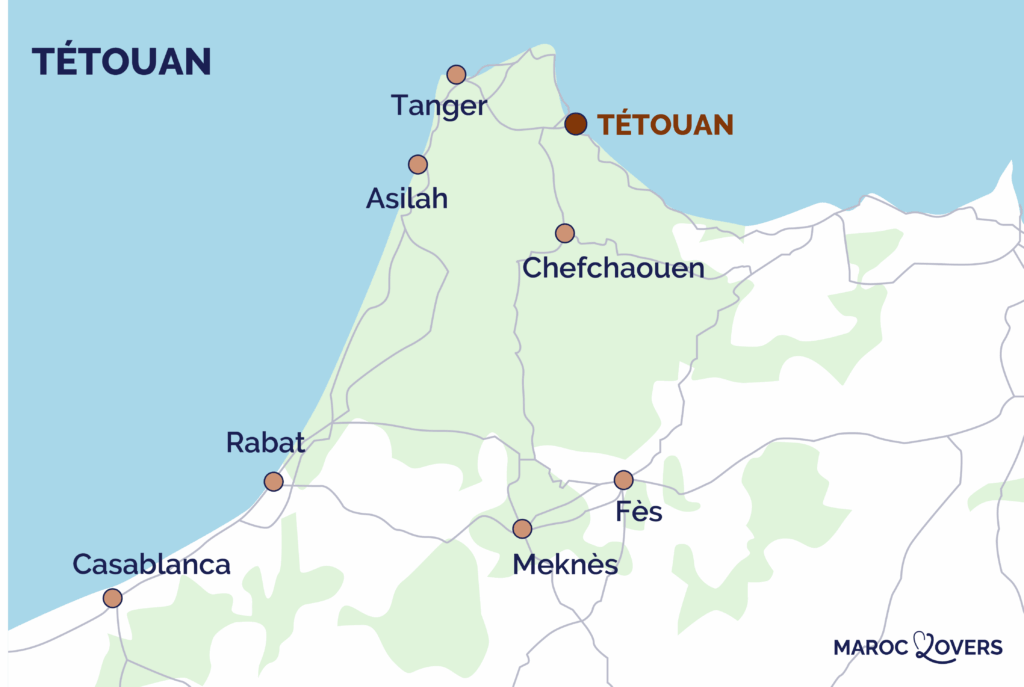
Tetouan enjoys a remarkable geographical position in northern Morocco, between Tangiers (1h30 away), Chefchaouen (1h25 away) and Ceuta (1h away). This makes it an efficient base from which to explore the region without ever having the impression of passing through a transit zone. From Tetouan, we explored several destinations that are well worth a visit. Chefchaouen, the famous “blue pearl of the Rif”, is the first to come to mind. Its painted alleyways and mountain atmosphere make it a must-see. Tangier, a major port city rich in history, also deserves a day out in its own right. Ceuta (Sebta), a Spanish enclave on the border, offers an unusual blend of European and Moroccan influences – you can even opt for a guided tour of its old town. Finally, the Akchour waterfalls in the Rif, accessible by hiking from Chefchaouen, and Asilah, a small coastal town known for its walls and art festival, further enrich the itinerary. To make the most of the surrounding area, we recommend renting a car.

Subscribe to our Newsletter
- Get away from it all with Region Lovers’ beautiful destinations!
- Once a month
- Advertising-free

Some disadvantages of a trip to Tetouan
A hilly town with demanding lanes
Tetouan is built at the foot of the mountains, and you can feel it when you walk. The medina has cobbled streets, often on slopes, with irregular steps that can be slippery in wet weather. We advise you to bring good shoes with non-slip soles. Strollers are unsuitable for this environment: a baby carrier would be much more practical. The kasbah and ramparts, accessible on foot, also require a certain degree of physical ease. The modern city, on the other hand, has wide sidewalks and flat streets, which are much easier to navigate for all types of travelers.

Limited public transport and no trains
Tetouan is not connected to the Moroccan rail network. To reach the city from Casablanca, Rabat or Marrakech, you need to take the train to Tangier-City, then connect by cab, bus or rental car. Companies such as CTM and Supratours provide comfortable bus connections from Tangier, Chefchaouen or Ceuta, with a terminus close to Ensanche. We found that this access required more organization than elsewhere. If you want to explore the coast and surrounding area at your own pace – Martil, M’diq, Aïn Zarka, the archaeological sites – we think the car is the most flexible solution.

More visitors in summer and during festivals
In summer, the coastal strip between Tétouan, Martil and M’diq attracts many Moroccan and international travelers. The crowds can make travel slower and accommodation harder to find. Several annual festivals also amplify this phenomenon: the Mediterranean Film Festival (usually late October – early November), the National Theatre Festival and the International Andalucia Music Festival (between late November and early December). These events enrich the experience of the city, but we recommend that you book your accommodation as early as possible during these periods. Spring and autumn remain the most pleasant seasons to visit Tetouan in good conditions. Read our advice on where to stay in Tetouan here.

DISCOVER Tetouan
How to get to Tetouan
Tetouan is located in northern Morocco, between Tangiers (1h30 drive) and Chefchaouen (1h25 drive). You have several options:
- By car: from Tangier, allow around 1h30 via the A1 freeway and then the N2; from Chefchaouen, the N2 offers a winding but panoramic route northwards. The car remains the most flexible option for exploring the surrounding area.
- By bus: CTM and Supratours provide air-conditioned connections from Tangier, Chefchaouen and sometimes Ceuta. The bus station is located near Ensanche, close to the city center.
- By train: Tetouan is not served by the Moroccan rail network. You need to get to Tangier-City station (accessible from Casablanca, Rabat or Marrakech via the TGV Al Boraq or conventional trains), then take a cab or bus to Tetouan.
- Organized tour: from Tangier or Chefchaouen, a guided day trip is a good option for a first discovery. See available options.
PLAN YOUR TRIP TO Morocco
- Best of
Top Destinations
Must-See Places in Morocco
Most Beautiful Riads
Most Beautiful Cities
Most Beautiful Medinas
Morocco’s Most Beautiful Landscapes
Most Beautiful Gardens
Best Museums
Morocco’s Most Beautiful Beaches

- Practical advice
When to go?
How to rent a car in Morocco
Driving tips

- The must-dos
Marrakech
Casablanca
Fez
Meknes
Chefchaouen
Essaouira
Rabat
Tangier
Tetouan
Agadir
The Sahara Desert

