
Are you considering Agadir for your next vacation?
An excellent idea, this Moroccan seaside town will enable you to enjoy beautiful beaches, discover a lively souk and explore the region.
But before you go, here are all the details to answer your question: How safe is Agadir?
Find out all our tips for a carefree vacation!
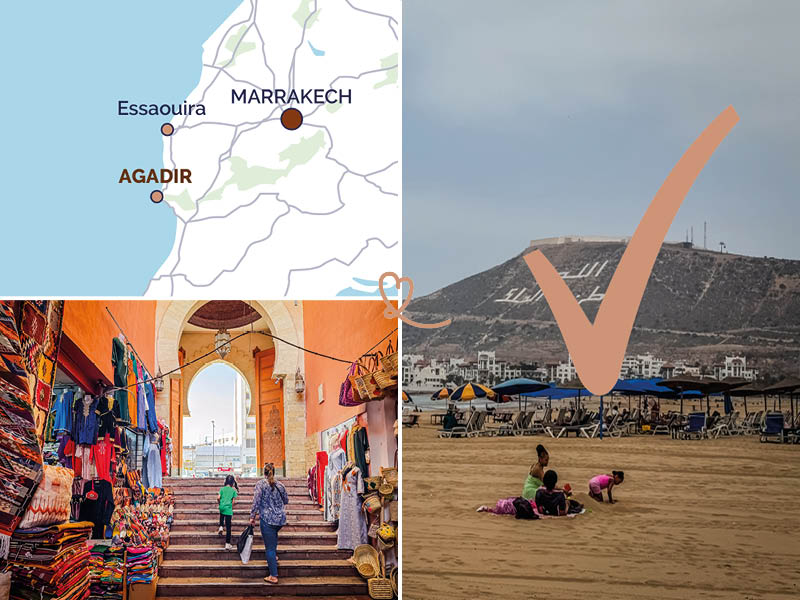
This opinion is completely independent, based on our experiences. We visited the region anonymously, making our own choices and paying our bills in full.
How safe is Agadir? Quick response
Yes, on the whole, Agadir is a safe destination for travelers. The city is one of Morocco’s most popular tourist destinations, and welcomes large numbers of visitors every year without major incident.
The few risks to be aware of are pickpocketing in busy areas, the sometimes insistent salesmen in the souk, the sun which can be intense, and a few classic tourist destination scams.
Agadir nevertheless remains a welcoming city where it’s good to stay.
Agadir is a city in Morocco where Moroccan laws apply. Morocco is a constitutional monarchy whose state religion is Islam. We always recommend taking the usual precautions as you would in any destination.
Seismic risks

Agadir suffered a devastating earthquake on February 29, 1960, which destroyed almost the entire city. Following this tragic event, Agadir was completely rebuilt to strict, modern earthquake-resistant standards. Today’s buildings are designed to withstand earthquakes. Low-intensity tremors are still possible in the region, but major risks remain limited thanks to adapted construction and the regulations in force.
Advice
If you feel a tremor during your stay, stay calm and take shelter under a solid piece of furniture such as a table, or in a doorway. Keep away from windows, mirrors and objects that could fall. When the shaking is over, calmly exit the building by the stairs (never by elevator) and move to an open area away from buildings. Follow any instructions issued by local authorities.
Risks in the ocean

Agadir’s main attraction is its magnificent, kilometre-long beach.
The beach is generally safe for swimming, thanks in particular to the presence of lifeguards during the high season. Note that even good swimmers can be surprised: the waves can be powerful and the currents sometimes strong. We therefore recommend that you limit yourself to the indicated swimming areas and respect the signposts. On the other hand, you should know that there is no danger from marine animals: swimming in Agadir presents no risk of dangerous jellyfish or sharks. Finally, beware of the sun! Remember to protect yourself.
OUR TIPS FOR RENTING A CAR IN Maroc
- Compare prices on our preferred platform: DiscoverCars – one of the best rated sites.
- Adapt your choice of vehicle to your itinerary!
- For more choice, book early.

Read our tips (coming soon)
Theft and incivilities

As in all tourist destinations, you’ll find petty crime such as pickpocketing, especially in crowded areas such as the Souk El Had, the Corniche or shopping areas.
In crowded places, some may try to distract you while an accomplice tries to take something from your bag.
Car thefts are still rare, but objects left visible inside attract opportunists, particularly in poorly supervised parking lots or by the beach.
Tips:
Be careful not to leave anything visible in the car to tempt would-be thieves. In crowded areas, keep your valuables safe. We suggest carrying a bag slung over your shoulder rather than on your back. Never leave your belongings unattended on the beach. Use guarded parking lots or hotel car parks to reduce the risk considerably.
WHERE TO STAY IN Morocco
Our independent picks for the accommodation of your dreams:
- Where to stay in Morocco (coming soon)
- The most beautiful riads in Morocco
Select by city:
- Best hotels in Marrakech
- Best hotels in Casablanca
- Best hotels in Rabat
- Best hotels in Tangier
- Best hotels in Fez
- Best hotels in Tetouan
- Best hotels in Meknes (coming soon)

Tourist scams

Agadir has its share of classic tourist destination scams. We have observed several recurring situations that you should be aware of.
Common scams to be aware of:
- Fake tour guides who approach you on the street to take you to stores where they earn a commission
- Cabs that refuse to use the meter and offer inflated fares
- People who present themselves as “friends” to help you, then ask for money
- Tourist restaurants with attractive prices but unadvertised extras on the bill
- Souk vendors advertising very high prices, knowing that you will negotiate
Advice:
- Before getting into a cab, make sure the meter is on or agree a price in advance.
- Choose official cabs (often red in Agadir)
- Avoid following unofficial people who spontaneously offer their services as guides.
- In the souks, remain courteous but do not hesitate to end the discussion if the sale becomes too insistent.
- Always check the restaurant bill before paying
Safety for women travelers

Women can travel to Agadir without any particular difficulties, but it’s best to keep certain precautions in mind. Verbal harassment can occur, especially on public transport and near tourist sites. Some travelers choose to wear revealing clothing to feel more comfortable in the face of insistent stares. Note, however, that this remains a personal choice, as women are free to dress as they wish in Morocco. In fact, you’ll find a wide variety of clothing styles on the streets. Tourist areas such as the Marina or the Corniche are generally more accustomed to the presence of tourists in summer attire.
Women can book and stay alone in Agadir hotels without difficulty. This situation is commonplace and perfectly acceptable.
Tips for women traveling alone:
- In non-touristy areas, choose clothing that covers shoulders and knees.
- Avoid walking alone late at night in dimly lit alleys.
- Remain confident and firm if someone insists on accompanying you or selling you something.
- Favour official cabs recognizable by their meters
- Trust your instincts and don’t hesitate to refuse a situation that makes you feel uncomfortable.
A LITTLE MORE PATIENCE
All the photos, maps, information and addresses you need to make your stay at Maroc a success will soon be available in a single ebook!
Coming soon!
Traffic hazards and pollution

Traffic in Agadir can seem dense at first, especially if you’re not used to driving in Moroccan cities. Right-of-way rules are not always respected, scooters weave in and out of cars and pedestrians sometimes cross without looking.
We also noticed that the horn is frequently used as a means of communication between drivers.
As a pedestrian, stay alert because crosswalks are not always respected. Always look both ways before crossing, even on a protected crossing.
As far as pollution is concerned, Agadir enjoys a more favorable situation than other major Moroccan cities, thanks to its seaside location and the ocean winds that renew the air. Air quality is generally good, except perhaps at rush hour in areas with the heaviest traffic.
Counterfeiting

You’ll find plenty of counterfeit goods in Agadir, especially in the El Had souk. We remind you that it is illegal to possess counterfeit products in most countries, including Morocco. Beyond the legal aspect, these products are often of mediocre quality and don’t last.
If you want to bring back authentic souvenirs, why not focus on local Moroccan crafts? Berber rugs, pottery, leather goods, spices or argan products. These purchases also support the local economy.
Is it dangerous to drive in Agadir?

Driving in Agadir is not particularly dangerous, but it does take some getting used to. Driving can be a challenge for the unaccustomed, but you need to be aware of the dense traffic, traffic jams and the local driving style.
Tips for driving in Agadir:
- Stay alert and anticipate the unpredictable behavior of other vehicles, including motorcycles and bicycles.
- Avoid driving at night if possible, as street lighting is sometimes inadequate.
- Anticipate priorities
- Park in guarded parking lots rather than on the street
- Don’t leave anything visible in your vehicle to avoid temptation
Outside Agadir, the main roads to regional attractions such as Paradise Valley or Taghazout are in fair condition. Just beware of occasional potholes and animals that may cross in rural areas.
Subscribe to our Newsletter
- Get away from it all with Region Lovers’ beautiful destinations!
- Once a month
- Advertising-free

Is it safe to drink the water in Agadir?

We advise against drinking tap water in Agadir. There is no serious health risk, but it can cause digestive problems for unaccustomed visitors.
Choose bottled, sealed water, which is available throughout the city at a modest price. Always check that the bottle is properly sealed before you buy it.
Tap water is generally fine for brushing your teeth, but if you have a sensitive stomach, use bottled water too.
Emergency numbers in Agadir
Keep these numbers handy during your stay:
- General emergency number from a cell phone: 112
- Police: 19
- Royal Gendarmerie: 177
- Fire and medical emergencies: 15
Agadir’s medical infrastructure is well suited to a city of its size. There are several hospitals and private clinics equipped to deal with common medical emergencies. The medical staff generally speak French and sometimes English.
However, we advise you to take out travel insurance before you leave, as treatment may be billed directly.
Neighborhood safety
Agadir has no truly dangerous neighborhoods for tourists. The city was completely rebuilt after the 1960 earthquake according to a modern urban plan, creating a clear, airy organization.
How safe is the Agadir Marina?

Agadir Marina is generally a safe neighborhood for tourists. This modern, well-appointed area is home to numerous restaurants, cafés and stores. We found it a pleasant place to stroll in the evening, as it is well-lit and busy.
As everywhere, you should be vigilant about your personal belongings, especially on restaurant terraces where bag snatching can occur. Prices at the Marina are often higher than elsewhere in town, which is to be expected in a tourist area.
Is Souk El Had safe?

The Souk El Had is one of Morocco’s largest covered markets, open every day except Monday. On the whole, it’s a safe place, but you need to be extra vigilant.
We recommend that you keep your valuables safe, as the dense crowds make pickpocketing easy. Vendors are often very insistent, which can create a heavy atmosphere for some visitors. Don’t hesitate to refuse firmly with a “La’ shukran” (“No thanks” in Arabic) and move on if you don’t want to buy.
Haggling and bargaining are an integral part of the souk experience. Initial prices are usually high. We’ve found that prices can be halved by calm negotiation. If the seller refuses your offer, you can walk away – he’ll often call you back to accept your price.
How safe is Agadir beach?

Agadir’s beach is generally a safe place for tourists. This long, sandy beach is supervised during the tourist season and is very popular, which limits certain risks.
Beware, however, of theft of belongings left unattended. We advise you never to leave valuables on your towel while swimming. Some hotels offer beach lockers, an interesting option if you want to keep your phone or money safe.
Street vendors regularly roam the beach offering drinks, snacks or handicrafts. They can sometimes be insistent, but generally remain respectful after a polite refusal. Swimming is supervised on certain stretches of the beach, identified by the presence of lifeguard posts.
PLAN YOUR TRIP TO Morocco
- Best of
The most beautiful landscapes in Morocco
What to do in Morocco (coming soon)
The most beautiful riads
The most beautiful cities
The most beautiful medinas (coming soon)
The most beautiful gardens (coming soon)
The best museums (coming soon)
The most beautiful beaches in Morocco (coming soon)

- Practical advice
When to go? (coming soon)
How to rent a car in Morocco (coming soon)
Driving tips (coming soon)
Itineraries (coming soon)
Where to stay in Morocco (coming soon)

- The must-dos
Marrakech
Casablanca
Fès
Meknès
Chefchaouen
Sahara Desert (coming soon)

