
Morocco is a multifaceted destination: deserts with golden dunes, labyrinthine medinas, imposing mountains, rugged coastlines, and cities steeped in history. This country will captivate you as much with the richness of its heritage as with the diversity of its landscapes.
Here is our selection of the best things to do in Morocco and the must-see places to visit to help you plan your trip.
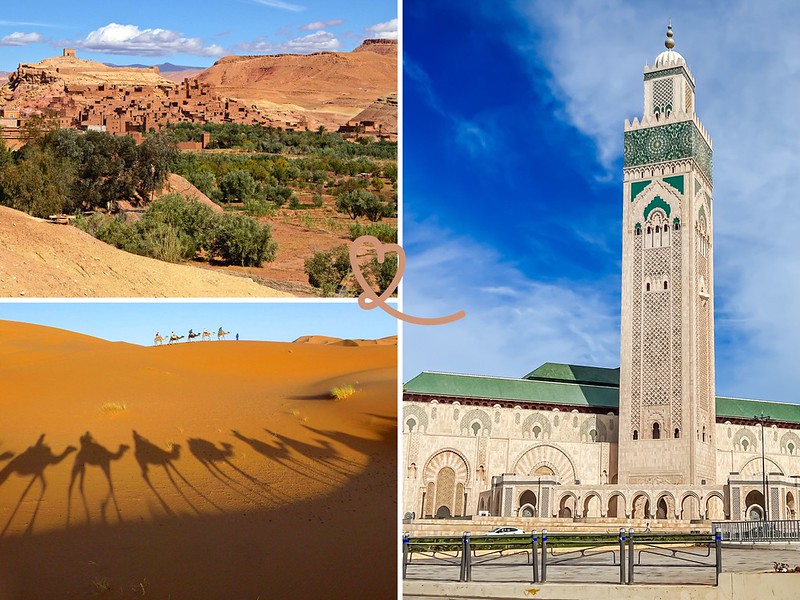
This opinion is completely independent, based on our experiences. We visited the region anonymously, making our own choices and paying our bills in full.
Must-See Attractions in Morocco: A Selection and Map
It’s really hard to choose just 21 places. The country is rich in cities, monuments, and exceptional natural sites.
Here is our personal selection, which showcases different aspects of Morocco, along with a map to help you locate all the places mentioned in this list:
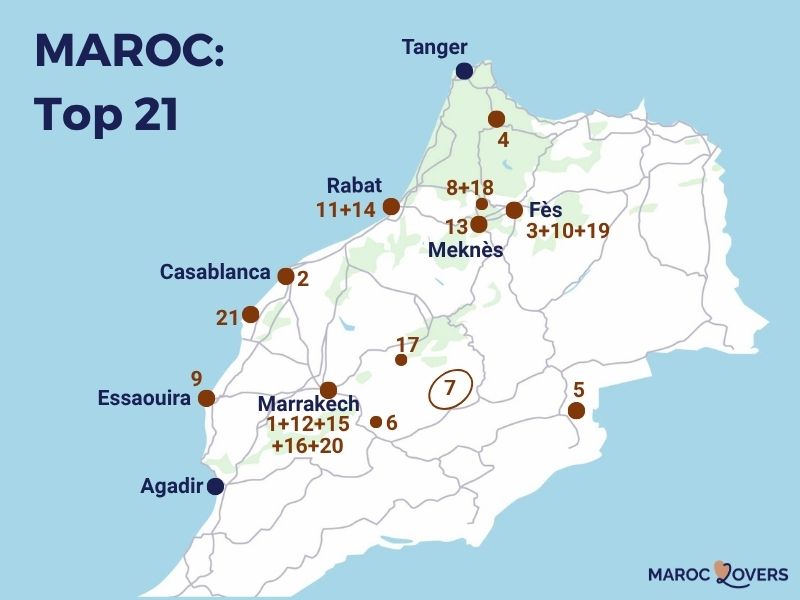
This map doesn’t show the magnificent beaches and cliffs of Legzira. They deserve a spot on this top 21 list, but they’re a 3-hour drive south of Agadir, so they’re not easy to fit into a trip. We’re mentioning them as a bonus.
1. The Medina of Marrakech and Jemaa el-Fna Square (UNESCO)

Why it’s a must
Jemaa el-Fna Square is the beating heart of Marrakech. This square transforms from morning to night: stalls selling fresh orange juice in the morning, musicians and storytellers in the afternoon, and open-air food stalls in the evening. We were captivated by the energy that radiates from this unique place. The medina that surrounds it is a labyrinth of narrow streets lined with artisan souks, riads, fountains, and mosques. We highly recommend getting lost there—it’s the best way to experience the city’s atmosphere.
For travelers visiting Marrakech for the first time, it’s important to know that the medina is vast and that finding your way around can be difficult. The souks are generally organized by trade: dyers, metalworkers, leatherworkers, and spice merchants.

Practical advice
- The square is within walking distance of most accommodations in the medina
- Plan to spend at least half a day on this tour, preferably in the morning when it’s not as hot.
- Plan your visit for late afternoon or evening to enjoy the liveliest atmosphere
- The café terraces around the square offer a panoramic view of the entire esplanade
- Prices in the souks are negotiable: it’s customary to haggle—it’s part of the experience
- Book a guided tour of the medina of Marrakech
2. Hassan II Mosque, Casablanca

Why it’s a must
The Hassan II Mosque in Casablanca is an architectural marvel that impressed us with its grandeur and the finesse of its craftsmanship. Built between 1987 and 1993, it boasts the world’s tallest minaret, rising to 210 meters. The variety of local materials used is remarkable: marble from Agadir, cedar wood from the Atlas Mountains, and tadelakt (a traditional plaster derived from Berber craftsmanship).
We were fascinated by the exquisite details of the prayer hall, particularly the Venetian chandeliers, the 1,100-metric-ton retractable roof, and the stunning zellige patterns. A total of 10,000 Moroccan artisans contributed to the construction of this building.
Read more in our article.

Practical advice
- The mosque is one of the few religious buildings in Morocco that are open to non-Muslim visitors
- A guided tour is required to enter the building; tours are offered several times a day
- Please wear clothing that covers your shoulders and knees
- The outdoor esplanade is open to the public and offers beautiful views of the ocean
- Book your admission ticket for the guided tour

It’s time to book!
Compare everything: companies, prices, schedules and availability.
3. Medina of Fez (Fez el-Bali, UNESCO)

Why it’s a must
Fès el-Bali is the largest medieval medina in the world and a UNESCO World Heritage Site. Founded in the 8th century, it has more than 9,000 narrow streets lined with artisans, mosques, madrasas (historic Koranic schools), and fondouks (former caravanserais). We were struck by the intensity of this city-within-a-city, where mules still replace cars for transporting goods.
The architecture is remarkably refined, featuring carved doors, zellige fountains, gardens, and shaded courtyards. We recommend that you take the time to immerse yourself in this medina without trying to see everything in a single visit.

Practical advice
- A local guide is highly recommended for first-time visitors, given how dense the network of narrow streets is
- The main entrance gates are Bab Boujloud (the blue gate) and Bab Rcif
- Be sure to wear comfortable shoes: the ground is often uneven, and there are frequent uphill sections
- The souks usually close in the late afternoon and on Fridays at prayer time
- See our complete guide to Fez
4. Chefchaouen (the Blue City)

Why it’s a must
Nestled in the Rif Mountains, Chefchaouen charms visitors with its narrow streets painted entirely in blue. We spent hours getting lost in the medina, admiring the different shades of blue that adorn the walls, doors, and staircases. Every street corner holds a visual surprise. The origin of this color remains a subject of debate: some attribute it to Jewish tradition, while others cite more practical reasons, such as protection against insects.
Beyond its photographic appeal, the city offers a relaxing setting where life moves at a noticeably slower pace than in the country’s major cities. We also enjoyed the cool climate in the summer, thanks to the altitude.
See more photos and our guide to Chefchaouen

Practical advice
- Chefchaouen is about a 2-hour-and-20-minute drive from Tangier, 4 hours from Fez, and 4 hours and 15 minutes from Rabat
- Plan to stay at least one night to enjoy the evening atmosphere, once most of the day-trippers have left
- Hiking trails in the nearby Rif Mountains are accessible from downtown
- The local market is held every Monday and Thursday
- Organized tours available from Tangier and Fez— see options
5. Erg Chebbi Dunes, Merzouga (Sahara)

Why it’s a must
The Erg Chebbi dunes, near Merzouga, are among Morocco’s most iconic sites. These sand dunes reach heights of 150 meters and stretch about 22 kilometers from north to south. We were captivated by the golden and orange hues that change throughout the day.
Watching the sunrise from the top of a dune is a breathtaking sight, as the fiery colors set the landscape ablaze. We recommend spending the night camping to fully enjoy this experience and gaze at the stars in a sky of rare clarity.

Practical advice
- Merzouga is about a 9-hour drive from Marrakech and a 7-hour drive from Fez: it’s not a day trip from the major cities
- Most travelers include this visit as part of a multi-day tour that takes them through the Dades and Todra Gorges
- Camel treks usually depart in the late afternoon to reach the campsite at sunset
- Be sure to pack warm clothes for the night, even in the summer: temperatures drop sharply in the desert
- See excursions in the Merzouga Desert
WHERE TO STAY IN Morocco
Our independent picks for the accommodation of your dreams:
- Where to stay in Morocco (coming soon)
- The most beautiful riads in Morocco
Select by city:

6. Aït Benhaddou (UNESCO ksar)

Why it’s a must
Listed as a UNESCO World Heritage Site, the Ksar of Aït Benhaddou is a strikingly beautiful fortified city. Its red-ochre adobe buildings stand on a hill, forming a silhouette that has attracted many filmmakers: *Gladiator* and *Game of Thrones*, among others, were filmed there.
We particularly enjoyed the view from the top of the ksar, which overlooks the entire valley with the Atlas Mountains in the background. The site is still home to a few families who continue to live a traditional way of life. And from certain angles, the town really does look like a sandcastle!

Practical advice
- Located about 30 km from Ouarzazate, on the road between Marrakech and the desert
- It’s best to visit early in the morning or late in the afternoon to avoid the heat and take advantage of the ideal light for photos
- To reach the ksar, you must cross the river on foot (via a footbridge or by wading, depending on the season)
- The climb to the summit is short but steep: be sure to wear closed-toe shoes
- Admission to the site is free; local guides offer their services on site
7. The Dadès and Todra Gorges

Why it’s a must
The Dades Gorge offers an impressive geological spectacle where the river has carved its way through the red rocks over millions of years. The road that runs through it winds between dizzying cliffs and rock formations sculpted by erosion.
Traditional kasbahs dot the landscape and bear witness to the region’s ancient architecture. Along the way, don’t miss the Monkey Fingers, those vertically standing stone columns formed by millions of years of erosion on the limestone rock.
Not far from there, the Todra Gorge is one of Morocco’s most spectacular canyons. The rock walls rise to a height of 300 meters and narrow in places to leave only a passageway a few dozen meters wide.

Practical advice
- The Dadès Gorges are located north of the town of Boumalne Dadès, on the “Road of a Thousand Kasbahs” between Ouarzazate and Errachidia
- The road is paved but winding; driving requires caution
- There are several hiking trails that allow you to explore the gorges more intimately
- The Todra Gorge is located about 15 km from the town of Tinghir. The narrowest and most impressive section can be explored on foot in about 30 minutes. The light is best in the morning when the sun shines into the canyon.
- The Dadès Valley and the gorges can easily be combined into an itinerary that includes the Todra and Merzouga
8. Volubilis (Roman ruins, UNESCO)

Why it’s a must
The archaeological site of Volubilis, a UNESCO World Heritage Site, is well worth a visit. This ancient Roman city, founded in the 3rd century B.C., reached its peak during the Roman Empire before being gradually abandoned in the 11th century.
We loved strolling around the site, among the remains of columns, the remarkably well-preserved mosaics, and the panoramic views of the surrounding valley. Caracalla’s Triumphal Arch and the House of Orpheus are among the most impressive features. The lush vegetation surrounding the ruins enhances the atmosphere of the site.

Practical advice
- Located about 30 km from Meknes and 60 km from Fez
- Allow 1½ to 2 hours for a complete tour of the site
- There is very little shade: be sure to bring a hat, sunscreen, and plenty of water
- This tour can easily be combined with a visit to Moulay Idriss Zerhoun, just 5 km away
- There are many excursions available from Fez
OUR TIPS FOR RENTING A CAR IN Maroc
- Compare prices on our preferred platform: DiscoverCars – one of the best rated sites.
- Adapt your choice of vehicle to your itinerary!
- For more choice, book early.

Read our tips (coming soon)
9. Essaouira Medina (UNESCO)

Why it’s a must
Essaouira offers a side of Morocco that is radically different from the major inland cities. This port city, whose medina is a UNESCO World Heritage Site, combines 18th-century Portuguese fortifications, white and blue alleyways, and a seaside atmosphere enhanced by the trade winds.
We loved watching the activity at the port at the end of the day, when the fishermen unload their catch as the seagulls look on. The sunset from the ramparts is a sight not to be missed. The city is also famous for its Gnaoua music festival and its art galleries.

Practical advice
- Essaouira is about a 2½-hour drive from Marrakech
- It’s often windy: be sure to bring an extra layer, even in the summer
- The long beach is popular with surfers and kitesurfers
- Take a seat along the ramparts or on the beach to enjoy the golden hues of the sunset over the ocean
- Learn more in our article on Essaouira
10. Chouara Tannery, Fez

Why it’s a must
The Chouara Tannery in Fez carries on an ancestral craft that has been passed down from generation to generation for centuries. We observed the natural dyeing of the leather—a captivating spectacle: red from poppies, blue from indigo, orange from henna, green from wild mint, brown from cedar, and yellow from saffron or turmeric.
More than 250 families work in these tanneries, a figure that underscores the importance of this industry to the city. The bird’s-eye view from the terraces of the surrounding shops reveals a scene of colorful vats unlike any other in the world.

Practical advice
- Access to the panoramic terraces is through the leather shops located around the tanneries; you’ll often be offered a sprig of mint to mask the odors
- Access to the terraces is free, but a small contribution is usually expected
- The morning offers the best light and the most intense activity
- The shops offer leather goods at attractive prices, which are negotiable
- Guided tours of Fez include a stop at the tanneries. It’s worth it to gain a better understanding of the city. See options.
A LITTLE MORE PATIENCE
All the photos, maps, information and addresses you need to make your stay at Maroc a success will soon be available in a single ebook!
Coming soon!
11. Hassan Tower and Mohammed V Mausoleum, Rabat

Why it’s a must
The monumental complex comprising the Hassan Tower and the Mohammed V Mausoleum is one of Rabat’s most iconic sites. The Hassan Tower, an unfinished minaret dating from the 12th century, was intended to be the tallest religious tower in the world. We were fascinated by its imposing proportions and the remains of the mosque that was never completed, whose hundreds of columns bear witness to the ambition of the original project.
Across from the tower, the Mohammed V Mausoleum impresses with its richly decorated interior. This site, guarded by the Royal Guard in traditional dress, houses the tombs of King Mohammed V and his sons.

Practical advice
- The site is located right in the heart of Rabat and is easily accessible by tram
- Admission to the esplanade and the mausoleum is free
- Appropriate attire is required to enter the mausoleum
- Allow about 45 minutes for the tour of the entire complex
- Read more in our article.
12. Majorelle Garden and Yves Saint-Laurent Museum, Marrakech

Why it’s a must
Designed by the painter Jacques Majorelle in the 1920s, the Majorelle Garden is an oasis of freshness in the heart of the Guéliz neighborhood. We were captivated by the intensity of the cobalt blue that covers the buildings, a shade now known worldwide as “Majorelle blue.” The garden features more than 300 plant species native to all five continents: giant bamboos, palm trees, bougainvilleas, and a remarkable collection of cacti. We also enjoyed our visit to the Museum of Berber Arts, located within the garden grounds, which displays traditional artifacts that showcase the cultural diversity of the Berber people.

Practical advice
- Located in the Guéliz neighborhood, about a 20-minute walk from Jemaa el-Fna Square
- Arrive as soon as it opens to avoid the crowds, especially between 10 a.m. and 2 p.m.
- Allow about 1 hour and 30 minutes to tour the garden and the museum
- Admission to the garden and the museum are sold separately
13. Bab Mansour, Meknes

Why it’s a must
Bab Mansour is considered one of the most beautiful monumental gates in Morocco, if not the entire Maghreb. Completed in 1732, it marks the entrance to the imperial city of Meknes, one of the country’s four imperial cities. We were impressed by the intricacy of its zellige and stucco decorations, featuring geometric patterns of great precision. The marble columns incorporated into the façade come from the ancient site of Volubilis, located a few dozen kilometers away. The gate opens onto Place el-Hedim, a lively square lined with cafés and shops.

Practical advice
- Meknes is about a 1-hour drive from Fes and 45 minutes from Volubilis
- The gate is open to the public from Place el-Hedim
- Take advantage of your visit to explore the granaries and stables of Moulay Ismaïl (a 17th-century Alawite sultan who made Meknes his capital), located nearby
- Meknes, Volubilis, and Moulay Idriss Zerhoun can easily be visited in a single day
14. Kasbah of the Oudayas and its Andalusian Garden (Rabat)

Why it’s a must
Perched on a hilltop, the Kasbah of the Oudayas is the historic heart of Rabat. Founded by the Almoravids and fortified by the Almohads in the 12th century, it served as a defensive stronghold before welcoming Andalucian exiles in the 17th century.
Designated a UNESCO World Heritage Site, you’ll be charmed by its picturesque narrow streets lined with white and blue houses and its ramparts, which offer breathtaking views of the Atlantic. It is also home to a Hispano-Moorish-inspired garden that offers a refreshing oasis with its fountains and lush vegetation.

Practical advice
- In the heart of the city of Rabat
- Allow about 2 hours to explore the kasbah and its garden, and to have time to stroll along the ramparts overlooking the sea
- Cobblestone streets, some of which are sloped, are not well suited for people with limited mobility
- Learn more with our article
15. Koutoubia, Marrakech

Why it’s a must
The Koutoubia Mosque, a jewel of 12th-century Almohad architecture, towers over Marrakech with its 69-meter-high minaret. The minaret, adorned with green glazed tiles and geometric patterns, served as the model for the Giralda in Sevilla and the Hassan Tower in Rabat.
The gardens surrounding the mosque, filled with orange trees and palm trees, offer a haven of tranquility just a stone’s throw from the hustle and bustle of Jemaa el-Fna Square. We enjoyed relaxing there at the end of the day, when the golden light envelops the minaret.

Practical advice
- The mosque is not open to non-Muslim visitors, but the gardens and the exterior are open to the public
- The minaret is visible from many points in the city and serves as a natural landmark for finding your way around the medina
- Located just a few minutes’ walk from Jemaa el-Fna Square
16. Bahia Palace, Marrakech

Why it’s a must
The Bahia Palace is a masterpiece of 19th-century Moroccan architecture, built to be the largest palace of its time. Its name, which means “the brilliant one,” pays homage to the favorite wife of the grand vizier who commissioned its construction.
We were captivated by the succession of inner courtyards, gardens planted with orange trees, and reception rooms adorned with painted cedar wood ceilings, zellige, and carved stucco. The layout of the 150 rooms, arranged around open-air patios, reflects the opulent lifestyle of a Moroccan palace. We particularly appreciated the contrast between the simplicity of the exterior facades and the ornate richness of the interior.

Practical advice
- Located in the medina of Marrakech, about a 15-minute walk from Jemaa el-Fna Square
- Allow 1 hour for the tour
- There are no detailed explanatory signs inside: an audio guide or a tour guide is helpful for understanding the history of the site
- The palace gets very crowded in the middle of the day; it’s best to visit right when it opens or in the late afternoon
17. Ouzoud Falls

Why it’s a must
Located in the Middle Atlas Mountains, the Ouzoud Falls are among the highest in North Africa. The water plunges 110 meters in three successive stages, creating a breathtaking natural spectacle. The site is also home to a colony of Barbary macaques that live freely in the surrounding trees.
Please note that the water flow can vary greatly.
Practical advice
- The waterfalls are about a 2½-hour drive from Marrakech
- Arrive early in the morning to enjoy the site before the crowds arrive and to catch the best light on the falls
- The descent down to the base of the waterfalls is steep; be sure to wear appropriate footwear
- Boats allow visitors to get as close as possible to the falls (a few dirhams)
- Do not feed the Barbary macaques: their natural food sources must be preserved
- See tours to the Ouzoud Waterfalls from Marrakech
18. Moulay Idriss Zerhoun, a spiritual village

Why it’s a must
Perched on the hillsides, Moulay Idriss Zerhoun is a holy site of Islam in Morocco, renowned for the mausoleum of Moulay Idriss I (founder of the country’s first Muslim dynasty in the 8th century). The village charms visitors with its white-washed alleyways, panoramic views of the surrounding plain, and its atmosphere of contemplation.
We enjoyed the tranquility and authenticity of this place, where tourism remains low-key. The traditional architecture blends with a palpable sense of serenity, far from the hustle and bustle of the large medinas.
Learn more about Moulay Idriss Zerhoun

Practical advice
- The village is a 45-minute drive from Meknes and 5 km from Volubilis
- The mausoleum is not open to non-Muslim visitors, but the surrounding alleys and scenic viewpoints are worth a visit
- Combine this tour with a visit to Volubilis for a half-day excursion from Meknes or Fes
19. Al-Qarawiyyin University, Fez (UNESCO)

Why it’s a must
Founded in the 9th century by Fatima Al-Fihri, a visionary of her time, Al-Qarawiyyin University stands as a testament to the role of women in the intellectual history of the Arab and Muslim world. Today, it is considered the oldest university in the world still in operation.
From the street, you can see its white minaret—one of the oldest in the country—and its green tiles, which symbolize its connection to the royal family. It also houses a remarkable library that preserves rare manuscripts, some of which are written on parchment or gazelle skin.
It is here that generations of scholars have studied mathematics, medicine, philosophy, and astronomy. Although the mosque remains reserved for Muslim worshippers, you can admire part of it through the open doors leading into the medina.

Practical advice
- In the Heart of Fez
- 30 minutes for outdoor use
- Active mosque; interior accessible only to Muslims
- You can also explore this marvel on a guided tour of the medina—More info here
20. Saadian Tombs (Marrakech)

Why it’s a must
The Saadian Tombs, rediscovered in 1917 after having been walled up for centuries, are a hidden gem of Moroccan funerary architecture. We were dazzled by the decorative splendor of these 16th-century mausoleums, where some sixty members of the Saadian dynasty are buried.
The Hall of the Twelve Columns, an architectural masterpiece, houses the tomb of Sultan Ahmed al-Mansour beneath a carved cedar dome supported by Carrara marble columns. You’ll admire the exquisitely carved stucco, the zellige tiles with complex geometric patterns, and the gilded Kufic inscriptions that adorn the walls.
We liked the flower garden where other graves are scattered. It offers a haven of peace, contrasting with the opulence of the interior rooms which bear witness to the past grandeur of this dynasty.

Practical advice
- In the city of Marrakech
- Visit duration: 30min to 45min
- There are some narrow passages
- Book now your guided tour and guided ticket
21. Oualidia Lagoon

Why it’s a must
And we’ll end on a slightly different note. The Oualidia Lagoon is a haven of tranquility on the Atlantic coast, between El Jadida and Safi. This semi-enclosed lagoon, protected by a natural rock barrier, forms a calm body of water with turquoise hues that contrasts sharply with the power of the ocean.
The atmosphere here is peaceful; it is popular with Moroccan families and still relatively unknown to international tourists. Oualidia is also renowned for its oyster beds, which have been located in the lagoon since the 1950s.

Practical advice
- Oualidia is about a 2½-hour drive from Marrakech and 3 hours from Casablanca
- Swimming in the lagoon is possible and safe, even for children, thanks to the calm waters
- Fishing boats offer tours of the lagoon
- This spot is perfect for a stop if you’re driving along the Atlantic coast
Other towns and villages to explore
Morocco is home to many beautiful cities and medinas. See our complete list.
Here are a few others to consider:
Kasbah of Tangier

As a gateway between Europe and Africa, Tangier boasts a medina steeped in history, perched on the hills overlooking the port and the Strait of Gibraltar. The city has long attracted international artists and writers. We loved the diversity of influences—blending Andalusian, colonial, and Moroccan heritage—which is evident in the architecture and atmosphere of the old city.
Asilah
A small coastal town north of Rabat, Asilah charms visitors with its Portuguese ramparts, white walls adorned with frescoes, and peaceful atmosphere. The Caraquia viewpoint, at the western end of the ramparts, overlooks the Atlantic Ocean and offers a breathtaking panorama. We made our way there to gaze out at the ocean horizon—a perfect spot to listen to the waves crashing against the rocks.

Taroudant
Nicknamed “Little Marrakech,” Taroudant is a walled city in southern Morocco, surrounded by 7 km of adobe ramparts. Its medina, which is more compact and less touristy than Marrakech’s, offers renowned local crafts, particularly leather goods and Berber silver jewelry. The city serves as a base for exploring the Souss Valley and the foothills of the Anti-Atlas Mountains.

Ouarzazate
Nicknamed the “African Hollywood” because of its movie studios, Ouarzazate is a strategic hub for travelers heading to the desert or the gorges. The Kasbah of Taourirt, the former residence of Pasha el-Glaoui, is worth a visit for its adobe architecture and its view of the mountains. From there, the drive to Aït Benhaddou takes only 30 minutes.
A LITTLE MORE PATIENCE
All the photos, maps, information and addresses you need to make your stay at Maroc a success will soon be available in a single ebook!
Coming soon!
Other Natural Landscapes
Legzira Arch (far to the south)

Why it’s a must
Legzira Beach, near Sidi Ifni, is famous for its natural arches carved by the ocean into the red cliffs. One of the two original arches collapsed in 2016, but the remaining one is still a remarkable natural sight. We were impressed by the vivid red of the rock, which contrasts beautifully against the blue sky. The landscape is particularly photogenic at sunset, when the cliffs glow with coppery hues.
Legzira is located in southern Morocco, about an 8-hour drive from Marrakech.
Caves of Hercules, Tangier

Located 14 km from Tangier, the Caves of Hercules captivate visitors with their natural opening, which resembles the inverted shape of the African continent. According to legend, the mythological hero Hercules rested in these caves between his twelve labors. We were impressed by this natural formation carved out by the ocean over thousands of years. The opening toward the sea frames a unique scene where the waves crash against the rocks. At low tide, it’s possible to reach the small beach below. The site also bears evidence of prehistoric human occupation.
Drâa Valley

Stretching over 200 km between Ouarzazate and Zagora, the Drâa Valley is Morocco’s longest river valley. It forms a ribbon of oases lined with palm groves that stands in stark contrast to the surrounding desert. We were captivated by the succession of fortified villages and the lush gardens where date palms, olive trees, and almond trees grow. Numerous traditional ksour line the road, bearing witness to the region’s rich architectural heritage. Take the time to stop in the villages to explore the local crafts and sample some dates.
Talassemtane National Park
Located in the Rif Mountains, near Chefchaouen, Talassemtane National Park protects a forest of endemic fir trees (the Moroccan fir, a rare and endangered species) and cedars. Hiking trails wind through landscapes featuring gorges, waterfalls, and dense forests. The park is still relatively uncrowded, allowing visitors to enjoy unspoiled nature and a rare sense of tranquility.
Cape Spartel, Tangier

Cape Spartel marks a unique geographical point: the meeting of the Atlantic Ocean and the Mediterranean Sea. We were truly captivated by this promontory at the southern entrance to the Strait of Gibraltar. Shades of blue blend together as far as the eye can see, while the surrounding forest and the lighthouse complete the picture. We were intrigued by the visible changes in the color of the water and the currents where the ocean and the sea meet.
Jebel Toubkal, High Atlas

The High Atlas forms the backbone of Morocco and reaches its highest point at Jebel Toubkal, at an elevation of 4,167 meters—the highest peak in North Africa. The mountain range offers varied landscapes, with snow-capped peaks, lush green valleys, and hilltop Berber villages. We were impressed by the changing scenery as we climbed higher, moving from palm groves to cedar forests and then to alpine landscapes. In winter, the peaks are covered in snow—a striking contrast that reminds us that Morocco is more than just the desert.
Ourika Valley

Just 45 minutes from Marrakech, the Ourika Valley offers an easy day trip to escape the city’s heat and discover a lush mountain landscape. The Ourika River winds its way through Berber villages and terraced fields. The Monday market in Tnine Ourika offers a chance to explore a rural souk where residents from the surrounding villages gather. As you hike up the valley, waterfalls await hikers.
Taghazout Beach

Once a fishing village north of Agadir, Taghazout has become one of Morocco’s most renowned surfing spots. The beach attracts both beginners and experienced surfers thanks to its consistent waves and mild climate year-round. Aside from surfing, the village retains an authentic coastal charm, far removed from run-of-the-mill beach resorts.
Erg Chigaga (Sahara)
A less-visited alternative to Erg Chebbi, Erg Chigaga is an isolated dune field south of Zagora. Its dunes reach heights of 300 meters, and access requires a 4WD vehicle or an organized tour from M’hamid. The site’s isolation guarantees a wilder and more intimate experience of the Sahara, ideal for travelers seeking solitude in the desert.
Akchour waterfalls

Nestled in Talassemtane National Park, near Chefchaouen, the Akchour Waterfalls can be reached at the end of a hike along a river with crystal-clear waters. The trail, which winds through wooded gorges, leads to a natural stone bridge and then to the waterfalls. The lush green setting and clear pools make this a popular destination for a day trip from Chefchaouen (about a 30-minute drive to the trailhead).
Azrou Cedar Forest
The Azrou cedar forest, in the Middle Atlas Mountains, is home to century-old trees and a colony of Barbary macaques living in the wild. This dense, cool forest offers a complete change of scenery from the arid landscapes of the south. The town of Azrou, known for its cedar wood crafts, is a pleasant stop along the route between Fez and the south of the country.
It’s time to book!
Compare everything: companies, prices, schedules and availability.
Frequently asked questions
When is the best time to visit Morocco?
Spring (March through May) and fall (September through November) are the most pleasant times to explore the entire country. Temperatures are mild, and tourist crowds remain moderate. Summer can be very hot in inland cities and the desert (over 40°C), but the Atlantic coast enjoys a climate tempered by the trade winds. Winter is mild on the coast but cold in the mountains, where some passes in the Atlas Mountains may be snow-covered.
Should you rent a car in Morocco?
A car offers great freedom, especially when exploring gorges, villages, and natural landscapes. The main roads are in good condition, but driving in major cities (Marrakech, Fes, Casablanca) requires caution due to heavy traffic and the sometimes unpredictable behavior of other drivers. Organized tours are a good option for sites such as the Ouzoud Falls or the Merzouga Desert.
How many days should you plan for a trip to Morocco?
Morocco is a vast country with many attractions. For a tour of the main sites (Marrakech, Fes, the desert), plan on 7 to 10 days. To include the Atlantic coast, Chefchaouen, and the gorges, allow 2 weeks. A 3-week trip allows you to explore the country in depth and include some lesser-known destinations.
What can you do in Morocco without a car?
- Explore the medinas of Marrakech, Fes, and Essaouira on foot
- Travel to major cities by train (the ONCF network connects Tangier, Rabat, Casablanca, Marrakech, and Fez)
- Book guided tours to the desert, the Ouzoud Waterfalls, or the gorges
- Use intercity buses (CTM or Supratours) for trips between cities
Free Attractions in Morocco
- Get lost in the medinas of Marrakech, Fes, Essaouira, Tangier, and Chefchaouen
- Admire the Hassan II Mosque from the esplanade and the ramparts of Casablanca
- Visit the Hassan Tower and Mohammed V Mausoleum in Rabat
- Enjoy the Atlantic beaches (Essaouira, Taghazout, Legzira)
PLAN YOUR TRIP TO Morocco
- Best of
Must-See Places in Morocco
Most Beautiful Riads
Most Beautiful Cities
Most Beautiful Medinas
Morocco’s Most Beautiful Landscapes
Most Beautiful Gardens
Best Museums
Morocco’s Most Beautiful Beaches

- Practical advice
When to go?
How to rent a car in Morocco
Driving tips
Where to Stay in Morocco
- The must-dos
Marrakech
Casablanca
Fez
Meknes
Chefchaouen
Essaouira
Rabat
Tangier
Tetouan
Agadir
The Sahara Desert
