
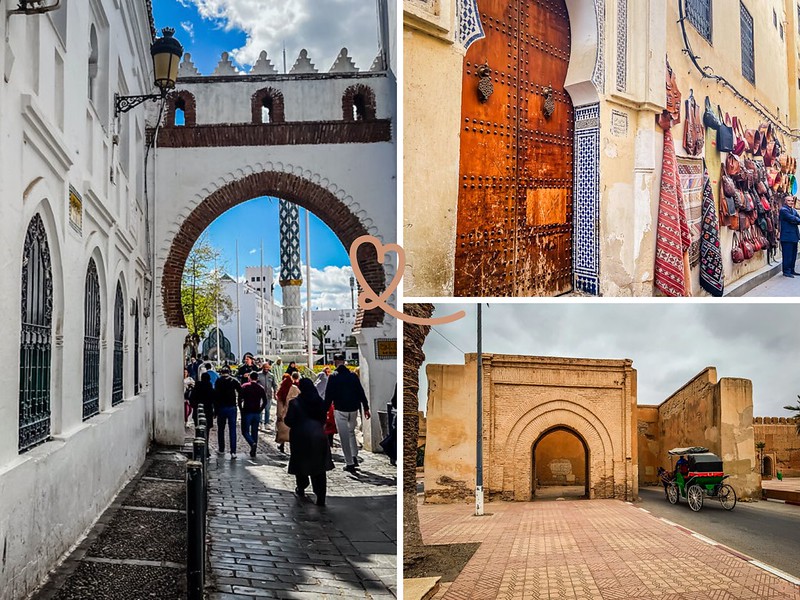
Morocco’s medinas offer an immersion in the country’s history and daily life. These ancient districts, surrounded by ramparts, reveal a remarkable architectural heritage and a unique atmosphere.
We’ve selected ten of Morocco’s most beautiful medinas that are well worth a visit: we tell you why, and share practical tips for exploring them.
This opinion is completely independent, based on our experiences. We visited the region anonymously, making our own choices and paying our bills in full.
The medinas: historic centers
The medina refers to the historic center of a city in the Arab-Muslim world.
In Morocco, these fortified districts are home to souks, mosques, public fountains and traditional houses organized around narrow streets. Each medina has its own identity, shaped by its history and geography. These are fascinating places to explore!
These areas remain places where people and craftsmen perpetuate ancestral know-how. Urban density and vernacular architecture create a microclimate that protects against summer heat.
1. Medina of Tetouan, UNESCO world heritage site

Why we love it
Did you know that the medina of Tetouan is unique in Morocco? We were fascinated to explore it. Spread out on the slopes of the Djébel Dersa mountain, it occupies a special place in the country’s history: as early as the VIIIᵉ century, its location made it a strategic passage between the kingdom and Andalucia. Destroyed and then completely rebuilt after the Spanish Reconquest, it owes its current appearance to the Andalucia refugees who recreated a veritable art of living here.
Another distinctive feature is its unmistakable green-and-white visual identity. Nicknamed “the white dove” for its immaculate walls, Tetouan also features touches of green on doors, windows and minarets. Although green appears in various architectural traditions throughout the Arab-Muslim world, its use in Tetouan is above all the result of a local evolution: the city gradually adopted it, particularly under the Spanish protectorate, until it became a distinctive element of its visual identity. If you’ve ever explored other Moroccan medinas, you’ll notice that this chromatic duo doesn’t exist anywhere else with such consistency.
Its organization, combined with lively craftsmanship and architectural simplicity, creates a peaceful, authentic atmosphere.
Exploring the medina is one of the highlights of your visit to Tetouan.

Practical advice
- Length of visit: 2 hours to half a day, depending on your pace and interests
- Visit in the morning or late afternoon for soft light and calm.
- Access: you can only enter on foot through several gates, the most convenient of which are Bab el-Okla (museum side), Bab Tut (direct access to the main arteries) and Bab Rouah for a first reference.
- Parking: Feddan and Hammadi pay underground parking lots within a 15-minute walk
- Narrow and sometimes steep streets, as the town is very hilly; uneven cobblestones can be slippery in wet weather;
- Use a baby carrier rather than a stroller because of the slopes and stairs; wear good shoes with non-slip soles.
- Opt for a guided tour if you want to understand Andalucia’s influences and urban organization, with Moroccan pastry tasting to boot!
WHERE TO STAY IN Morocco
Our independent picks for the accommodation of your dreams:
- Where to stay in Morocco (coming soon)
- The most beautiful riads in Morocco
Select by city:

2. Chefchaouen: the blue medina

Why we love it
To stroll through this medina is to enter a blue-and-white world you won’t see anywhere else. Every alleyway, colorful doorway and flower-filled staircase was transformed into a postcard setting during our visit.
Did you know that painting walls blue keeps insects away and protects homes from the heat of the mountains?
Here, we discovered murals by numerous artists that adorn the streets. Look up to see every nook and cranny, sometimes a little cul-de-sac hides artistic wonders or flowery arrangements.
Exploring the medina is one of the highlights of your visit to Chefchaouen.

Practical advice
- Tour duration: 2h to 3h
- Bring good shoes with non-slip soles
- Cobbled and sometimes steep streets, many staircases
- Best light for photographers: early morning or late afternoon
- Stroll around during the day to better discern the nuances of color and frescoes.
- You can visit it on an excursion from Fez or Tangier – see options
3. Marrakech medina: the labyrinth!

Why we love it
Marrakech’s Medina, a UNESCO World Heritage site, is the historic heart of the city. We wandered through its narrow streets lined with traditional riads and colorful boutiques, where Arabo-Andalusian architecture reveals all its splendor. The ochre walls are home to architectural treasures such as carved fountains, finely crafted cedar wood doors and courtyards adorned with zellij.
You’ll be transported to a world where craftsmen perpetuate age-old skills, from tanners to coppersmiths, to weavers who create magnificent fabrics on their traditional looms.
Exploring the medina is one of the highlights of your visit to Marrakech.

Practical advice
- Length of visit: 3 to 4 hours for an in-depth exploration
- Opening hours: accessible 24 hours a day, but stores generally open from 9am to 8pm.
- Difficulties and PRM access: narrow, cobbled streets, difficult access for people with reduced mobility.
- Rates: free access
- Access: several entrances from Place Jemaa el-Fna, Bab Doukkala, Bab Agnaou
- Book your guided tour of the Medina now!

It’s time to book!
Compare everything: companies, prices, schedules and availability.
4. Medina of Fez, a thousand-year-old labyrinth and the oldest in the world

Why we love it
Fès el-Bali, Morocco’s largest medina, took us back in time. It is considered the oldest medina in the world. Built in a basin near the Sebou River by Moulay Idriss II, who ruled Morocco in the 9th century, it takes its name from “fès”, which means “pickaxe” in Arabic.
We were impressed by this labyrinth of 14,000 listed buildings, where 137 mosques rub shoulders with 23 public hammams. The two main arteries, Talaa Kbira and Talaa Sghira (“big and little rise” in Arabic), will guide you through thisUNESCO world heritage site.
As you wander through the narrow streets, you’ll discover such marvels as the 13-window hydraulic clock facing the Médersa Bouanania, the interconnecting terraces and the historic fondouks. This thousand-year-old city is also home to Al-Quaraouiyine University, the world’s leading university and a testament to the intellectual importance of Fez.
Exploring the medina is one of the highlights of your visit to Fez.

Practical advice
- Length of visit: minimum 2 hours to a full day, depending on your interests and the activities you choose.
- Opening hours: accessible 24 hours a day, we recommend a daytime visit to better appreciate all its treasures.
- Difficulties and PRM access: not recommended for claustrophobic people, uneven cobbled floor, narrow and sometimes uphill streets, limited PRM access, secure area with surveillance cameras, wear good shoes with non-slip soles.
- Rates: free access to the medina
- Access: several gateways, Bab Boujloud being the best known
- Parking: outdoor parking lot opposite Bab Chorfa, parking lot behind Bab Boujloud, Ain Zleten parking lot overlooking rue Talaa Kbira
- Dining: numerous options in the medina or in the immediate vicinity, we recommend Restaurant Ishq (bistronomic), Café-restaurant Moulay Idriss (traditional Moroccan), Restaurant Gayza Riad Fès Relais et Châteaux (gastronomic).
- Take a half-day guided tour of the Medina of Fez with a local guide!
5. Asilah: the white medina and its colorful gates

Why we love it
Arriving in the city, we were immediately captivated by the beauty of the Asilah medina. You’ll stroll through alleys with white walls, punctuated by blue, green or yellow doors that create a surprising contrast. Every turn reveals a postcard setting, where the atmosphere invites you to take a leisurely stroll. We particularly appreciated the cleanliness of the premises and the harmony of colors that transform every street corner into a work of art.
At the western end of the ramparts, we made our way to the Caraquia viewpoint, one of the most striking panoramas of our stay. This belvedere overlooks the Atlantic Ocean, the perfect place to contemplate the infinite seascape in front of you. You can listen to the soothing sound of the waves breaking on the rocks while admiring the sunset or the horizon. In the medina, it’s the only vantage point offering a view of both the city walls and the vastness of the ocean.

Practical advice
- Free access all day
- Medina closed to traffic (except residents)
- Relatively flat, accessible to all, some cobblestones
- A few steps up to the stone promenade
- Slope with ramp installed close to steps for PRM access
- Vigilance on the promenade as there are no safety barriers and the area can be windy.
- Day trips from Tangier: see options
OUR TIPS FOR RENTING A CAR IN MOROCCO
- Compare prices on our preferred platform: DiscoverCars – one of the best rated sites.
- Not too wide
- A good engine
- For more choice, book early.

6. Meknes medina

Why we love it
To immerse yourself in local craftsmanship by wandering among colorful pottery, traditional fabrics and spice stalls in Meknes is to discover a more intimate atmosphere than in the neighboring medinas. The medina of the imperial city is aUNESCO World Heritage Site. Founded in the 11th century by the Almoravids as a military settlement, Meknes became the capital under the reign of Moulay Ismaïl, founder of the Alaouite dynasty.
We enjoyed this Hispano-Moorish-style city surrounded by high walls pierced by more than 20 gates, 9 of them monumental. Here, we saw the meeting of Arabo-Andalusian and European styles in 17th-century Maghreb. Sheltered by high defensive walls pierced by nine monumental gates, you’ll discover twenty-five mosques, ten hammams, palaces, vast granaries, remnants of fondouks and private dwellings.
Indeed, Meknes is distinguished by the gigantic appearance of its ramparts, which reach 15 meters in height. It’s a medina on a human scale, where we enjoyed getting lost, stopping, observing and listening to the heartbeat of the city.
Exploring the medina is one of the highlights of your visit to Meknes.

Practical advice
- Duration: 1 hour to several hours for leisurely exploration
- Free access 24 hours a day, 7 days a week. We recommend a daytime visit to better appreciate all its treasures with complete peace of mind.
- Difficulties and PRM access: not recommended for claustrophobic people, uneven cobbled ground, narrow streets but fairly flat ground (few undulations), partial PRM access (some stairs), wear good shoes with non-slip soles.
- Parking: several paying parking lots at the main gates with security guards (bring change in dhs), Bab Khemis parking lot near the Jewish cemetery or Zine-El-Abidine parking lot 5 minutes’ walk from the mausoleum, then visit on foot.
5. Essaouira: the windy medina

Why we love it
Essaouira is a maritime medina with a distinctive character. Built in the 18th century by French architect Théodore Cornut for the Alawite sultan Sidi Mohammed ben Abdallah, it blends European and Moroccan influences.
The checkerboard layout, unusual for a medina, facilitates orientation. The ramparts overlook the Atlantic Ocean, offering spectacular views. We enjoyed the mild climate, although the wind blows constantly (hence the nickname “City of the Trade Winds”). The medina attracts artists and craftsmen, especially those who make markers from the local wood, thuya. The fishing port enlivens the seafront, where fishermen bring in sardines and fresh fish every morning.
Essaouira’s relaxed atmosphere contrasts with the hustle and bustle of other Moroccan medinas. The locals welcome visitors without undue commercial pressure. We appreciate the bohemian atmosphere.

Practical advice
- 1 to 2 hours are enough to explore the compact, organized medina.
- Bring windproof clothing, as gusts are frequent all year round.
- The ramparts (Skala de la Ville and Skala du Port) offer the best views, especially at sunset.
- The port is worth a visit in the morning between 9 and 11 am, when the fishermen disembark.
- The marquetry workshops welcome visitors to watch cedar being worked.
- Essaouira is 2h30 from Marrakech by bus or car.
- Day trips from Marrakech are also available. see options
A LITTLE MORE PATIENCE
All the photos, maps, information and addresses you need to make your stay at Maroc a success will soon be available in a single ebook!
Coming soon!
7. Rabat medina

Why visit?
Rabat’s medina offers an authentic experience far removed from the mass tourism found in other Moroccan cities. We particularly appreciated its lively but less frenetic atmosphere than that of Marrakech.
Take a stroll through the maze of narrow streets, and admire the traditional architecture with its ornate doors, whitewashed walls and Merinid fountains.
We loved the explosion of color in the artisans’ stalls, with their carpets, pottery, jewelry and traditional clothing. Don’t resist!
Exploring the medina is one of the highlights of your visit to Rabat.

Practical advice
- Length of visit: allow half a day for leisurely exploration
- Opening hours: stores are generally open from 9 a.m. to 7 p.m., some close during Friday prayers.
- Difficulties and PRM access: narrow and sometimes cluttered streets, not suitable for people with reduced mobility.
- Prices: free access but please allow a budget for purchases
- Access: entrance through the Bab El Had gate
- Parking: not possible inside, we recommend you leave your car at the hotel for the medina tour.
- Eating out: numerous options, from cafés to traditional restaurants
- Tip: don’t hesitate to negotiate prices in the souks, as this is a local tradition.
- Visit the official website for more info here
9. Taroudant

Why we love it
Taroudant embodies the authentic Morocco of the south, far from the usual tourist circuits. Nicknamed “little Marrakech”, we were charmed by its ochre ramparts stretching for 6km. Its position at the foot of the Atlas and Anti-Atlas mountains creates a spectacular mountain setting.
We enjoyed the tranquil atmosphere of the medina, where the locals go about their daily business undisturbed by the crowds.
See all Taroudant attractions (coming soon).

Practical advice
- Allow 1 to 2 hours to explore
- Flat
- Southern Morocco, Souss Valley
- From Agadir: 85km (1h by car)
10. Tangier Medina

Why we love it
Tangier occupies a strategic position facing the Strait of Gibraltar, at the crossroads between Africa and Europe. Its medina bears the traces of multiple influences: Phoenician, Roman, Arab, Portuguese and Spanish. The city’s cosmopolitan character is reflected in its architecture and atmosphere. We felt this uniqueness during our visits: Tangier is unlike any other Moroccan city.
And neither does its medina. Petit Socco, the former market square, is the historic heart of the town. The Kasbah dominates the medina and port, housing the Kasbah Museum and gardens with sea views. Steep alleyways lead to legendary cafés, home to 20th-century writers and artists.
Exploring the medina is one of the highlights of your visit to Tangier.

Practical advice
- Allow half a day for the medina and kasbah.
- The main entrance is via the Grand Socco (Place du 9 avril 1947), which marks the transition between the new town and the medina.
- The Kasbah Museum is open from 10am to 6pm (10 dirhams).
- The Petit Socco cafés offer tea breaks in authentic surroundings. The American Legation, the first American diplomatic building abroad (1821), can be visited (free, donations appreciated).
- The medina can be windy, so pack accordingly.
- Tourist demand is there, but less intense than in Marrakech.
Subscribe to our Newsletter
- Get away from it all with Region Lovers’ beautiful destinations!
- Once a month
- Advertising-free

Safety: Who to watch out for in the medinas?
In the medinas, certain situations call for vigilance without giving in to paranoia. False guides are the most frequent solicitation. These people approach you offering to show you the way or a craftsman, then demand payment. A polite but firm refusal is usually enough. If someone insists on accompanying you despite your refusal, repeat “no thanks” without engaging in conversation.
Pickpockets operate in densely populated tourist areas, particularly in Marrakech and Fez. We advise you to carry your bag in front of you in crowded souks, and avoid showing off valuables, phones or cameras. A closed inside pocket secures your passport and money.
Some retailers charge excessive prices for tourists. Ask about average prices before buying expensive items such as carpets or jewelry.
Beware of insistent invitations to visit workshops or cooperatives. Some guides earn commissions on your purchases, which explains their insistence. You are never obliged to buy after a visit, even if social pressure can be strong.
Keep an eye out for vehicles (motorcycles, carts, loaded donkeys) in the narrow lanes. The cry “balak” means “watch out” in Arabic and indicates that you should pull over.

Frequently asked questions about medinas
How to negotiate in the medinas
Negotiation is an integral part of the shopping experience in Moroccan medinas. In traditional souks, there’s no such thing as a posted price; every transaction becomes a social interaction.
Find out about prices before you start negotiating. Take a look at several stores and ask for prices without intending to buy immediately. This scouting phase will give you an idea of the real price.
Only enter into negotiations if you are serious about buying. The retailer invests time in showing you his products, demonstrating different parts and explaining techniques.
The initial price quoted is usually between double and triple the final acceptable price. In very touristy areas (Jemaa el-Fna in Marrakech), first prices can be four to five times the actual rate. Offer around 40-50% of the advertised price as a starting point for negotiation.
Adopt a relaxed, smiling attitude. Negotiation is not a confrontation but a friendly exchange. The seller will appreciate it if you take the time to examine the merchandise and ask questions about the manufacturing process. This human interaction is more than just a business transaction.
Can we visit the medinas with children?
The medinas can be visited with children, with a few adaptations. The narrow streets and lack of sidewalks require constant vigilance. We recommend holding young children by the hand, as vehicles (motorcycles, carts, donkeys) circulate without restriction. Strollers are impractical on uneven cobblestones and in narrow passages. A physiological baby carrier offers greater comfort and mobility.
The hustle and bustle of the souks quickly tires children. It’s best to visit in the morning, when crowds are moderate and temperatures mild.

Are the medinas accessible to people with reduced mobility?
Accessibility of the medinas for people with reduced mobility remains limited. The cobbled streets, often on slopes, have irregular surfaces. Narrow passages and frequent steps make wheelchair access difficult. None of Morocco’s medinas meet European accessibility standards.
Nevertheless, some areas remain more walkable. In Marrakech, the main arteries leading to Jemaa el-Fna are relatively flat and wide. In Essaouira, the checkerboard layout makes it easier to find your way around, and some of the main streets are drivable.
Do I need a guide to visit the medinas?
The need for a guide depends on the medina you are visiting and your experience. In Fez, we strongly recommend a guide for a first visit. The maze of 9,000 alleyways makes orientation very difficult, and even GPS applications struggle to work under the covered passageways.
In Marrakech, a guidebook is useful but not essential. The main monuments are signposted, and the medina, though complex, is more accessible than Fez.
The medium-sized medinas (Meknes, Tetouan, Essaouira) are easy to discover on your own. Their small size limits the risk of getting lost for long periods. However, a guide is still useful for historical anecdotes and access to traditional workshops.
What are the opening hours in the medinas?
The medinas never close completely, as they are inhabited neighborhoods. However, commercial activity follows precise rhythms. Souks generally open between 9 and 10 am. The hustle and bustle continues until 1pm, when many shops close for lunch, between 1pm and 3:30pm or 4pm. The afternoon continues until 7 or 8pm, depending on the season and the city.
Friday, the day of prayer, sees a noticeable slowdown between 12pm and 3pm. Some shops remain closed all day. This day is less suitable for shopping, but offers a quieter atmosphere in which to stroll.

Can we take photos in the medinas?
Photography in the medinas requires discernment and respect. Alleys, architecture, colorful doors and souk stalls can be photographed freely. These shots immortalize the atmosphere without invading privacy. We encourage you to capture these charming elements of the medinas.
Photographing people requires their permission. Always ask permission before taking a photo of someone, with a hand gesture pointing to the camera and a questioning look, or verbally if you speak French or Arabic. Some people willingly accept, others refuse out of religious conviction or simple preference. Always respect refusals without insisting.
Artisans in their workshops generally appreciate being photographed at work, as it enhances the value of their skills. Nevertheless, ask permission, especially if you’re not planning to buy anything. Some artisans may ask for a small tip (10 to 20 dirhams) in exchange for posing, which is fair enough considering the time involved.
PLAN YOUR TRIP TO Morocco
- Best of
Top Destinations
Must-See Places in Morocco
Most Beautiful Riads
Most Beautiful Cities
Most Beautiful Medinas
Morocco’s Most Beautiful Landscapes
Most Beautiful Gardens
Best Museums
Morocco’s Most Beautiful Beaches

- Practical advice
When to go?
How to rent a car in Morocco
Driving tips

- The must-dos
Marrakech
Casablanca
Fez
Meknes
Chefchaouen
Essaouira
Rabat
Tangier
Tetouan
Agadir
The Sahara Desert


SHE MADE THE TRIP Myriam
