
Visiting Marrakech? Don’t miss the
In this article, you’ll find some useful tips to help you prepare for your visit and have a wonderful time!
This opinion is completely independent, based on our experiences. We visited the region anonymously, making our own choices and paying our bills in full.
Why visit the Yves Saint Laurent Museum in Marrakech?
Is the museum worth it? Our opinion:
Yes, the Musée Yves Saint Laurent is well worth a visit, and not just for fashionistas. We were won over by this institution, which celebrates the work of the French couturier with elegance and modernity. The architecture of the building itself is a work of art, while the permanent and temporary collections offer a fascinating journey into theworld of haute couture.
In our opinion, this is one of the best things to do in Marrakech.

Why is the museum famous?
The museum is famous for being theonly institution in Morocco dedicated to the work of Yves Saint Laurent, the iconic designer who revolutionized women’s fashion. Marrakech held a special place in the couturier’s heart, where he owned the Majorelle Gardens and found an inexhaustible source of inspiration for his creations. Discover how the ochre city influenced his most emblematic collections.

Our favorite moments
We particularly appreciated it:
- The immersive scenography of the permanent exhibition, which chronologically retraces the designer’s career. The room dedicated to evening gowns dazzled us with its spectacular creations.
- The audiovisual space, where archive films reveal the intimacy of the creative process.
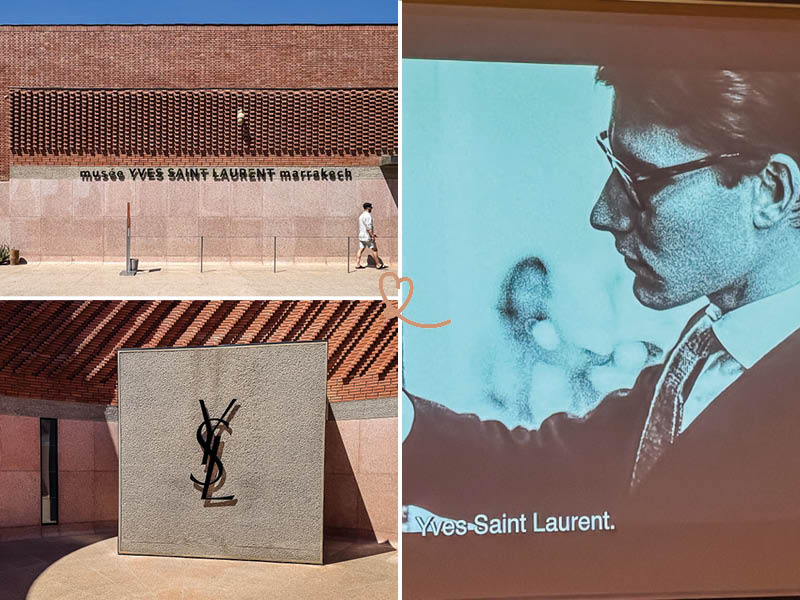
- The building’s architecture, with its sensual, fabric-like curves, is in itself a remarkable visual experience.

WHERE TO STAY IN Marrakech
Our favorites: neighborhoods and hotels
In the Medina
Riad Kbour & Chou – See prices, photos and availability
In the Kasbah, an ancient fortified quarter
Riad Jonan & Spa – See prices, photos and availability
Luxury Hotel
Royal Mansour Hotel – See prices, photos and availability

History in brief
The Yves Saint Laurent Museum in Marrakech opened in October 2017, simultaneously with the one in Paris. It is the result of a collaboration between the Fondation Pierre Bergé – Yves Saint Laurent and the architects of Studio KO. Here are the key dates:
- 1966: Yves Saint Laurent’s first visit to Marrakech
- 1980: Acquisition of the Majorelle Gardens by YSL and Pierre Bergé
- 2008: Death of the couturier whose ashes are scattered in the gardens
- 2014: Construction of the museum begins
- 2017: Official opening of the museum
- 2019: The museum welcomes its 500,000th visitor

Access: Yves Saint Laurent Museum, Marrakech
Where is the museum?
- In the Guéliz district of Marrakech
- Rue Yves Saint Laurent
- Adjacent to the famous Majorelle Gardens
- 15min drive from the medina

OUR TIPS FOR RENTING A CAR IN Maroc
- Compare prices on our preferred platform: DiscoverCars – one of the best rated sites.
- Adapt your choice of vehicle to your itinerary!
- For more choice, book early.

Read our tips (coming soon)
How to get there?
- The museum is located in the modern Guéliz district, within easy reach of the city center.
- You can take a cab from the medina (cost around 50 dirhams) or use the line 4 buses which serve the district.
- We recommend that you combine your visit with that of the Majorelle Gardens and the Pierre Bergé Museum of Berber Arts, located right next door. Tickets can be booked in advance: See prices, photos and availability.

Parking
- Guarded parking is available directly in front of the museum, shared with Jardins Majorelle. Parking costs around 20 dirhams for the day.
- We advise you to arrive early, especially in high season, as places fill up quickly.
- You’ll also find parking spaces along rue Yves Saint Laurent, but for greater safety, use the official parking lot.

DISCOVER Marrakech
- Attractions in Marrakech
- Best hotels in Marrakech
- Luxury hotels
- Best restaurants (coming soon)
- Majorelle Garden

Useful tips: duration, schedules, eating…
Best time to visit
- We advise you to visit the museum in the morning, when it opens at 10 a.m., to take advantage of the smaller crowds.
- Avoid weekends and Moroccan public holidays, when crowds are highest.
- The best time to visit is from October to May, when temperatures are milder in Marrakech.
- You’ll particularly appreciate the cool air-conditioned rooms during the summer months.

Length of visit and main difficulties
- Allow between 1h30 and 2h for a complete visit of the museum.
- The facility is fully accessible to people with reduced mobility. We appreciated the fluidity of the route, with no stairs or obstacles.
- The rooms are spacious and well laid out, allowing easy circulation even during busy periods. You can take a break in the rest areas provided.

Advice on how to visit
We began our visit with the permanent exhibition. We then visited the two temporary exhibitions, before moving on to the studio and ending our visit in the Pierre Bergé auditorium.

A LITTLE MORE PATIENCE
All the photos, maps, information and addresses you need to make your stay at Maroc a success will soon be available in a single ebook!
Coming soon!

Visiting with children
The visit can be enjoyed by the whole family. We’ve noticed that younger visitors are particularly fascinated by the spectacular gowns and colorful accessories, while the audiovisual area offers a welcome immersive break. The flowing, relatively short itinerary makes for an accessible cultural discovery, provided you adapt your pace and expectations. The space is large enough for families to move around comfortably.

Schedules and rates
The museum is open:
- Every day except Wednesday, from 10 a.m. to 6:30 p.m. (last admission at 6 p.m.)
- Adult rate: 140 dirhams
For the latest price list, visit the official website here.

Guided tours
- A free audio guide is available via QR code in several languages (French, English, Arabic), and we highly recommend it to enhance your visit.
- We didn’t see any guided tours on site. More information on the official museum website here.

Catering
The museum features an elegant café-restaurant with terrace, Café Le Studio, offering a welcome break after your visit. Here you can enjoy light dishes inspired by Moroccan and French cuisine, in a refined contemporary setting. Prices are higher than in town, but the quality is top-notch. We particularly appreciated the fountain and its large, refreshing pool.

Contemporary architecture at the service of creativity
A facade inspired by textiles
The museum’s facade immediately appealed to us for its architectural boldness. Studio KO’s architects created an envelope of terracotta bricks arranged like the threads of a fabric, creating a hypnotic geometric pattern. The texture is reminiscent of haute couture, yet in keeping with Moroccan architectural tradition. You’ll notice how light plays differently on this surface at different times of day, creating shifting shadows that bring the façade to life. We were struck by this successful synthesis of modernity and local references.

Volumes designed for contemplation
The museum’s interior features a succession of generously proportioned spaces, bathed in skilfully controlled natural light. We particularly admired the circular entrance hall with its vaulted ceiling, which creates a contemplative atmosphere conducive to discovery. The fountain patio is also a much-appreciated haven of coolness, both for its color and for the presence of water.

The permanent exhibition: an emblematic tour of couture
Please note that photographs are not permitted in the permanent exhibition, in order to preserve the fragile textile works.
The Dior years: the audacity of a young designer
The first section of the permanent exhibition traces Yves Saint Laurent’s meteoric beginnings at Christian Dior. At just 21, he became artistic director of the prestigious house after the founder’s sudden death in 1957. We were moved by the original sketches and early creations that already bear witness to his creative genius. You’ll discover the 1958 “Trapèze” collection, which revolutionized the female silhouette by freeing the body from the constraints of the New Look. This seminal period reveals an audacious young man, already in search of a new modern elegance.

A personal work between rigor and freedom
The central hall showcases the iconic creations that defined the Saint Laurent style. We admired the 1966 women’s tuxedo, a veritable manifesto of women’s sartorial emancipation. Mondrian dresses with pure geometric lines rub shoulders with sumptuous evening gowns embroidered with pearls and sequins. You’ll be fascinated by the exceptional technical mastery of these pieces, where the rigor of the cut meets the exuberance of the materials. Each silhouette tells a story of timeless elegance, testifying to the designer’s unique ability to sublimate the female body while offering unprecedented freedom of movement.

The ready-to-wear adventure and the Left Bank revolution
The final part of the permanent exhibition celebrates the luxury ready-to-wear revolution initiated by Saint Laurent with his Rive Gauche boutique in 1966. We discovered how the designer democratized haute couture by offering accessible pieces without compromising on quality. Saharonis, peasant blouses and revisited raincoats bear witness to this desire to create a modern wardrobe for the active woman. You’ll see how this visionary approach transformed the fashion industry, making Yves Saint Laurent the first couturier to design a complete wardrobe for every moment of contemporary life.

Temporary exhibitions in contrasting universes
Birds of Mexico: a dialogue between nature and creation
The temporary exhibition “Birds of Mexico” transported us into a world where fashion meets exotic nature. Photographs are not permitted in this exhibition for conservation reasons. This presentation highlights the influence of the designer’s travels on his collections, particularly his fascination with the vibrant colors and organic patterns of Mexico. You’ll discover exceptional pieces where feathers, embroidery and prints create a fantastic bestiary, testifying to the couturier’s ability to sublimate cultural references into a personal, modern vision.

La vilaine Lulu: contemporary views and irreverence
The exhibition “La vilaine Lulu” offers a daring counterpoint to Saint Laurent’s classic creations. This presentation explores the designer’s taste for controlled provocation. We appreciated this lesser-known facet of his work, where humor and irreverence rub shoulders with the usual elegance. You’ll be surprised by this comic strip that challenges established codes.

Complementary areas to extend your visit
The audiovisual space: an immersion in the life and work of the creator
The audiovisual room is a highlight of the visit, offering an intimate insight into the world of Yves Saint Laurent. We were touched by archive footage showing the couturier at work in his studio, surrounded by his loyal collaborators. The documentaries reveal his complex personality, between creative genius and human fragility. You’ll discover rare interviews in which he talks about his passion for Marrakech and the city’s influence on his work.

The Studio: drawing as the starting point for creation
The studio offers a fascinating insight into Yves Saint Laurent’s creative process. We have admired the hundreds of original sketches that reveal the genesis of his most famous creations. You can see how a simple pencil line is gradually transformed into a dress or a stage costume. This space allows you to appreciate the importance of drawing in the work of Saint Laurent, who considered the sketch to be the soul of every clothing creation.

The bookshop: extending the experience through publishing
The museum’s bookshop-boutique is the perfect place to extend your discovery of the Saint Laurent world. We were impressed by the selection of books on Moroccan fashion, art and culture. The richly illustrated exhibition catalogs provide a valuable record of your visit. You’ll also find limited editions and reproductions of the designer’s original sketches. In addition to books, the boutique offers a line of objects inspired by the collections, from scarves to stationery accessories, perfect for taking home a refined souvenir of this immersion in timeless elegance.

Subscribe to our Newsletter
- Get away from it all with Region Lovers’ beautiful destinations!
- Once a month
- Advertising-free

Frequently asked questions
Can I visit the museum and the Majorelle Gardens on the same day?
Absolutely! We even recommend combining the two visits with a visit to the Musée Pierre Bergé des Arts Berbères. A combined ticket is available at an attractive price. Allow a full half-day to enjoy the sites to the full. Start with the gardens in the morning to take advantage of the cooler temperatures, then move on to the air-conditioned museums at the hottest times of the day.

Is the museum just for fashion lovers?
Not at all! We’ve found that the museum fascinates fashion enthusiasts and neophytes alike. The building’s contemporary architecture is an attraction in itself, and the exhibits tell the cultural story of the 20th century. You’ll appreciate the artistic, historical and sociological aspects of the presentations, which go far beyond fashion. The links between Saint Laurent and Marrakech also offer a unique perspective on cultural exchanges between East and West.

PLAN YOUR TRIP TO Morocco
- Best of
The most beautiful landscapes in Morocco
What to do in Morocco (coming soon)
The most beautiful riads
The most beautiful cities
The most beautiful medinas (coming soon)
The most beautiful gardens (coming soon)
The best museums (coming soon)
The most beautiful beaches in Morocco (coming soon)

- Practical advice
When to go? (coming soon)
How to rent a car in Morocco (coming soon)
Driving tips (coming soon)
Itineraries (coming soon)
Where to stay in Morocco (coming soon)

- The must-dos
Marrakech
Casablanca
Fès
Meknès
Chefchaouen
Sahara Desert (coming soon)


SHE MADE THE TRIP Julie
