
On one side, a garden that will amaze you with its vibrant colors and lush vegetation, a true haven of peace in the heart of Marrakech. On the other, a museum that reveals the richness of Berber culture through carefully displayed objects, jewelry and textiles. Together, the Jardin Majorelle and the Musée des Arts Berbères Pierre Berger offer a visual and cultural experience, where art, history, traditions and nature meet and intertwine to tell a different story of Maroc.
In this article, you’ll find some useful tips to help you prepare for your visit and have a wonderful time!
This opinion is completely independent, based on our experiences. We visited the region anonymously, making our own choices and paying our bills in full.
Why visit the Jardin Majorelle and the Pierre Berger Museum of Berber Art?
Are the Jardin Majorelle and the Pierre Berger Museum worth it? Our opinion:
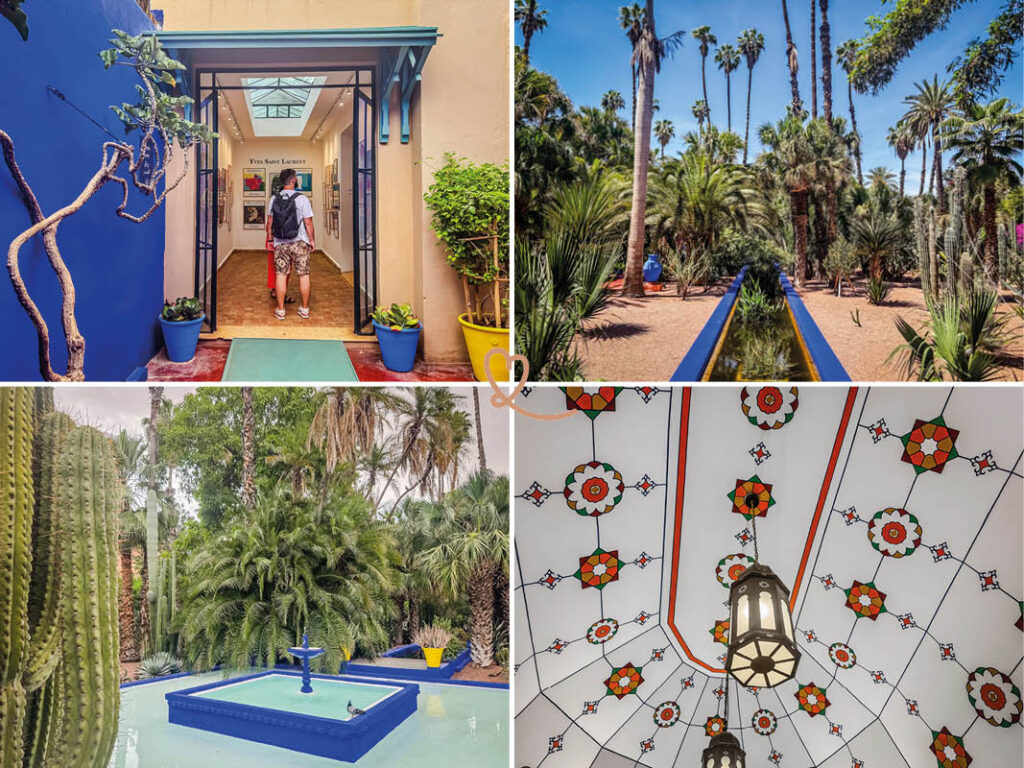
Yes, and for many reasons! The Jardin Majorelle offers an oasis of calm and chromatic beauty in the middle of the often frenetic city of Marrakech. We enjoyed its shady walkways, ponds and exotic plants, inviting us to relax and contemplate. The museum, meanwhile, enriches this moment of peace with a profound cultural dimension. You’ll discover the richness of an age-old culture, that of the Berbers (Amazighs), often overlooked despite its importance in the history of Maroc. Together, these 2 spaces create a journey that blends nature, art and the senses. One of the best things to do in town!

Before reading any further, we would like to point out that photos are not permitted inside the museum, so the images used to illustrate the museum are limited to the outside areas or annexes.
What are the Jardin Majorelle and the Pierre Berger Museum of Berber Art famous for?
The Jardin Majorelle is renowned for its vibrant color palette – particularly the famous “Majorelle blue” – and for its incredible collection of exotic plants assembled by painter Jacques Majorelle over several decades. We learned that the site was restored and protected by Yves Saint Laurent and Pierre Bergé in the 1980s, ensuring its international renown.
The museum, housed in the painter’s former studio, exhibits over 600 objects from the personal collections of Pierre Bergé and Yves Saint Laurent, retracing the art, traditions and daily life of the Berber populations of Morocco, from the Rif to the Sahara.

Our favorite moments
- Lose ourselves in the garden’s tropical alleys and observe its giant cacti, contrasting with the impressive colors of the art-deco building facades.
- Stroll through the rooms of the museum, where each object tells a fascinating story.

WHERE TO STAY IN Marrakech
Our favorites: neighborhoods and hotels
In the Medina
Riad Kbour & Chou – See prices, photos and availability
In the Kasbah, an ancient fortified quarter
Riad Jonan & Spa – See prices, photos and availability
Luxury Hotel
Royal Mansour Hotel – See prices, photos and availability

History in brief
- The Jardin Majorelle was imagined and designed from 1922 by painter Jacques Majorelle as a space for botanical creation and experimentation, blending Moorish and Art Deco influences. After its restoration by Yves Saint Laurent and Pierre Bergé in the 1980s to save it from a real estate project, it became a symbol of Marrakech.
- The Musée Pierre Bergé des Arts Berbères was inaugurated in 2011 in Jacques Majorelle’s former studio, under the patronage of the King of Maroc, to showcase a unique collection of Berber art and objects, gathered by Bergé and Saint Laurent during their travels in the region.

How to get there: Jardin Majorelle and Musée d’Arts Berbères, Marrakech
Where are the garden and museum?
The garden and museum are located in Marrakech’s Guéliz district, on Rue Yves Saint Laurent – an area easily accessible from all parts of the city. They form an adjacent ensemble: a visit to the garden naturally leads into a visit to the museum.
- 25min drive from Marrakech-Ménara airport,
- about 15 minutes by car or 35 minutes on foot from Jemaa el-Fna Square,
- in the immediate vicinity of the Yves Saint Laurent Museum,
- Close to Marrakech’s main attractions
OUR TIPS FOR RENTING A CAR IN Maroc
- Compare prices on our preferred platform: DiscoverCars – one of the best rated sites.
- Adapt your choice of vehicle to your itinerary!
- For more choice, book early.

Read our tips (coming soon)
How to get there?
- By public transport, the nearest stop is ” Alfa 2000” or“Ben Tbib“. Consult the route map and timetables here.
- On foot, it takes 20 minutes from Plaza Guéliz and 40 minutes from the Medina.
- Alternatively, you can opt for a cab.

Parking
There is no dedicated parking, but several spaces are available along rue Yves Saint Laurent and in adjacent streets. In high season, we recommend arriving early to find a space easily, or using a cab to avoid the search for parking.
DISCOVER Marrakech
- Attractions in Marrakech
- Best hotels in Marrakech
- Luxury hotels
- Best restaurants (coming soon)
- Majorelle Garden

Useful tips: duration, schedules, eating…
Best time to visit
We think that early mornings, just after opening, are ideal for avoiding the crowds and enjoying the soft light on the garden’s colors, and avoiding the afternoon heat. The end of the day, before closing, also offers more golden light and fewer visitors.

Length of visit and main difficulties
- Allow around 1h30 for the garden, and another 45 minutes for the museum, depending on your pace.
- The floor is generally smooth and passable for PRMs, but beware that it can be slippery in wet weather.
- We saw ramps at several points in the garden and museum.

Advice on how to visit
There is no imposed direction of visit. We advise you to trust your mood and emotions when choosing whether to enjoy the Garden first, then the Museum, or vice versa.

A LITTLE MORE PATIENCE
All the photos, maps, information and addresses you need to make your stay at Maroc a success will soon be available in a single ebook!
Coming soon!

Visiting with children
In our opinion, the garden is a pleasant and easy space to explore with children. Its shady paths, ponds and colors are often a hit with younger visitors. The museum, on the other hand, requires more attention. Younger visitors may find it difficult to immerse themselves in the exhibition. It’s best to adapt the visit to the age of the children and their interests and habits (some objects may be more interesting for older children or teenagers).

Schedules and rates
- The Jardin Majorelle is open daily from 8:30 am to 6 pm.
- The Pierre Bergé Museum of Berber Art is open daily from 9am to 5:30pm.
- Admission to the museum and garden costs 230DH (approx. 21€).
We strongly recommend that you book your tickets in advance!
You can also opt for a combined ticket including: Jardin Majorelle + Musée Pierre Bergé + Musée Yves Saint-Laurent. More info on the official website, here.

Catering
After your visit, head to Café Bousafsaf (also known as Café Majorelle)! This is an excellent address for a gourmet break just 2 steps from the garden. It offers a relaxed atmosphere, ideal for enjoying a cool drink, a local pastry or a light meal, while prolonging the experience in the heart of the green oasis.

See our article on the city’s best restaurants (coming soon)
Jardin Majorelle: a haven of color and greenery in the heart of Marrakech
Explore the lushness of exotic plants

We wandered through the shady alleys of the Jardin Majorelle, discovering a surprisingly dense vegetation for a space located in the heart of Marrakech. Conceived as both a sanctuary and a laboratory by French painter Jacques Majorelle, you can observe an impressive collection of exotic plants from 5 continents: monumental cacti, slender palms, bamboos, agaves, yuccas and succulents create almost unreal scenes in the Moroccan light.

We’ve observed how the winding paths, playful shadows and pools help to create a cool, soothing atmosphere. As you stroll along, you may get the feeling that each viewpoint has been conceived as a living tableau.
Discover colorful buildings with Moorish and Art Deco influences

We were struck by the visual power of the garden’s buildings, dominated by Majorelle blue contrasting with bright yellows, touches of ochre or motifs inspired by Moorish architecture. As you stroll through the garden, you’ll pass Jacques Majorelle’s former studio and the various colorful buildings that appear between the plants.

We love the way geometric lines, arches, pergolas and walkways interact with the vegetation. You can observe the perfect harmony between art deco influences and Moroccan architecture. Colors, shapes and volumes create an enchanting whole.
Find the Yves Saint Laurent memorial

We ended our walk in a quieter spot, where we found the memorial to Yves Saint Laurent, set in a clearing away from the main walkways. A sober, elegant stele surrounded by vegetation, designed as a place of recollection, recalls the deep bond between the designer and the place he helped to preserve.

We loved the calm atmosphere that accompanies it and marks the intimate and historic dimension of the garden. Like us, you may have a thought for this renowned designer, for his work in preserving the oasis that is the Jardin Majorelle, but also for the impact of his work in the fashion world.
Subscribe to our Newsletter
- Get away from it all with Region Lovers’ beautiful destinations!
- Once a month
- Advertising-free

The Pierre Bergé Museum of Berber Art: a rare immersion in the heart of Amazigh culture
Photos are not permitted inside the museum, which is why the images in this section are limited to outdoor areas or annexes.
Understanding Berber identity

We discovered the entrance to the Musée des Arts Berbères in the blue building that once housed Jacques Majorelle’s studio, a place of simple architecture contrasting with the exuberance of the garden. We enjoyed the first part of the visit, which was based on careful explanations and contextualization.

Inside, you’ll discover the major Berber regions of Maroc – the Rif, the Middle Atlas, the High Atlas, the oases of the South – with maps, documents and audiovisual aids to help you understand who the Amazigh populations are and how they have shaped their traditions. You’ll get a clear picture of their history, their way of life and the diversity of their cultural expressions, before entering the rooms devoted to the objects themselves.
Discover traditional skills: textiles, weaving and everyday objects

In the rooms devoted to textiles and objects of daily life, you’ll see a range of objects that demonstrate the ingenuity and creativity of Amazigh communities. In particular, you’ll discover a selection of carpets, weavings and wedding blankets, recognizable by their geometric patterns and artisanal techniques handed down over generations.

We loved the diversity of materials, the shades of wool and textures that bear witness to skills deeply rooted in the Atlas and southern Moroccan regions. You’ll also see pottery, vessels and utensils that tell the story of daily life, and you’ll follow the same logic of progressive discovery, guided by the scenography that sheds light on the use, origin or function of each object.
Admire the wealth of Amazigh ornaments and symbols

We ended our visit with the rooms devoted to jewelry and ornaments, a particularly impressive collection that underlines the importance of symbols in Amazigh culture. You’ll discover silver fibulae, bracelets, necklaces and amulets, sometimes adorned with coral or glass, whose precise shapes reflect a strong aesthetic identity and an essential social function.

We enjoyed discovering and understanding their uses: protection, status, marriage or family transmission. The dark atmosphere and targeted lighting reveal every detail of the pieces. You can round off your visit with a visit to the Love Gallery, the bookshop or the boutique, which extend the world of the exhibition.
Frequently asked questions
What is Majorelle Blue?
Bleu Majorelle is an intense, saturated shade of blue invented by painter Jacques Majorelle in the 1920s. He used it to paint his studio and several elements of the garden he was creating in Marrakech. This color has become emblematic of the Jardin Majorelle and contributes to its unique visual identity, creating a striking contrast with the greenery.

Who are Pierre Berger and Yves Saint Laurent?
Yves Saint Laurent was an internationally renowned French couturier, credited with revolutionizing fashion in the second half of the XXᵉ century. Pierre Bergé, his life and business partner, was also an influential patron and collector. Together, they played a key role in protecting and promoting artistic and cultural heritage, particularly in Morocco.

What does Morocco have to do with Pierre Berger and Yves Saint Laurent?
Pierre Bergé and Yves Saint Laurent discovered the Jardin Majorelle in the 1980s and decided to restore it to save it from a real estate project. They then created the Musée Pierre Bergé des Arts Berbères, in Majorelle’s former workshop, to exhibit their collection of Berber art. Their commitment has made it possible to preserve these emblematic sites and open them to the public, establishing a lasting link between their artistic work and Morocco’s heritage.

PLAN YOUR TRIP TO Morocco
- Best of
The most beautiful landscapes in Morocco
What to do in Morocco (coming soon)
The most beautiful riads
The most beautiful cities
The most beautiful medinas (coming soon)
The most beautiful gardens (coming soon)
The best museums (coming soon)
The most beautiful beaches in Morocco (coming soon)

- Practical advice
When to go? (coming soon)
How to rent a car in Morocco (coming soon)
Driving tips (coming soon)
Itineraries (coming soon)
Where to stay in Morocco (coming soon)

- The must-dos
Marrakech
Casablanca
Fès
Meknès
Chefchaouen
Sahara Desert (coming soon)

