
Marrakech, the red pearl of Morocco, fascinates with its bewitching blend of ancestral traditions and elegant modernity. Three days in this imperial city is enough to discover its most emblematic treasures: the labyrinthine medina, lush gardens, sumptuous palaces and the unique atmosphere of Jemaa el-Fna square. Between colorful souks, Berber architecture and delicious gastronomy, this trip will plunge you into the heart of the Moroccan soul.
In this article, discover our itinerary ideas and must-see places, as well as all our tips and lots of photos!
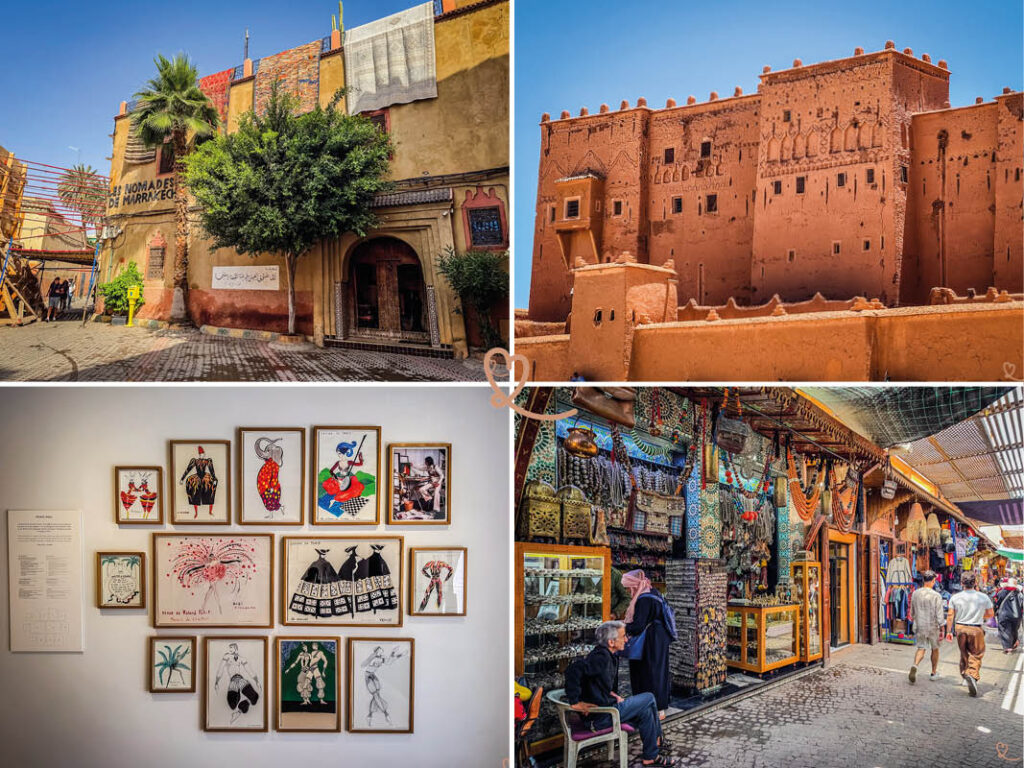
Practical tips for a 3-day visit to Marrakech
What can you see in Marrakech in 3 days? Is it long enough?
3 days in Marrakech is an ideal length of time to discover the city’s must-sees. You’ll be able to explore the historic medina, visit major monuments such as the Koutoubia Mosque and the Bahia Palace, soak up the atmosphere of the souks, and recharge your batteries in the magnificent Majorelle or Menara gardens. You’ll also have time to experience the unique Jemaa el-Fna square at different times of the day, and even plan a day trip to the surrounding area, such as the Ourika valley or Essaouira.
However, if you wish to explore the city’s museums in greater depth, take full advantage of the traditional hammams, discover the modern districts such as Guéliz and Hivernage, or multiply your excursions to the Atlas Mountains or the desert, allow 4 to 5 days. Marrakech has enough to keep you busy for an entire week.

Getting around Marrakech
Marrakech’s medina is best explored on foot, as most of its alleyways are inaccessible to vehicles. Bring good, comfortable shoes and download an offline GPS application, as it’s easy to get lost in the maze of souks.
To reach attractions outside the medina (Majorelle Gardens, Palmeraie, Guéliz district), you have several options: small red cabs are practical and affordable, but remember to negotiate the price before departure or insist on using the meter. VTC apps such as Careem or InDrive also work well in Marrakech. For more freedom, you can hire a scooter or a car, but driving can be confusing for the uninitiated.
For day trips (Essaouira, Ourika Valley, Ouzoud), use organized tours or rent a car with driver.

OUR TIPS FOR RENTING A CAR IN Maroc
- Compare prices on our preferred platform: DiscoverCars – one of the best rated sites.
- Adapt your choice of vehicle to your itinerary!
- For more choice, book early.

Read our tips (coming soon)
Where to sleep in Marrakech
Your choice of accommodation will depend on the ambience you’re looking for. For an authentic experience, opt for a traditional riad in the medina. These typical Moroccan houses, often beautifully decorated with central patios and rooftop terraces, offer total immersion in the Marrakchi atmosphere. The Mouassine, Derb Dabachi and Jemaa el-Fna districts are home to many charming riads.
If you prefer more modern comforts and facilities (swimming pools, spas, restaurants), hotels in the Hivernage district or near the Majorelle gardens are more suitable. These establishments generally offer more space and are easier to reach by car.
For those on a tight budget, you’ll find some nice youth hostels in the medina and Guéliz district. Whatever your choice, book well in advance, especially in high season (spring and autumn).
See our article dedicated to the best hotels in Marrakech

WHERE TO STAY IN Marrakech
Our favorites: neighborhoods and hotels
In the Medina
Riad Kbour & Chou – See prices, photos and availability
In the Kasbah, an ancient fortified quarter
Riad Jonan & Spa – See prices, photos and availability
Luxury Hotel
Royal Mansour Hotel – See prices, photos and availability

Our ideal itinerary: 3 days in Marrakech
Day 1: Dive into the historic medina
Start your tour in the historic heart of Marrakech. Start your morning with a visit to the Koutoubia Mosque, the city’s landmark with its 77-meter minaret visible from afar. Although the interior is not accessible to non-Muslims, you can admire the Almohad architecture and surrounding gardens.

Then head for the Bahia Palace, a 19th-century architectural masterpiece. Allow around 1h30 to explore its magnificent courtyards, lush gardens and lounges richly decorated with zellige, stucco and painted wood. The atmosphere is particularly pleasant in the mornings, before groups arrive.

After lunch in a traditional restaurant in the medina, lose yourself in the souks of Marrakech. These covered markets form a fascinating labyrinth of spicy smells, colorful fabrics and the sounds of craftsmen at work. Each souk has its own specialty: dyers, ironmongers, babouchiers and carpet sellers. It’s the perfect time to exercise your bargaining skills.

End your day at the legendary Jemaa el-Fna square. Arrive in the late afternoon to observe the gradual transformation of the square: snake charmers and storytellers give way to street food stalls, Gnaoua bands and an electric atmosphere unlike any other in the world. Dine in for the full experience.

Day 2: Gardens, culture and modernity
Spend the morning discovering the Majorelle gardens, an oasis of calm created by painter Jacques Majorelle and later saved by Yves Saint Laurent. The brilliant Majorelle blue contrasts magnificently with exotic plants, giant cacti and ponds. Visit the Berber Museum in the garden, with its fine collection of handicrafts and traditional costumes. Arrive as soon as it opens (8 a.m.) to avoid the crowds.

After this green interlude, explore the modern Guéliz district. Stroll along Avenue Mohammed V, discovering contemporary boutiques, art galleries and French-style cafés. This is where the heart of modern Marrakech beats, far from the hustle and bustle of the medina.

In the afternoon, visit the Saadian Tombs, an architectural gem rediscovered only in 1917. These 16th-century mausoleums house the tombs of members of the Saadian dynasty in a sumptuous décor of marble, finely chased stucco and cedar wood.

End the day with a wellness experience in a traditional hammam. Choose an authentic establishment to enjoy a black soap scrub and a relaxing massage, essential rituals of Moroccan culture.

A LITTLE MORE PATIENCE
All the photos, maps, information and addresses you need to make your stay at Maroc a success will soon be available in a single ebook!
Coming soon!
Day 3: Palace, gardens and excursion
Start your final day with a visit to El Badi Palace, a ruined fortress that bears witness to Marrakech’s past grandeur. Built in the 16th century by Sultan Ahmed al-Mansour, this open-air palace offers a striking perspective on the royal architecture of the time. Climb the ramparts for a panoramic view of the medina and the Atlas Mountains.

Continue with the Ménara gardens, an immense 100-hectare olive grove with a pool reflecting the Saadian pavilion. It’s a popular spot for family walks, with the snow-capped Atlas Mountains as a backdrop (in winter and spring).

In the afternoon, opt for an excursion to the Ourika Valley (approx. 1h drive). This verdant valley at the foot of the Atlas Mountains offers a striking contrast to the surrounding aridity. You can hike to the Setti Fatma waterfalls, visit traditional Berber villages and enjoy a riverside lunch with your feet in the water. Another option: an excursion to Essaouira, the fortified port city on the Atlantic, 2h30 away.
Book your excursion to the Ourika Valley and Atlas Mountains now!
or
Choose a day trip to Essaouira, with pick-up and drop-off in Marrakech

Alternative 1: With more culture and heritage
Medersa Ben Youssef
This fully restored 14th-century Koranic school is one of the most beautiful in Morocco. Its Islamic architecture is breathtaking: marble courtyard, finely carved stucco, cedar woodwork and polychrome zellige. You can visit the cramped student cells and admire the central pool reflecting the delicate arches. It’s a masterpiece of Hispano-Moorish art, and well worth a visit of at least an hour.

DISCOVER Marrakech
- Attractions in Marrakech
- Best hotels in Marrakech
- Luxury hotels
- Best restaurants (coming soon)
- Majorelle Garden

The Marrakech Museum
Housed in the Palais Mnebhi, a magnificent 19th-century riad, this museum presents collections of traditional and contemporary Moroccan art, ceramics, jewelry and textiles. The building’s architecture alone is worth a visit, with its central courtyard topped by a monumental chandelier. The museum regularly organizes temporary exhibitions featuring local artists.

Bahia Palace (in-depth visit)
If you want to deepen your knowledge of Moroccan palatial architecture, spend more time at this 19th-century jewel. Hire an official guide to discover the fascinating story of Grand Vizier Ba Ahmed and his wives, and understand the symbolism of the decorations. Andalucia gardens, fountain-filled patios and painted ceilings tell the story of the Moroccan aristocracy’s art of living.
The walls and gates of the medina
Marrakech is surrounded by 19 kilometers of red ochre adobe ramparts, pierced by 20 monumental gates. Spend a morning or late afternoon walking along part of these 12th-century Almohad fortifications. The most remarkable gates are Bab Agnaou, the former royal entrance to the Kasbah, and Bab Doukkala, magnificently preserved. A walk along the ramparts offers a different perspective on the city.

Alternative 2: With nature and adventure excursions
Ouzoud waterfalls
Around 150 km northeast of Marrakech (2h30-3h drive), the Ouzoud waterfalls are among the most spectacular in Morocco, with their 110-meter drop. On a full-day excursion, you can hike along the waterfalls, observe the magot monkeys in their natural habitat, take a boat trip to the foot of the falls and have lunch in one of the restaurants with panoramic views. The site is particularly impressive in spring, when the flow is at its highest.
Trekking in the Atlas mountains and Berber villages
Enjoy a day of immersion in the Atlas Mountains, just an hour’s drive from Marrakech. There are several valleys to choose from: Imlil, the starting point for climbs to Toubkal (North Africa’s highest peak), Asni and Ouirgane. These excursions combine mid-mountain hiking, visits to traditional Berber mud villages, sharing a mint tea with the locals, and lunch in a local house. The panoramic views of the snow-capped peaks (in winter and spring) are unforgettable.

Excursion to Essaouira
This charming fortified port town on the Atlantic coast is 2h30 from Marrakech. One day is all it takes to discover its blue-and-white medina, a UNESCO World Heritage site, its Skala du Port with its Portuguese cannons, its lively fishing port and its windy beaches popular with surfers and kitesurfers. The atmosphere is much more relaxed than in Marrakech, with a marked Portuguese influence in the architecture. Don’t miss the chance to try fresh grilled fish in the harbor.

Subscribe to our Newsletter
- Get away from it all with Region Lovers’ beautiful destinations!
- Once a month
- Advertising-free

What you need to know for your stay in Marrakech
The weather
Marrakech enjoys a semi-arid climate, with significant seasonal variations. The best times to visit are spring (March to May) andautumn (September to November), when temperatures oscillate between 20 and 28°C, ideal for exploring the city on foot.
Summer (June to August) is scorching, with temperatures regularly exceeding 40°C, making a visit to the medina a strenuous experience. If you’re traveling in summer, it’s best to visit in the morning and at the end of the day, and plan your afternoons around the pool or in air-conditioned areas.

Winter (December to February) is mild during the day (15-20°C), but nights can be cool (5-10°C). It’s a great time to visit, with fewer tourists and lower prices. Bring warm clothes for the evenings, and enjoy the view of the snow-capped Atlas peaks.
Rainfall is rare, but can occur between November and March, usually in the form of brief but intense showers.
Crowds in Marrakech
Marrakech has two major tourist peaks:April to May and September to October, when the climate is optimal. During these periods, the main attractions can be crowded, including the Majorelle Gardens from 10am and Jemaa el-Fna Square in the evening. Book your accommodation several months in advance and arrive early in the morning at the most popular sites.
The European school vacations (February, Easter, July-August) also boost visitor numbers. Summer remains less popular, however, due to the extreme heat, which can be an advantage if you can stand high temperatures.

Winter and early spring (January-March) offer a good compromise between acceptable weather and moderate crowds. Prices are generally lower and you’ll enjoy a more authentic experience with fewer queues.
Special events such as the Marrakech International Marathon (late January), the National Folk Arts Festival (July) and the Marrakech International Film Festival (November-December) are also very popular.
Adapt your itinerary when it rains
Although rare, rainy days in Marrakech do require some itinerary adjustments. Choose indoor activities such as visits to the covered palaces (Bahia, El Badi in its covered sections), the Medersa Ben Youssef, or the Marrakech Museum.
It’s also the perfect time to explore the medina’s covered souks, which offer natural protection from the rain. You can take your time bargaining for carpets, pottery or spices without the usual heat.
Treat yourself to an extended hammam and spa session in one of the city’s traditional or luxury establishments. There’s nothing like a black soap scrub and argan oil massage to get you through a rainy day in total comfort.
The cafés and restaurants with covered terraces around the Place Jemaa el-Fna will let you watch the hustle and bustle of the square while staying dry. Café de France and Café des Épices offer excellent vantage points.
Finally, if the rain persists, it’s time to discover modern Marrakech: stroll through the art galleries of Guéliz, visit the Yves Saint Laurent Museum, or store in the boutiques of contemporary Moroccan designers.
PLAN YOUR TRIP TO Morocco
- Best of
The most beautiful landscapes in Morocco
What to do in Morocco (coming soon)
The most beautiful riads
The most beautiful cities
The most beautiful medinas (coming soon)
The most beautiful gardens (coming soon)
The best museums (coming soon)
The most beautiful beaches in Morocco (coming soon)

- Practical advice
When to go? (coming soon)
How to rent a car in Morocco (coming soon)
Driving tips (coming soon)
Itineraries (coming soon)
Where to stay in Morocco (coming soon)

- The must-dos
Marrakech
Casablanca
Fès
Meknès
Chefchaouen
Sahara Desert (coming soon)

