
Do you know Tetouan? This city in northern Maroc seduced us with its fine architecture and its medina, the only one in the country entirely shaped by Andalusian heritage and a UNESCO World Heritage site. Set between the Mediterranean Sea and the Rif mountains, Tetouan revealed a rare blend of traditional craftsmanship, Hispano-Moroccan culture and contemporary creativity. We were touched by the authenticity of this city, where history, art and daily life blend naturally.
In this article, you’ll find our ideas on what to do in Tetouan, as well as useful tips and suggestions for complementary activities to enhance your visit.
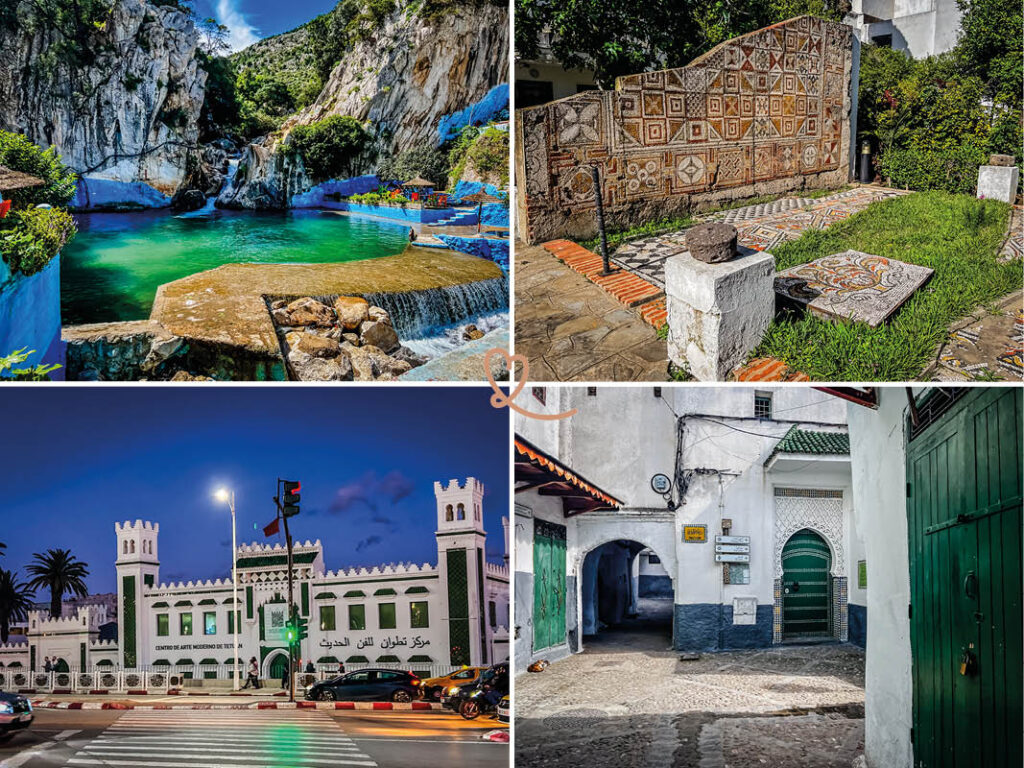
This opinion is completely independent, based on our experiences. We visited the region anonymously, making our own choices and paying our bills in full.
Is Tetouan worth a visit?
In our opinion, Tetouan and the surrounding area are well worth a visit. We were won over by the richness of its medina with its singular visual identity, the elegance of its Hispano-Moorish architecture and the diversity of its museums. Between Andalusian heritage, the legacy of the Spanish protectorate and contemporary creations, Tetouan promises a dense and authentic cultural experience just a few kilometers from the Mediterranean.
It’s one of the most beautiful cities in northern Maroc.
If you don’t have a car, you can discover Tetouan on an organized tour from Tangier.
1. Explore the UNESCO-listed medina of Tétouan

Did you know that the medina of Tetouan is unique in Maroc? We were fascinated to explore it. Spread out on the slopes of the Djébel Dersa mountain, it occupies a special place in the country’s history: as early as the VIIIᵉ century, its location made it a strategic passage between the kingdom and Andalucia. Destroyed and then completely rebuilt after the Spanish Reconquest, it owes its current face to the Andalucia refugees who recreated a veritable art of living here. Their legacy can still be seen today in the whitewashed facades, carefully landscaped patios, delicate zelliges and highly coherent urban fabric.
Another distinctive feature is its unmistakable green-and-white visual identity. Nicknamed “the white dove” for its immaculate walls, Tetouan also features touches of green on some of its doors, windows and minarets. Although green appears in various architectural traditions throughout the Arab-Muslim world, its use in Tetouan is above all the result of a local evolution: the city gradually adopted it, particularly under the Spanish protectorate, until it became a distinctive element of its visual identity. If you’ve ever explored other Moroccan medinas, you’ll notice that this chromatic duo doesn’t exist anywhere else in such coherence.
As we wandered through its alleyways, we appreciated the clear logic of circulation: main arteries link the seven historic gates such as Bab el-Okla, Bab Tut or Bab Rouah, and lead to more open spaces where fondouks, mosques, zaouïas and craftsmen’s workshops are concentrated. This organization, combined with lively craftsmanship and architectural sobriety, creates a peaceful, authentic atmosphere. Tetouan offers a singular synthesis of Moroccan heritage and Andalucia influences, in a medina where the rhythms of daily life unfold gently and discreetly.

- Length of visit: 2 hours to half a day, depending on your pace and interests
- Visit in the morning or late afternoon for soft light and calm.
- Access: you can only enter on foot through several gates, the most convenient of which are Bab el-Okla (museum side), Bab Tut (direct access to the main arteries) and Bab Rouah for a first reference.
- Rates: free of charge
- Opening hours: outdoor access 24 hours a day, 7 days a week (we recommend a daytime visit for better visibility and to take advantage of the shops open during the day).
- Parking: Feddan and Hammadi pay underground parking lots within a 15-minute walk
- Narrow and sometimes steep streets, as the town is very hilly; uneven cobblestones can be slippery in wet weather; medina is generally accessible to wheelchair users without special facilities; a baby carrier is preferable to a stroller because of the slopes and stairs; good shoes with non-slip soles are preferable.
- Dress respectfully around places of worship; avoid photographing people without asking for their consent, secure medina with regular police presence
- Opt for a guided tour if you want to understand Andalucia’s influences and urban organization, with Moroccan pastry tasting to boot!
A LITTLE MORE PATIENCE
All the photos, maps, information and addresses you need to make your stay at Maroc a success will soon be available in a single ebook!
Coming soon!
2. Admire the Royal Palace and the Khalifat Palace from Place El Mechouar

Place El Mechouar (or Place Hassan II – the square’s administrative name, as it is known to the locals) caught our eye for its symbolic dimension. Situated between the medina and the new town, it brings together several buildings that tell the story of Tétouan’s administrative and architectural history. We saw the Palais Royal, a remarkable example of Hispano-Moorish architecture that can only be admired from the outside. Its elegance contrasts with the sobriety of the neighboring Palais du Khalifat, which you can see to the left of the square. This building, now visible on the square, owes its current appearance to the period of the Spanish protectorate, when Tetouan was the administrative capital of the northern zone. It came into being around 1740 under the name of Dar al-Emrat. From 1913 onwards, it became the residence of the Khalifa and the administrative headquarters of the Spanish protectorate in northern Maroc. It is sometimes referred to as “Dar el Makhzen”, in reference to the traditional Moroccan use of the term to designate the palace of the sovereign or his representative. As a result of its colonial and post-colonial history, this place remains a strong marker of authority and power dynamics in Tetouan.
You’ll notice that the esplanade, vast and open, constitutes a veritable crossroads between daily life, ceremonial and urban passage. Without ever giving the impression of being staged, it allows you to appreciate the balance between heritage and contemporary uses.

- Visit duration: 30min to 45min
- Access: on foot in the immediate vicinity of the medina (Bab Rouah) or a 10-minute walk from Place Moulay El Mehdi (downtown Tétouan)
- Visible from outside only
- To fully appreciate the nuances of color on the façades, we recommend a visit in the late afternoon, when the light is softer.
- Rates: free of charge
- Opening hours: outdoor access 24/7
- Parking: Feddan and Hammadi pay underground parking lots within a 15-minute walk
- These unique monuments can be included in a guided tour of the city and medina – see options
3. Discover Dar El Oddi, house museum of Tetouan memories

The highlight of our stay was the delicate, warm atmosphere of the Dar El Oddi Museum, a traditional house built in 1927 and patiently restored by the founder’s grandson, Jalal El Oddi. This family home, steeped in the memory of Tetouan, has been transformed into a cultural space showcasing multiple visions of the city: paintings, old postcards, posters, stamps, family archives and photographs. Each floor told us a different facet of Tetouan, between landscapes of the Rif, representations of the medina, scenes of urban life or historical maps linking the city to the Mediterranean. We particularly appreciated the finesse of the architectural work: carved woodwork, original mosaics, modernist tiling added in the 1920s, restored ironwork… All these elements reveal the mixed Andalucia, Moroccan, Amazigh and European influences that have marked the city over time. The intimate setting allowed us to move from room to room as if we were moving through an inhabited house. Across the 7 spaces spread over 2 levels, we discovered a remarkable collection: paintings by Mariano Fortuny, Mariano Bertuchi and Paul Emil Gabel; rare stamps tracing the city’s evolution; old maps of Morocco, “Berberia” and Spain; posters from the XIXᵉ to XXᵉ centuries; and carefully preserved original furniture. The icing on the cake: the top floor offered us one of the finest panoramas of the medina rooftops and surrounding mountains. A wonderful place, but one to be approached with caution if visiting with children! We also loved the ground-floor patio, the heart of the house, where zellige murals and period furniture create a soft, contemplative atmosphere. This museum can be visited as a place of transmission. It’s a great way to understand Tetouan through the eyes of those who lived there, lived through it or represented it.

- Length of visit: 1h30 to 2h30 depending on your level of interest
- Access: located in the medina, on foot from Place Feddan parking lot (10-15min)
- Accessibility: level ground to medina entrance, then narrow cobbled streets, one step up to first floor, high stairs to other levels (no PRM access), unprotected terrace (be careful with children and people prone to vertigo), tour accessible from age 5 to discover a traditional house (lots of stairs if visiting with young children, bring a baby carrier if necessary).
- Explanatory panels in 4 languages (Arabic, French, English, Spanish), photos authorized for the house but forbidden for the works.
- Rates: price per person 25 dhs (MAD)
- Opening hours: open all year round, Tuesday to Sunday, 10am to 6.30pm, closed on Mondays.
- Parking: Feddan and Hammadi pay underground parking lots within a 15-minute walk
- Find out more on the official website here
OUR TIPS FOR RENTING A CAR IN Maroc
- Compare prices on our preferred platform: DiscoverCars – one of the best rated sites.
- Adapt your choice of vehicle to your itinerary!
- For more choice, book early.

Read our tips (coming soon)
4. Immerse yourself in the contemporary art scene at the Centre d’art moderne de Tétouan

Housed in Tétouan’s former railway station, built in 1918 by Spanish architect Julio Rodríguez Roda, the Centre d’art moderne revealed the singular place the city occupies in the artistic history of northern Morocco. The building, typical of the neo-Moorish style of the early XXᵉ century, has been carefully restored: white facade punctuated with green, semicircular arches, uncluttered volumes… A visual identity that echoes that of the nearby medina.
Stroll through a luminous space where the original architecture blends naturally with the temporary exhibitions. Inside, paintings, graphics, photography and installations coexist in a program that explores the links between Tetouan, the Mediterranean Sea and the visual traditions that have shaped the region.
The focus on Moroccan artists (particularly those associated with the Tetouan School of Fine Arts) will enable you to appreciate the diversity of contemporary approaches and cross-influences that characterize the local art scene. Exhibitions also feature international artists, offering an open look at the cultural circulations that have crossed Tetouan for over a century.
Did you know that the building itself is part of the tour? The restoration respects the historic structure of the old station, while adapting it to its cultural vocation.
We recommend that you consult the program before you come: each exhibition cycle offers a new reading of modern and contemporary creation in Morocco, and of the links that unite Tetouan with its artistic and Mediterranean history. Enjoy your visit!

- Length of visit: 1h30 to 2h depending on your interests
- Access: located in the old railway station at the entrance to the city, 15 minutes’ walk from Place Feddan.
- Accessibility: wide sidewalks in the vicinity, level access and wide entrance door (suitable for most visitors), exhibition spaces on several levels accessible to wheelchair users, smooth floor and fluid circulation in the rooms, visits possible with stroller, baby carrier recommended if crowded.
- Rates: 30 dhs (MAD) per person, free for children under 12.
- Opening hours: open all year round, Tuesday to Saturday, 10am to 2pm and 3pm to 6:30pm, Sundays 10am to 4pm, closed on Mondays.
- Parking : Paid underground Feddan or Hammadi parking lots, 15 min walk away, street parking available nearby (limited spaces – provide coins for guards).
- Find out more here
5. Visit the Tetouan Archaeological Museum

Let’s continue our tour of the Tetouan Archaeological Museum. We found this cultural site essential for understanding the historical depth of the Tetouan region. Its collections will enable you to place the city in a vast continuum from the earliest prehistoric occupations to the ancient era, with a particular focus on Tamuda, a Mauritanian and then Roman city located a few kilometers from the present-day center. Inside, mosaics, pottery, coins, inscriptions and architectural fragments bear witness to the ancient exchanges between northern Maroc and the Mediterranean basin. What marvels! We found the rooms sober and clearly organized. The labels helped us understand the uses, techniques and influences of each period. We then headed for the museum garden, which surrounds the building, where other remains stand out among the trees and shrubs. We enjoyed this outdoor walk, even if the lack of explanations in front of the large jars, vases, sculpted blocks or mosaic fragments limits their interpretation. The walk is pleasant, but more contemplative than didactic.
In our opinion, this museum is a good complement to Dar El Oddi, which explores urban and family memories. Here, you can immerse yourself in the long history of the area, before the emergence of Andalucia’s Tetouan. For families, the visit remains accessible: children will find visual objects (mosaics, amphorae, sculpted fragments) easy to observe, but note that the museography is not specifically designed for them. If you’re planning to visit archaeological sites in the region (Tamuda, or even further afield, Volubilis), this museum will clearly enrich your experience, providing landmarks that make it easier to read these sites in the field.

- Length of visit: 1h to 1h30 depending on your interest in archaeology (add 15 to 30 min for the outdoor garden)
- Access: located at the southern entrance to the city, 5-minute walk from the medina (Bab Rouah)
- Accessibility: ground-level entrance, wide door with low threshold, fairly free-flowing interior rooms, smooth floors, sometimes narrow corridors on the 1st floor,
irregular paths (earth, gravel) in the garden, no explanations in front of the remains,
only the first floor is accessible for wheelchair users, no elevator, if you have children, bring a baby carrier (many stairs). - Rates: 10 dhs (MAD) per person, free admission on Fridays for Moroccan citizens and foreign residents in Morocco.
- Opening hours: open all year round, Monday to Sunday, 10 am to 6 pm, closed on Tuesdays.
- Parking: spaces in adjacent streets (often guarded, please provide change in MAD dhs)
- Find out more on the official website here
WHERE TO STAY IN Tetouan
Our favorites: neighborhoods and hotels
By the sea
Sofitel Tamuda Bay Hotel – See prices, photos and availability
St Regis La Bahia Blanca Resort Hotel – See photos and availability
In the Medina
Riad El Reducto Hotel – See prices, photos and availability

6. Contemplating the kasbah and ramparts

Perched high above the city, we recommend climbing to the Kasbah for its panoramic view of the medina and the Djébel Dersa hills. From the ramparts, you can observe Tetouan’s clear urban organization: the medina’s white terraced streets, the minarets punctuating the horizon, and the mountains framing the city.
The walls are a reminder of the defensive role Tetouan played for several centuries, linked to its strategic position between the Mediterranean Sea and the Rif mountain range. It’s one of the best vantage points for understanding the city’s geography and the way Tetouan developed between mountains, valleys and roads to the Spanish enclave of Ceuta.
- Length of visit: 30min to 1h depending on your pace and the time spent at the viewpoint
- Access: 25 minutes’ walk from the medina (Bab Rouah), climb up on foot from the medina or its outskirts, plan an itinerary before setting off as signs are limited.
- Accessibility: paths can be steep, stairs uneven, ground stony, not suitable for wheelchair users or baby carriages, bring good shoes and water, visit during the day for better visibility, avoid going in the rain or on damp ground.
- Rates: free, open access
- Opening hours: 24 hours a day, 7 days a week. Daytime visits are safer and take advantage of the light.
- Parking: Place Feddan or Hammadi parking lots 15 to 20 minutes’ walk away
7. Visit the Isaac Bengualid synagogue

We were touched by the Isaac Ben Walid Synagogue, an essential place for understanding Tetouan’s Jewish history and the city’s Sephardic heritage. It is located in the new mellah (denomination of the Jewish quarter in every medina of Morocco), created in the XIXᵉ century south of the old town. This place of worship owes its name to Moroccan rabbi Isaac Ben Walid, a major figure in the community and author of the two-volume Vayomer Yitzhak, a valuable source on Tetouan Jewish life.
At that time, Tetouan had 16 synagogues and was one of the most active centers of Sephardic Judaism in Morocco. During your visit, you’ll discover a restored space, sober and silent, where ritual objects, manuscripts, Torah scrolls and archival images mingle. The ensemble bears witness to the rabbi’s spiritual and educational role, and provides an insight into the place occupied by the Jewish community in the life of the city.
We invite you to explore this site in a spirit of listening and respect: it offers a valuable insight into the religious and cultural plurality that has shaped Tetouan.

- Length of visit: 30min to 1h depending on your interests
- Access: located in the new mellah, south of the medina; 15-minute walk from Place Feddan
- Accessibility: alleyways sometimes narrow and slightly sloping; entrance on site with a small step; interior on a single level, suitable for most visitors; possible with compact stroller or baby carrier; dress code required for visiting a place of worship; ask before taking photos inside
- Admission: free or symbolic contribution in MAD dhs (donation recommended for upkeep of the site)
- Times: visits generally possible during the day; times vary depending on the janitor (contact Elias by telephone on +212 6 67 99 21 19).
- Parking: Feddan or Hammadi underground pay parking lots (10-15 min walk)
8. Entering the Spanish heritage at Our Lady of Victories Church

Located in the heart of the Ensanche district (a new town planned during the Spanish protectorate), the Church of Notre-Dame des Victoires stands out for its sober neo-Gothic architecture and light-colored facades. We have discovered a place of worship that is still active, carefully maintained, and which offers another facet of Tétouan’s urban heritage.
Take time to observe the elevation, the pointed arches and the stained glass windows that filter soft light into the nave.
The building is located on Place Moulay El Mehdi, a vast esplanade that is emblematic of the modern district. We suggest extending your visit by exploring the geometric streets of Ensanche, where white buildings and touches of water green illustrate the urban aesthetic of the early XXᵉ century. A simple and enjoyable way to understand how Tetouan today articulates its two faces: historic medina and planned city.

- Visit duration: 15 to 45 min
- Access: located in the Ensanche district, a 15-minute walk from Place Feddan and a 10-minute walk from the Bab Rouah gate (medina).
- Accessibility: flat sidewalks and wide avenues around the square; level entrance; smooth flow of traffic inside; suitable for most visitors, respect for rules of dress required for visiting a place of worship
- Times: vary according to Mass (see official website here)
- Rates: free access
- Photographs: authorized outside; inside, please comply with staff instructions and respect the peace and quiet of worshippers
- Parking: spaces in adjacent streets (often with security guards – bring change in MAD dhs); Feddan or Hammadi underground parking lots 10-15 min walk away
Subscribe to our Newsletter
- Get away from it all with Region Lovers’ beautiful destinations!
- Once a month
- Advertising-free

9. Take a break at Aïn Zarka, a popular waterfall for locals

Would you like to discover a natural interlude so popular with the inhabitants of Tétouan? Head for the Aïn Zarka waterfall, a 20-minute drive from the city center. We really enjoyed the tranquil setting and the superb shades of green and ochre in the surrounding countryside. This small waterfall is easily discovered by car or local cab. More than just a “site to be ticked off”, it’s a place where you can relax and enjoy the soothing sound of the water. The charm of the place lies in its simplicity: the landscape changes with the seasons and the flow of the waterfall, revealing in turn rocks, river plants and small pools. We enjoyed watching the light glide over the walls and the viewpoints which, at times, offer beautiful vistas of the Rif foothills.
Take a few minutes to fill your lungs with fresh air and observe the beauty of the mountains. After a short walk, you’ll discover a charming store selling local honeys, where we were treated to a delightful tasting session!
Aïn Zarka can be visited with no expectation of the extraordinary: above all, it promises a local breath of fresh air, an immersion in a calm and accessible natural landscape, ideal for getting away from the hustle and bustle of the city for a few hours.
At the waterfall, there’s a café where you can take a break, and a small guarded parking lot nearby (bring change for the attendant). There’s also a campsite a little further on.
The road is winding and sometimes narrow, but you do need to be careful: we recommend that you drive during the day, and that you leave the driving to someone who is used to mountain roads. If you’re planning a short hike in the area, keep an eye out for terrain conditions and variations in sunlight.

- Length of visit: 1 to 2 hours, depending on whether you want to walk or just enjoy the surroundings.
- Access: 10 km from Tétouan, accessible by car or local cab; mountain road with sharp bends.
- Road safety: best visited during the day; driving recommended for experienced drivers as the road is winding and narrow (deep ravine, no guardrail), avoid rainy days.
- Accessibility: uneven ground around the waterfall, no PRM access; can be used by young children, but must remain vigilant (unsupervised area).
- Parking: small guarded parking lot (change in MAD dhs)
- Times and prices: free access 24/7 (we recommend a daytime visit for better visibility and safer access to the natural site).
- Facilities and activities: café near the waterfall, parking lot, several hiking trails around the site (but caution is required depending on the terrain and weather), campsite
10. Reaching Martil, the sea just a few minutes from Tétouan

Do you know Martil beach? It’s the closest seaside resort to Tétouan and one of the most popular with locals. We appreciated its lively, family atmosphere, far from the images of “spectacular” beaches. Here, the appeal lies in the simplicity of the Mediterranean coastline and the daily life that unfolds here: late-night strolls, discussions between neighbors, quiet fishing, children’s games and family bathing.
The changing light over the Mediterranean creates a soothing atmosphere, especially at sunset. Martil is not intended to impress: rather, it offers a shared space, frequented all year round, where everyone can find their place. The commune provides a number of facilities to facilitate access and use of the beach, including a lifeguard post in season, playgrounds and sanitary facilities. We also spotted a sloping access for people with reduced mobility, although no specific PMR equipment was present at the time of our visit.
At the end of the promenade, Hotel Omeya (which we include in our selection of places to stay) is a good base for enjoying the sea. The long Martil beach invites you to spend a refreshing moment after a day of cultural exploration in Tetouan’s medina.

- Recommended duration: 1h to half a day, depending on your program (walking, swimming, fishing…).
- Access: 15 minutes by car from the center of Tétouan
- Accessibility: wide, flat promenade; access to the beach via a slope suitable for most visitors; no specific PRM facilities identified during our visit.
- Facilities: public toilets, playgrounds, supervised beach in summer; restaurants and cafés all along the corniche
- Parking: paid public parking lots along the corniche (provide change in MAD dhs for the guards), such as the one opposite the Hôtel Omeya at the end of the promenade, or in the alleyways perpendicular to the main avenue.
11. Stroll through the Ensanche district, a legacy of the Spanish protectorate

Designed from 1913 onwards by Spanish urban planners, the Ensanche district reflects Tétouan’s urban evolution at the beginning of the XXᵉ century. We strolled along its geometric avenues lined with white buildings accented with aqua green, a chromatic duo found on balconies, shutters or wrought-ironwork that contributes to the city’s visual identity. The architecture combines neo-Moorish lines, Mediterranean influences and sober decorative details, typical of this period of urban planning.
Stroll between iconic landmarks such as Place Moulay El Mehdi, Église Notre-Dame des Victoires, the central post office and several carefully proportioned buildings. We enjoyed the lively atmosphere of this area, where cafés, shops and social spots punctuate the day. L’Ensanche promises an interesting counterpoint to the medina: regular urban planning, designed with traffic in mind, telling another side of Tetouan’s history. A stroll through its streets will enable you to grasp this dialogue between ancient and modern city, still perceptible today.

- Length of visit: 45 min to 1h30 depending on your pace and points of interest
- Access: 10-15 min walk from the medina (Bab Okla or Place Feddan depending on itinerary)
- Accessibility: wide sidewalks and level streets, generally suitable for most visitors; easy stroller access
- Opening hours: the district is open 24 hours a day (daytime visits are recommended to better observe the architectural details).
- Parking: Feddan and Hammadi underground pay parking lots, or on-street parking (limited spaces, security guards present – please provide change in MAD dhs), outdoor public parking lots Avenue Alger or Rue Aljazaer
12. Tasting local specialities: Mediterranean cuisine, Andalucia and Maroc

We savored Tetouan cuisine, intimately linked to the sea, the surrounding gardens and the historical movements that have shaped the region. You’ll taste dishes that bear witness to gestures that have been handed down, worked with precision, without the search for superfluous effects, but with a true understanding of the territory.
Among the must-tries: Tetouanese pastilla, grilled fish, sweet-salty harira (a hearty soup traditionally eaten to break the fast during Ramadan) or morning msemen (Moroccan pancakes). Traditional family pastries round out the flavors, and you can also sample them in the city’s bakeries and tearooms.

To explore this culinary wealth, we tried out a number of restaurants, each reflecting a different face of Tetouan and its region. Here are our 3 favorites:
- Restaurant at Riad El Reducto, in the medina: housed in a former 17thᵉ century Arab palace, renovated in 1948 to become the residence of the Grand Vizier of Tetouan. We appreciated the harmony between Moroccan decorations and Spanish touches, notably the perfectly preserved Sevillian tiles. You’ll also find this cultural richness on your plate!
- Restaurant La Méditerranée by Robuchon, in M’diq: a gourmet table on stilts overlooking the sea, where Moroccan and French cuisine engage in subtle dialogue. The exceptional view adds to the experience. A must-try!
- La Brasserie Baie Blanche, at the St Regis La Bahia Blanca Resort in Tamuda Bay: on the menu, bistronomy and elegance in a place where seafood and local produce are worked in a contemporary vein.

Here, local roots take precedence over demonstration. It’s a gentle, authentic way to explore the region in a different way, through its flavors and those who perpetuate them. Because for us, eating well is also part of the journey!
Other attractions in and around Tetouan
We’ve spotted other interesting places around Tetouan that will enrich your stay.
Other cultural and archaeological sites

Here are a few other cultural highlights to help you better understand the Tetouan region and its thousand-year-old heritage:
- In the medina, a veritable open-air museum, take time to observe the small squares, mosques and ramparts dating back to the 15th century. You can also visit the Bab Okla ethnographic museum in the same area to learn more about the local heritage.
- Do you know Place Feddan in the new town? Here you can take a stroll, observing the kasbah on one side and the descent to the medina on the other.
- Around Tetouan, several archaeological sites also invite you to grasp the historical depth of the territory. The ancient city of Tamuda, still under excavation, offers a rare glimpse of a Roman-Mauritan settlement and its military remains. Further south, the ruins of Ksar Sghir and Cotta bear witness to ancient exchanges around the Strait, revealing a North Morocco shaped by Mediterranean circulation rather than by clear-cut breaks.
Other beaches and resorts

Beyond Martil, the Mediterranean coast revealed other seaside atmospheres accessible from Tétouan:
- In M’diq, you’ll find a well-tended promenade and a family beach lined with cafés where people come to enjoy the end of the day.
- Fnideq, closer to the Ceuta border, offers a lively local atmosphere, with its small ports and wide-open maritime horizons.
- Further south, Marina Smir offers a more developed setting, appreciated for its marina, restaurants and calm waters.
Each of these resorts illustrates a different way of living on the coast, between daily life, relaxation and seaside outings.

Excursions around Tetouan
We explored the surrounding area and found some wonderful destinations within easy reach of Tetouan.
- Chefchaouen: the famous blue pearl of the Rif, about 1 hour’s drive away, with its painted streets and mountain atmosphere – read our article
- Mount Jebel Moussa hike: for hiking enthusiasts, this peak offers spectacular panoramic views of the Strait of Gibraltar.
- Ceuta (Sebta): Spanish border enclave, blending European and Moroccan influences – opt for a guided tour of its old town

- Tangier and surrounding area: large port city rich in history, about 1 hour from Tetouan – read our article
- Tamuda archaeological site: remains of the ancient city a few kilometers from Tetouan, ideal complement to the Archaeological Museum
- Akchour waterfalls: a refreshing hike in the Rif, with natural pools and incredible landscapes – book your excursion now!
- Asilah: small coastal town famous for its white walls and art festival – read our article

How to get to Tetouan + parking
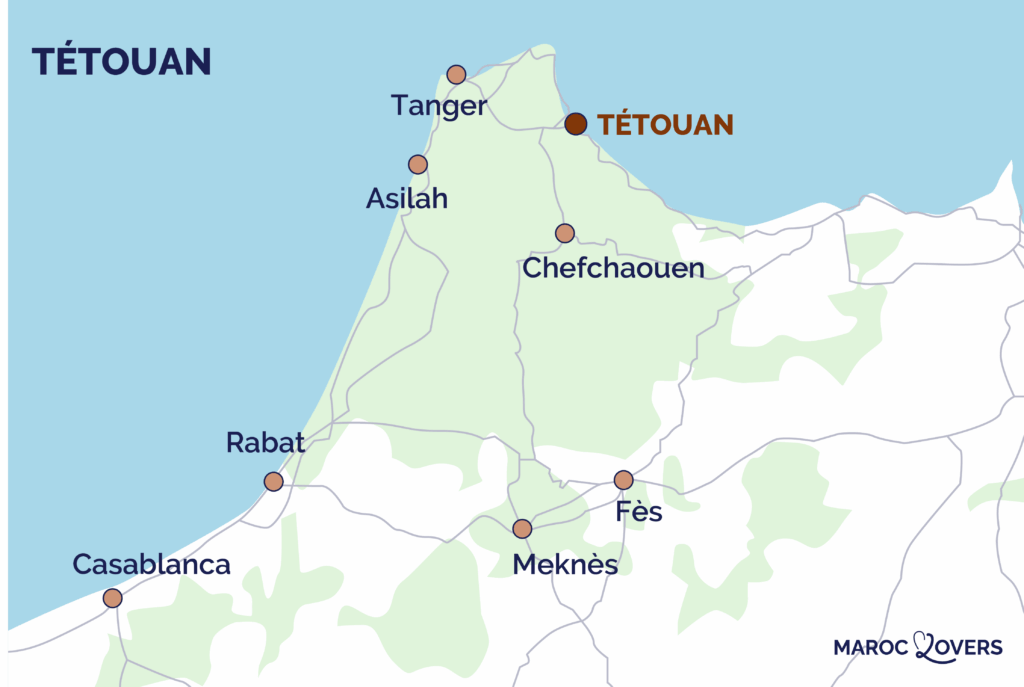
Where is Tetouan
- In northern Maroc, between Tangiers and Chefchaouen
- Tangier: 1h30min drive
- Chefchaouen: 1h25min drive
- Ceuta: 1h drive
How to get there
There are several options for getting to Tetouan.
- By car: Tetouan is easily accessible by road: from Tangier, allow around 1h15 via the A1 freeway, then the N2 which crosses the Rif foothills; from Chefchaouen, the N2 offers a winding but panoramic route northwards.
The car remains the most flexible option for exploring the surrounding area (Martil, M’diq, Aïn Zarka, archaeological sites…). - By public transport: Regular buses link Tetouan to the main cities in northern Morocco, such as CTM and Supratours, which provide comfortable, air-conditioned connections from Tangiers, Chefchaouen, Ceuta and many other towns in the region. The bus station is located near the Ensanche, making it easy to get to the city center.
- Organized tour: From Tangier or Chefchaouen, opt for a day trip that includes a guided tour of the medina, the main historic sites and free time for strolling or lunch. This is a practical option if you’re looking for a structured first discovery without having to deal with transport logistics. See the options
- By train: Tetouan is not connected to the Moroccan rail network. To get to the region by train, you’ll need to arrive at Tangier-City station (TGV Al Boraq from Rabat, Casablanca, Marrakech; classic trains from Fez and Meknes), then take a cab, bus or hire a car to Tetouan.

Parking in Tetouan
We recommend parking in the Place Feddan underground parking lot, near the medina. Access to the old town is on foot only, and takes 10 to 15 minutes. The ground is flat and paved until you reach the entrance to the medina, then the streets are narrow and cobbled. Bring your change in dirhams (MAD).
The Hammadi underground pay parking lot is also a good option, with the same walking time as Place Feddan from the city’s main attractions. Other outdoor pay parking lots are available on Avenue Alger or Rue Aljazaer on the Ensanche side of town.
In the rest of the city, parking is possible in certain alleyways.

Useful tips for visiting Tetouan
How long and when?
Allow a full day to explore the medina, visit a museum and stroll through the Ensanche. If you’d like to add a nature getaway to Aïn Zarka, or some time by the sea in Martil or the rest of the coast, allow two days on site.
In terms of seasonality, we particularly enjoyed our spring getaway, when the gardens are lush green and the light softens the white and water-green facades. Autumn also offers pleasant temperatures and ideal light for photography.
In summer, temperatures rise, although the Mediterranean breeze brings a little coolness. It’s also a busy time of year, with many Moroccan and international travellers visiting the coastal strip.

Last but not least, major national and religious holidays also lead to a significant increase in travel and bookings. Annual festivals also influence the number of visitors to the city, its surroundings and accommodations:
- Festival de Cinéma Méditerranéen de Tétouan – major regional cinema event (see details here – usually late October/early November, depending on the edition)
- Festival National du Théâtre de Tétouan – a highlight of theater in all its forms, performed by amateur troupes from all over the country.
- International Festival of Andalusian Music – showcases the city’s Andalusian musical heritage (between late November and early December, depending on the festival).
These events offer a lively insight into Tetouan’s cultural heritage and can enrich your stay… But remember to book in advance, especially for accommodation, because a dynamic cultural city means an influx of visitors!

Tour directions, map and difficulty
To organize your discovery of Tetouan, we suggest a logical and fluid itinerary that respects the rhythm of the city:
- Start in the medina in the morning, when the light is soft and the streets are still quiet. This will allow you to fully appreciate the architecture and the daily atmosphere.
- Continue on to the Dar El Oddi House Museum, where you can gain an in-depth understanding of Tetouan’s visual and domestic history.
- Then there’s the Archaeological Museum, ideal for placing the city in the context of its long history, from pre-Roman times to Antiquity.
- In the afternoon, stroll through Ensanche, with its geometric urbanism and white facades accented with aqua green.
- Finish off at Place El Mechouar (or Place Hassan II), where you can see the link between the medina, the modern city and the institutions.

Be aware that the medina has cobbled alleys, some of them sloping: comfortable shoes are essential. Some museums have high or narrow staircases. Take your time, especially with young children. The modern city is more accessible, with wide sidewalks and easy traffic flow, and even some pedestrianized streets, notably part of Avenue Mohamed V leading to Place El Mechouar. Built close to the mountains, it can be quite hilly in places!

Visiting with children
Tetouan is ideal for families to explore: the city is compact and easy to walk around, even if some areas are hilly, particularly around the medina. Exploring the town is fun if you go at your own pace.
The Dar El Oddi Museum is particularly appealing to children aged 5 to 10: the traditional house, the colors, the patio and the collections of stamps and posters arouse curiosity, even if the many staircases require vigilance.
Older children will appreciate the Archaeological Museum more, especially if they cross the visit with sites such as Tamuda: understanding the mosaics, pottery and ancient objects gives meaning to the territory.

For a nature break or a change of pace, there are several options:
- Martil Beach, ideal after cultural visits thanks to its playgrounds and seasonal surveillance.
- the Aïn Zarka waterfall, for a local breath of fresh air in the middle of the mountains, best enjoyed during the day and accompanied on the road.
The medina itself is a wonderful adventure for children: a lively maze, where the narrow lanes and small climbs require a little attention but offer an enriching sensory immersion.

If you’re traveling with toddlers, it’s best to use a baby carrier: the medina has slopes, narrow alleys and uneven cobblestones that are unsuitable for strollers.
For breaks, anticipate your needs: pack water, snacks and hats to protect you from the sun, and alternate cultural visits with nature breaks (Martil, Aïn Zarka) to avoid fatigue and maintain the pleasure of the trip.
Restaurants
We tried out several restaurants in and around Tetouan. Here is a selection of our favourites:
- Riad El Reducto, in the medina, seduced us with its historic setting and Sevillian tiles.
- The Restaurant La Méditerranée By Robuchon, in M’diq, transported us for a gastronomic experience on stilts with a sea view.
- Brasserie Baie Blanche, in the Hôtel St Regis, offers bistronomic cuisine overlooking Plage Restinga

Tetouan in winter
In winter, the atmosphere in Tetouan is mild and bright. On the coast, temperatures generally hover around 14-18°C (57-64°F) during the day, with cooler, wetter evenings around 8-10°C (46-50°F). We loved the contrast between the white facades of Ensanche, bathed in crisp winter light, and the peaks of the Rif. The crowds here are definitely lower than in summer, making for a more leisurely exploration of the medina, museums and steep streets. It’s a pleasant time of year to stroll without the summer heat, enjoy the cultural sites in greater tranquillity, and observe the city in a less touristy daily rhythm. Make sure you bring warm clothing for the end of the day and for the heights of the kasbah, where the wind can be sensitive, even in fine weather.
Other tips
- Islam is the official state religion, so you’ll hear the 5 daily calls to prayer echoing from the minarets of mosques across Maroc.
- Note a particularity of the weekly rhythm: on Friday, the Muslim prayer day, some shops adapt their opening hours or close. But this is not an official holiday.
- On weekends (Saturday and Sunday), some stores close on Saturday, notably those serving the Jewish community, and others on Sunday.
- Maroc remains a modern Muslim country, economically liberal, open to the world, which cultivates a balance between traditions and international dynamics.
Read all our tips for visiting Maroc in our dedicated article – coming soon.
PLAN YOUR TRIP TO Morocco
- Best of
The most beautiful landscapes in Morocco
What to do in Morocco (coming soon)
The most beautiful riads
The most beautiful cities
The most beautiful medinas (coming soon)
The most beautiful gardens (coming soon)
The best museums (coming soon)
The most beautiful beaches in Morocco (coming soon)

- Practical advice
When to go? (coming soon)
How to rent a car in Morocco (coming soon)
Driving tips (coming soon)
Itineraries (coming soon)
Where to stay in Morocco (coming soon)

- The must-dos
Marrakech
Casablanca
Fès
Meknès
Chefchaouen
Sahara Desert (coming soon)

