
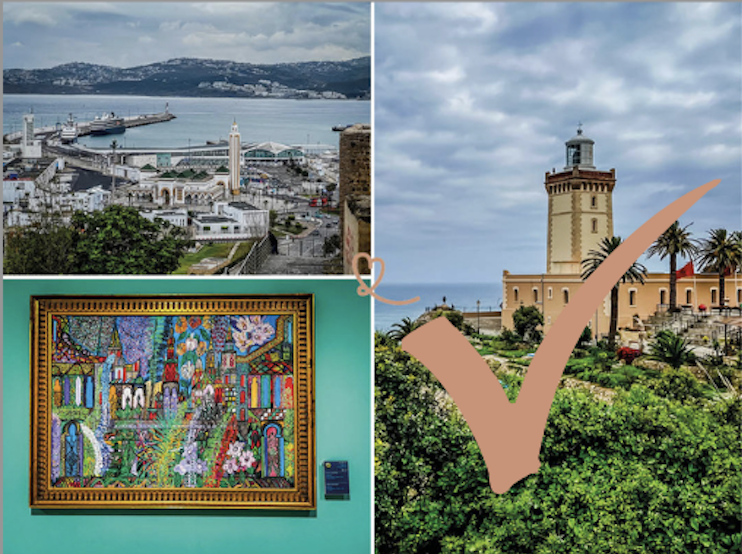
Tangier won us over with its unique atmosphere, featuring a bustling medina, historic cafés, and views of the Strait of Gibraltar. But before you start planning your trip, you might be wondering if the city is safe.
Here are all the details to answer your question.
With all our tips for a worry-free trip.
This opinion is completely independent, based on our experiences. We visited the region anonymously, making our own choices and paying our bills in full.
Is Tangier safe? Quick answer
Yes, overall, Tangier is a safe city for travelers. Violent crime remains rare there, and Moroccan authorities have increased the police presence around tourist areas, with units dedicated to assisting visitors. As in all major cities, the main things to watch out for are pickpocketing in the medina, tourist scams, and, to a lesser extent, ocean currents at certain beaches. We never felt physically unsafe during our visits to the city, even at night in the central neighborhoods.
As is the case throughout Morocco, certain customs may differ from those in your home country, particularly with regard to alcohol consumption or dress codes in the more traditional neighborhoods.
Risks in the ocean

Tangier borders both the Atlantic Ocean and the Mediterranean Sea, on either side of the Strait of Gibraltar. The beaches facing the Atlantic—particularly those nearAsilah —are subject to rip currents, locally known as “baïnes,” which can drag a swimmer out to sea in a matter of seconds. We have noticed that these currents can be difficult to spot from the shore, even when the sea appears relatively calm. The civil protection agency for the Tangier-Tetouan-Al Hoceima region records several drownings every summer, which, in our view, justifies being especially vigilant on unsupervised beaches.
A flag system indicates the risk level at supervised beaches: a green flag means swimming is permitted, an orange or red flag strongly advises against it, and a black flag prohibits it. Water quality may vary depending on the beach and the time of year. Before going for a swim, be sure to check the information signs and any restrictions posted on-site.
Advice:
- It’s best to swim at a beach supervised by lifeguards
- Please respect the color of the flag of the day
- If there is a current, do not fight it head-on: swim parallel to the beach until you get out of the current, then return to shore
- Check the water quality before swimming at less crowded beaches
A LITTLE MORE PATIENCE
All the photos, maps, information and addresses you need to make your stay at Maroc a success will soon be available in a single ebook!
Coming soon!
What to do in an emergency

The emergency numbers in Tangier, Morocco, are 15 (fire department), 141 (medical emergencies), +212 (0)5 39 94 04 77 (Tangier Central Police Station), 19 (city police), +212 (0)5 22 24 04 04 for SOS Médecins, +212 (0)537 68 64 64 for the Poison Control Center, or 117 (Royal Gendarmerie outside cities). The European emergency number 112 also works from any cell phone in Morocco and connects you to the appropriate service.
Tangier has several healthcare facilities and private clinics. In the event of a serious medical problem, it is best to go directly to a private clinic, where you will generally be seen more quickly than at a public hospital.
Theft and petty crime
As in many tourist cities, opportunistic theft and pickpocketing are the main risks in Tangier. Pickpocketing occurs mainly in the medina and its narrow alleys, especially during peak hours. We recommend keeping bags and phones securely closed and in plain sight, and avoiding carrying large amounts of cash. We have personally never been the victims of theft during our stays, but it’s still important to remain vigilant, just as you would in any major tourist city.
Advice:
- Carry your bag in front of you in crowded areas
- Avoid unnecessarily showing off your phone, jewelry, or large sums of money
- Don’t leave anything valuable in plain sight in a parked car
- Choose official taxis over unidentified cars
Counterfeiting
Please be aware that some popular markets sell counterfeit goods (bags, watches, clothing, etc.). We remind you that it is illegal to bring counterfeit goods across borders, as this practice is prohibited in virtually all countries.
Tourist scams

Beyond theft, it’s mainly scams that come up repeatedly in travelers’ accounts. They’re rarely dangerous, but they can ruin your day if you’re not prepared for them.
- A fake tour guide offers a free tour of the medina, then demands a commission or leads you to a partner shop
- A street money changer offers a supposedly favorable exchange rate, often accompanied by counterfeit bills or an incorrect count
- A restaurant with no menu on display, where the bill goes up once the meal is over
- Pushy touts near the port and the train station who try to redirect you to another hotel or store
Exchange your money only at a currency exchange office or a bank; always ask to see the price list before ordering; and don’t hesitate to politely but firmly decline any unsolicited offers.
Neighborhood Safety
The Medina and the Kasbah

The tourist district of Tangier is generally safe during the day. At night, it’s best to stick to the main streets and avoid deserted alleys, just as you would anywhere else.
The Marshan Neighborhood

We found the Marshan neighborhood to be a particularly pleasant and peaceful place to take a walk. It was also one of the places in the city where we felt most relaxed. We enjoyed the archaeological site of the Phoenician Tombs there, with its exceptional view of the Mediterranean Sea. Be careful if you get too close to the edge.
La Corniche and Malabata

This seaside promenade, lined with hotels and restaurants, is very popular and considered one of the quietest areas in Tangier.
The area around the port and certain outlying neighborhoods

The port area has historically had a higher concentration of touts. If you’re not familiar with the city, we simply advise you to avoid venturing out alone at night in certain outlying neighborhoods that aren’t popular with tourists, particularly around Bir Chifa or El Oumrane.
Traveling Alone in Tangier: What You Need to Know

In Morocco, it’s important to distinguish between physical safety—which is generally good—and street harassment, which is more common. A female traveler traveling alone may be subjected to staring or comments, especially in more traditional neighborhoods. This behavior usually takes the form of solicitation or verbal harassment, but can obviously be uncomfortable. We recommend dressing modestly in the medina, though we’d like to point out that no law imposes a specific dress code on tourists. In our experience, ignoring solicitations and continuing on your way often helps cut short persistent interactions.
Is it dangerous to drive in Tangier?

Driving in Tangier didn’t seem particularly dangerous to us, but the traffic takes a little getting used to. The main challenge is in the city center, where traffic can be heavy and parking can be difficult. Note that non-residents are not allowed to drive inside the Kasbah. Outside the city center, the main roads and the highway connecting Tangier to Rabat or Casablanca are in good condition.
Is the water safe to drink in Tangier?
Tap water is treated in Tangier. However, if you have a sensitive stomach or aren’t used to the taste, you might prefer to drink bottled water, which is readily available everywhere.
DISCOVER Tangier
- Attractions in Tangier
- Best hotels in Tangier
- Best riads
- Best restaurants
- Best excursions
- How to get there
- Asilah
- Itinerary: 1 day
Emergency Numbers in Tangier
- Police (in town): 19, or 190 from a cell phone
- Fire department and ambulance: 15, or 150 from a cell phone
- Royal Gendarmerie (outside urban areas): 177
- European number, accessible from any cell phone: 112
Keep these numbers handy, even though a trip to Tangier usually goes off without a hitch.
PLAN YOUR TRIP TO Morocco
- Best of
Must-See Places in Morocco
Most Beautiful Riads
Most Beautiful Cities
Most Beautiful Medinas
Morocco’s Most Beautiful Landscapes
Most Beautiful Gardens
Best Museums
Morocco’s Most Beautiful Beaches

- Practical advice
When to go?
How to rent a car in Morocco
Driving tips
Where to Stay in Morocco

- The must-dos
Marrakech
Casablanca
Fez
Meknes
Chefchaouen
Essaouira
Rabat
Tangier
Tetouan
Agadir
The Sahara Desert

